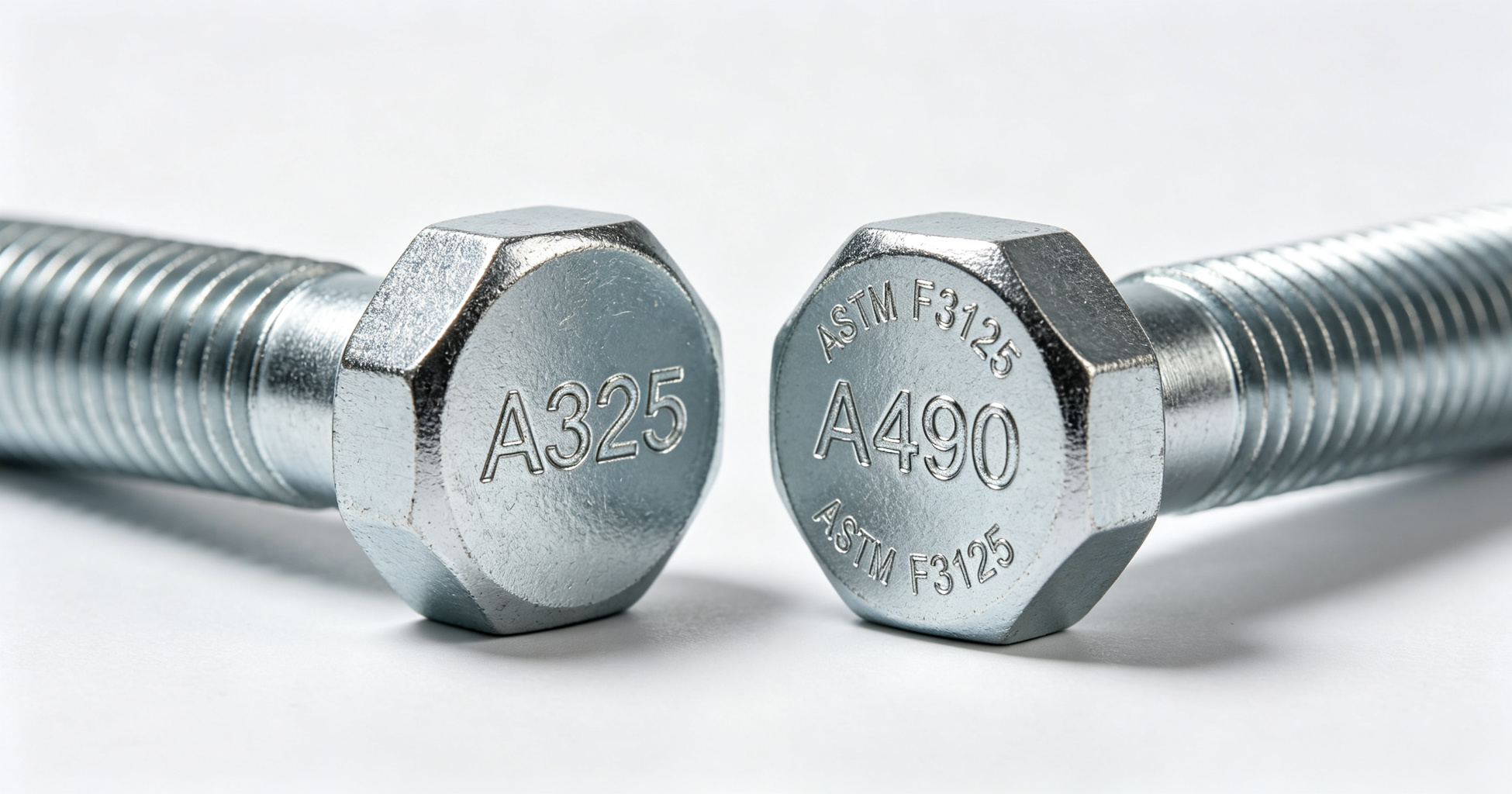
3. Head-to-Head: The Numbers That Actually Matter
In one sentence: A490 gives you 25% more tensile strength and 41% more yield strength than A325, and in exchange you lose every galvanizing option and pick up mandatory magnetic particle inspection. Everything below is from F3125 Tables 1, 4, 5, 6 and Annex A1, RCSC 2020 Tables 2.1 and 5.2, and RCSC Section 2.11.
[COMPARISON TABLE - TO BE ADDED]
Two numbers deserve a comment. A490 has a tensile ceiling, 173 ksi, and it is not a suggestion; above it the steel is hard enough that a thread-root notch or a little hydrogen does real damage. We temper to 155–165 ksi, and when a furnace lot comes back at 168–171 ksi we re-temper and re-test rather than ship a lot with no margin for the customer's retest. And the hardness maximums, 38 HRC for A490 and 34 HRC for A325, are what the receiving inspector actually checks with a portable tester, so those are the numbers argued about at the dock.
4. Type 1 vs Type 3: When Weathering-Steel Bolts Are Worth the Premium
Type 1 is the ordinary chemistry: medium-carbon or alloy steel, quenched and tempered, then coated or left plain. Type 3 is weathering steel. F3125 controls copper (0.20–0.60%), nickel, chromium and molybdenum so the bolt forms the same dense, self-limiting oxide as ASTM A588 plate. Nickel or molybdenum must be present in at least the minimum amount; a bolt with only copper does not qualify.
Sourcing Note for Global EPC Buyers
We supply structural bolts in full container-load quantities for overseas EPC contractors, project stockists and industrial distributors. Standard MOQ is 1 ton per size per grade for ex-stock items; custom drawings and full Grade 10.9 structural bolts per GB/T 1228 typically run 4-6 weeks from our Handan, Hebei production line. Sample packs of 50-100 pcs are available for engineering evaluation against tooling and assembly fit-up, but they are not sized for on-site erection work.
For full technical spec sheets, MTC 3.1 samples and an RFQ form tailored to your project (including Middle East, Southeast Asian and Latin American EPC procurement terms), use the 24-hour factory-direct quote link below. We respond within one working day with pricing, lead time and a full test report package for your client's engineer review.
6. For Global EPC Procurement: What to Do When the Spec Says "ASTM" But You're Sourcing From Asia
This is the question we get every week from procurement managers at Middle East, Southeast Asian, and Latin American EPC firms: the client's drawing calls out A325 or A490, the local steel and hardware market works in DIN/ISO, and nobody wants to explain to the client why the replacement bolt is "close enough." Here's how to handle it without risking a rejection on site.
The first step is to read what the spec actually requires, not just the grade mark. Many international project specifications write "A325 Type 1" but in the notes require only the mechanical properties from A325 Table 1, the A563 heavy hex nut pairing, and the RCSC pretension table. If that's the case, an ISO 898-1 Class 8.8 bolt with a matching ISO 898-2 Class 8 nut, supplied with an MTC 3.1 that references both ISO 898-1 and A325 equivalent properties, will pass most owner's-engineer reviews — as long as the MTC explicitly states the cross-reference. We've supplied this configuration for power plant projects in Indonesia and water treatment plants in Saudi Arabia without a single rejection.
The second step is to identify the three situations where substitution gets harder. First, when the project is funded by US EXIM bank or a US-AID program — those projects almost always require true ASTM material with a mill cert that traces to an ASTM-compliant mill, not an ISO "equivalent." Second, when the connection is in a fatigue-critical detail — floor beams on a crane runway, bridge hangers, anything with repeated live load — the Charpy and S-N data doesn't map cleanly between standards, and you should supply the actual A325/A490 even if it costs more. Third, when the specification explicitly forbids substitution — some Gulf-region client specs write "No equivalents accepted" in bold, and that means no equivalents.
The third step is the documentation package. When you substitute, build a 5-page submittal that includes: (1) the original drawing callout, (2) the ISO/DIN grade you're proposing, (3) a side-by-side mechanical property table showing tensile, yield, hardness, and proof load match, (4) the MTC 3.1 from the mill, and (5) a signed statement from the EPC's structural engineer accepting the substitution. Without the engineer's sign-off, the warehouse will reject the shipment on arrival. We've seen a container of 40 tons of Class 8.8 bolts sit in Jebel Ali free zone for six weeks waiting for that one signature.
For projects where the spec is flexible, we typically propose ISO 898-1 Class 8.8 for A325 and Class 10.9 for A490, with the same coating systems (HDG, Dacromet, Geomet) and the same heavy hex geometry per ISO 4014/4017. The price differential versus true ASTM material from a European or Korean mill is usually 25-35%, and lead time drops from 12 weeks to 4-5 weeks from our Handan production line. That's the math that makes the EPC project manager stop arguing about the grade mark and start asking for a sample batch.
If your project doesn't call out ASTM by name — say, a Middle East EPC bid written in ISO/DIN language, or a Southeast Asian infrastructure job where the client works in metric — you still need to know where A325 and A490 sit in the global strength ladder. Here's the deep mapping, not just a surface equivalent.
A325 Type 1 maps closest to ISO 898-1 Class 8.8, but with a caveat. Class 8.8 is 800 MPa ultimate (116 ksi) / 640 MPa yield (93 ksi). A325 minimum is 120 ksi (827 MPa) tensile and 92 ksi (634 MPa) yield. On paper A325 runs slightly hotter than 8.8. In practice the gap narrows because A325 caps at 120 ksi while 8.8 has no upper ceiling — typical production lands at 820-860 MPa. For structural tension applications, engineers treat them as functionally interchangeable, but never as a drop-in for fatigue-critical joints.
A490 maps to Class 10.9, and again the numbers tell the story. Class 10.9 is 1040 MPa (151 ksi) minimum tensile, 940 MPa (136 ksi) minimum yield. A490 minimum is 150 ksi (1034 MPa) tensile, 120 ksi (827 MPa) yield. The yield is the outlier — A490 yield at 120 ksi is below 10.9's 136 ksi. That's because RCSC controls A490 to a tighter tensile ceiling (173 ksi / 1193 MPa) to manage hydrogen embrittlement risk, and the yield follows. For pretensioned slip-critical joints the RCSC 2020 required pretension controls the design, not the raw yield number — A490-N and 10.9 both land around 85-90% of proof load, so the clamping force is close enough for most EPC substitutions.
Where they diverge: toughness testing. ASTM F3125 references Charpy V-notch requirements under F1852/F2280 for twist-off variants, typically 20 ft-lb (27 J) at -40°F (-40°C). ISO 898-1 does not mandate a minimum impact value in the base standard — it's an agreement between purchaser and supplier. If your spec sheet says "ISO 898-1 Class 10.9" without impact requirements, you're buying a bolt that passes chemistry and hardness but may fail a cold-climate Charpy. This is the single most common substitution mistake on Middle East and Southeast Asian EPC projects: the bolts pass the mill cert but crack in winter erection.
For a production checklist: when converting an A325 drawing to ISO 898-1, add the Charpy requirement explicitly on the PO — 27 J at -20°C is a reasonable floor for most climate zones. When converting A490 to Class 10.9, specify the tensile ceiling at 1100-1150 MPa (not the full 1040 MPa minimum) to keep the hydrogen embrittlement margin aligned with RCSC practice. And always call out the coating system separately — HDG on 10.9 carries the same hydrogen embrittlement restrictions as HDG on A490, regardless of which standard number you put on the p
aperwork.
Type 3 exists for one reason: unpainted weathering-steel structures, mostly bridges and transmission structures the owner has decided never to paint. There a galvanized A325 looks wrong after two years and a plain Type 1 bolt rusts faster than the plate. Type 3 matches the plate.
Two rules that get broken:
• Type 3 bolts need A563 DH3 nuts and F436 Type 3 washers. Put a plain DH nut on a Type 3 bolt and you have built a small galvanic cell that will stain the connection.
• Type 3 is identified by an underline beneath the grade mark on the head. If the RFQ says Type 3 and the sample head is not underlined, stop.
From the production side, Type 3 is a heat-lot product. We source weathering-grade wire by the heat, so a 5-ton order of 7/8 in. Type 3 A325 runs 5–7 weeks where Type 1 ships from stock. A490 Type 3 exists in the standard and almost nowhere else; I have made it twice in twelve years.
5. Twist-Off Bolts: F1852 and F2280 Are Not "Special" Bolts
F1852 is the twist-off (tension control, "TC") version of A325. F2280 is the twist-off version of A490. Under F3125 they are separate grades with their own head marks (A325TC and A490TC, or A325 and A490 as alternative marking), but the mechanical requirements are identical to their heavy hex siblings: 120 ksi and 150–173 ksi, same hardness bands, same proof loads.
The difference is installation. A TC bolt has a spline end that shears off at a calibrated torque, so the ironworker gets a visible, per-bolt record that pretension was reached, and the inspector does not need to witness turn-of-nut. RCSC 2020 Section 8.2.3 recognizes this as one of five accepted pretensioning methods.
Three constraints buyers miss:
• Coatings on TC assemblies must be applied under the manufacturer's direction, because the shear-off torque is calibrated against the lubricant and coating on that specific lot. F3125 Annex A1 approves only B695 mechanical galvanizing for F1852 and approves no coating at all for F2280. RCSC 2.8.1 says the same thing from the installer's side: no hot-dip galvanizing on spline-end assemblies, none on Group 150 at all.
• TC bolts ship as matched assemblies: bolt, nut and washer from one lot, tested together in Annex A2. Break the set, mix a nut from another pallet, and the shear-off torque no longer means anything.
• Pre-2015 stock of 1-1/8 in. and larger F1852 was calibrated to 105 ksi pretension. If a contractor pulls old inventory for a joint designed to the new 120 ksi table, the bolts will twist off at roughly 12% too little tension. Ask for the manufacture date.
If you only read one paragraph, read this one. ASTM F3125 Grade A325 is a 120 ksi bolt that can be hot-dip galvanized and covers the large majority of building and bridge connections. ASTM F3125 Grade A490 is a 150–173 ksi bolt that cannot be galvanized by any method and belongs in heavily loaded joints where you need fewer bolts or more clamping force per hole. Since 2015 neither is a standalone standard; both are grades inside ASTM F3125. Both take ASTM A563 nuts and ASTM F436 washers, and under RCSC 2020 neither A490 nor any galvanized bolt may be reused.
1. Why I Still Get This Question Every Week
"Last month an EPC in Alberta sent us an RFQ with two lines: \"7/8 x 3 A325 HDG\" and \"1 x 3-1/2 A490 HDG.\" The first line is a normal Tuesday. The second line describes a bolt that no compliant manufacturer can ship, because F3125 does not qualify hot-dip galvanizing for 150 ksi bolts. The buyer was not careless; the drawing simply copied a coating note from an A325 detail onto an A490 detail. We see a version of this on roughly one RFQ in ten."
"This article stays inside F3125: heavy hex and twist-off structural bolts from 1/2 in. to 1-1/2 in. I am not going to talk about A307, A193 or A354, and I am not going to tell you A490 is \"premium.\" The choice comes down to three things: how much load the joint carries, what corrosion environment it lives in, and whether you need zinc on the bolt."
2. What Happened in 2015: A325 and A490 Became Grades of F3125
ASTM published F3125/F3125M in January 2015 and withdrew the standalone A325 and A490 specifications in 2016. F3125 absorbed six documents: A325, A325M, A490, A490M, F1852 and F2280. The old names survived as grade designations, so the correct callout today is \"ASTM F3125 Grade A325 Type 1,\" not \"ASTM A325.\" Most engineers still write A325 on drawings and nobody rejects a shipment over it, but the mill test certificate must say F3125, or a careful inspector will.
The consolidation was sold as a housekeeping exercise, and mostly it was. Three technical changes matter to a buyer:
• Large-diameter A325 got stronger. Before 2015, A325 bolts over 1 in. were rated at 105 ksi. F3125 sets 120 ksi minimum for all sizes from 1/2 to 1-1/2 in. Proof load for the 120 ksi group is 85 ksi by the length-measurement method (92 ksi by the yield-strength method), up from 74/81 ksi.
• Head style and thread length were opened up. Bolts up to 4D that are fully threaded carry a "T" after the grade mark (Supplementary Requirement S1); any other non-standard dimension carries an "S" (S2). If you see "A325S" on a head, that is what it means.
• Twist-off bolts got ductility requirements, the rotational capacity test moved into Annex A2, and coatings got their own Annex A1 with a qualification table.
The 105 to 120 ksi change still causes friction. Two years ago a third-party inspector in Texas flagged a lot of 1-1/4 in. A325 because our certified tensile results read 128–131 ksi against a reference sheet that still said 105 ksi. The bolts were fine; the reference sheet was seven years out of date. If your QC binder predates 2015, replace it.