---
# FAQ
## FAQ 1: What is the difference between cold heading and hot forging?
Cold heading forms metal at room temperature using high-speed punches and dies. Hot forging heats the material above its recrystallization temperature before forming.
Cold heading usually provides better dimensional consistency, better surface finish, and continuous grain flow. Hot forging is used when material ductility at room temperature is insufficient or when part size is very large.
---
## FAQ 2: Which bolt property classes are commonly produced by cold heading?
ISO 898-1 Class 8.8 and Class 10.9 bolts are commonly produced by cold heading.
For Class 8.8, medium carbon steels are often used. For Class 10.9, alloy steels are typically required, and spheroidize annealing may be necessary to support reliable cold forming.
---
## FAQ 3: Why is spheroidize annealing important for Class 10.9 bolts?
Class 10.9 bolts use alloy steels with higher strength potential. These materials can have lower room-temperature ductility.
Spheroidize annealing transforms carbide structure to improve ductility and reduce forming resistance. Without this step, cold heading may create micro-cracks or die damage.
---
## FAQ 4: How do I verify cold heading quality from a supplier?
Buyers should review more than product appearance.
Recommended verification points include:
- raw material traceability
- mechanical test reports
- dimensional inspection records
- heat treatment control
- production process information
For high-strength fasteners, buyers should also confirm how the supplier controls:
- cold heading defects
- material preparation
- hydrogen-related risks
---
## FAQ 5: What is the typical lead time for custom cold headed fasteners?
Lead time depends on:
- product complexity
- tooling requirement
- quantity
- material availability
- inspection requirements
Repeat orders are usually easier to schedule because:
- tooling is available
- production parameters are established
- previous quality records exist
For EPC projects, early technical discussion helps reduce schedule risk.
---
# 4. Products Manufactured by Cold Heading
Cold heading supports a wide range of fastener types used across global EPC projects.
Common cold headed products include:
- hex bolts
- hex flange bolts
- carriage bolts
- socket head cap screws
- shoulder bolts
- special shoulder screws
- rivets
- custom cold formed parts
For structural and infrastructure projects, cold heading is especially relevant for:
- ISO 898-1 Class 8.8 bolts
- ISO 898-1 Class 10.9 bolts
- ASTM F3125 Grade A325 bolts for Middle East, Southeast Asia, and Latin American EPC projects referencing US-based engineering standards
- EN 14399 structural bolt systems for European-standard projects
The process can also be adapted to special head styles, flange configurations, and partial thread designs based on customer drawings.
For global EPC buyers, choosing a supplier who understands both standard catalog parts and custom cold forming reduces development time and improves production consistency.
---
# 5. What EPC Buyers Should Care About
For EPC procurement teams, cold heading quality affects more than production cost.
It affects:
- project schedule
- site installation efficiency
- structural safety
- inspection pass rate
- long-term maintenance risk
When evaluating a cold heading manufacturer, buyers should focus on the following areas.
## 5.1 Material Traceability
Can the supplier connect finished bolts back to the original heat of steel?
For EPC projects, traceability is essential.
If an issue appears on site, traceability helps identify:
- whether the problem is limited to one batch
- whether material or process variation was involved
- what corrective action is needed
A supplier with weak traceability creates project risk.
## 5.2 Process Documentation
A serious manufacturer should provide more than a final certificate.
Buyers should ask whether the supplier can provide:
- incoming material inspection records
- heat treatment records
- dimensional inspection records
- mechanical test reports
- coating test reports when required
Documentation supports procurement quality control and owner review.
## 5.3 Consistency Over Time
Repeat orders should not require relearning the production process.
A reliable supplier should maintain:
- tooling records
- process parameters
- production history
- quality records
This helps reduce variation between the first trial order and later bulk shipments.
For EPC projects with long delivery schedules and repeat procurement, consistency is often more valuable than a one-time low price.
---
# 6. Cold Heading Economics: Cost vs Lifecycle Value
When purchasing industrial fasteners, many buyers initially compare only unit price.
However, for EPC projects, the real cost of fasteners includes more than the purchase price.
A more complete evaluation considers:
- purchase cost
- installation cost
- inspection cost
- delay risk
- replacement cost
- maintenance risk
- failure consequence
A lower unit price may look attractive at the quote stage.
But if the fastener supplier has inconsistent quality, the total project cost can rise quickly through:
- repeated inspections
- delayed shipment approval
- site rejection
- replacement logistics
- schedule impact
A more reliable cold heading supplier may have a slightly higher unit price.
Yet over the project lifecycle, consistent quality often delivers better value.
For Middle East, Southeast Asia, and Latin American EPC projects, where construction schedules and local logistics are complex, predictable quality reduces risk.
---
# 7. Standards Reference
Cold headed fasteners must satisfy multiple standards depending on the project specification.
## ISO 898-1
ISO 898-1 defines mechanical properties for carbon steel and alloy steel fasteners.
For EPC projects, buyers commonly encounter:
- Class 8.8
- Class 10.9
- related property requirements
These classes are widely used in structural, mechanical, and industrial applications.
## ASTM F3125 A325/A490 International EPC Context
ASTM F3125 Grade A325 and Grade A490 are widely specified in Middle East, Southeast Asia, and Latin American EPC projects referencing US-based engineering standards.
In these markets, project owners and engineering firms often specify ASTM standards alongside local or international equivalents.
This creates a practical requirement for suppliers who understand both:
- international ISO / EN systems
- ASTM-based project specifications
For buyers outside the United States, this context matters. It shows that a supplier can support global project specifications without limiting itself to one regional standard system.
## DIN / ISO / EN Standard Relationship
Many overseas buyers compare DIN, ISO, and EN standards.
In practice:
- some dimensions are fully interchangeable
- some property requirements are similar but not identical
- some coatings or marking requirements differ
Buyers should not assume that all standards are completely identical.
A competent supplier can help map:
- thread dimensions
- property classes
- coating requirements
- marking requirements
- inspection expectations
This helps prevent misordering and quality disputes.
## EPC Procurement Standard Checklist
When sourcing cold headed bolts for EPC projects, procurement teams often verify:
- required standard
- property class
- material grade
- surface treatment
- testing requirement
- packing requirement
- documentation requirement
- inspection and acceptance criteria
Clear definition at the RFQ stage reduces misunderstanding.
---
# 8. Three-Level CTA
For global EPC buyers, choosing a supplier who understands this complete chain helps reduce technical risk.
## Tier 1: Technical Resources
Download cold heading quality checklist and process overview.
## Tier 2: Engineering Discussion
Send your bolt drawing or specification for engineering review.
Our technical team can advise on:
- material selection
- forming feasibility
- heat treatment direction
- inspection requirements
- documentation options
## Tier 3: Production Order
Move from sample to production with controlled quality records.
---
## Quality Certifications & Trust Backing
Yuanpai Fastener operates under:
- ISO 9001 quality management system
- IATF 16949 (automotive-grade quality system adapted for construction fasteners, bringing APQP, PPAP, FMEA, and PPM<50 zero-defect discipline into heavy industrial fastener manufacturing)
- CE marking where applicable
- MTC 3.1 material test certificates
These systems ensure every cold headed bolt meets consistent mechanical and dimensional standards.
---
# 3.5 8.8 vs 10.9 Cold Heading Process Difference
## Why Class 10.9 Requires Stricter Process Control
The difference between ISO 898-1 Class 8.8 and Class 10.9 is not simply a higher tensile strength requirement.
The manufacturing challenge increases because Class 10.9 fasteners normally use alloy steel with:
- higher hardenability
- higher strength potential
- lower tolerance for improper forming conditions
A supplier who treats Class 10.9 production the same way as Class 8.8 production may create unnecessary risks during heat treatment and service life.
The critical relationship is:
Steel Grade → Material Preparation → Cold Deformation Behavior → Heat Treatment Response → Final Mechanical Properties
Each stage depends on the previous one. If material preparation is weak, heat treatment cannot reliably fix it.
---
## The Role of Spheroidize Annealing in Class 10.9 Cold Heading
For high-strength Class 10.9 fasteners, the cold heading process starts with controlling the internal structure of the steel wire.
Unlike lower strength grades, Class 10.9 commonly uses alloy steel materials such as:
- SCM435 / 40Cr equivalent grades
- alloy steels with controlled carbon and alloying elements
These materials are selected because they can achieve high mechanical properties after quenching and tempering.
However, the same alloying elements that provide higher strength can also reduce cold forming capability.
This creates a manufacturing challenge:
- The material must be strong enough after heat treatment.
- The material must also be soft and ductile enough before cold heading.
This is where spheroidize annealing becomes critical.
Spheroidize annealing modifies the microstructure of alloy steel by transforming elongated carbide structures into finely distributed spherical carbides.
The purpose is to:
- reduce hardness
- improve ductility
- lower cold deformation resistance
- reduce the risk of cracking during heading
Without proper spheroidize annealing, Class 10.9 wire may not form reliably during cold heading.
---
## Micro-Crack Formation Mechanism During Cold Heading
Micro-cracks are among the most serious defects that can be introduced during cold heading.
These cracks may not be visible to the naked eye. They often appear at:
- the head-to-shank transition
- the flange fillet area
- regions with severe metal flow
Micro-cracks can originate when:
- material ductility is insufficient
- spheroidize annealing is incomplete
- die geometry is not optimized
- forming speed or load is unstable
The heat treatment process may not create the original defect. Instead, it can expose and amplify defects that already exist.
If a micro-crack exists before quenching, the subsequent heat treatment can:
- increase stress concentration
- expand the crack
- reduce fatigue performance
- create a starting point for premature failure
For EPC projects, hidden micro-cracks are dangerous because they may pass routine visual inspection.
This is why material preparation and forming control matter more than final hardness alone.
---
## Delayed Hydrogen Embrittlement Risk Control
Delayed hydrogen embrittlement is one of the most critical failure risks associated with high-strength fasteners.
Unlike mechanical overload failure, hydrogen embrittlement failures often do not occur immediately after installation.
A bolt may:
- pass factory inspection
- pass installation torque verification
- maintain preload during initial operation
and then fracture unexpectedly after exposure to service conditions.
This delayed behavior makes hydrogen-related failures particularly challenging for EPC projects.
Hydrogen can enter the fastener during:
- acid pickling
- electroplating
- surface treatment processes
- some coating operations
Class 10.9 bolts are more sensitive because higher strength materials are generally more susceptible to hydrogen-assisted cracking.
To control this risk, a responsible manufacturer should:
- minimize acidic surface treatment exposure
- perform suitable baking after plating when required
- avoid unnecessary over-strength material selection
- control production process variables consistently
- provide clear documentation for special applications
For Middle East, Southeast Asia, and Latin American EPC projects, where structural and infrastructure bolt failures can have major safety and schedule consequences, hydrogen control is not optional.
---
## Yuanpai Fastener Quality Control Measures
At Yuanpai Fastener, cold heading quality is controlled through:
- incoming steel grade verification
- wire drawing and surface preparation control
- spheroidize annealing process for Class 10.9 materials
- multi-station forming parameter control
- die condition inspection and scheduled replacement
- in-process dimensional checks
- heat treatment traceability
- final mechanical testing
- mill test certificate and batch documentation
Our quality approach is not limited to final inspection.
It starts from raw material and continues through every forming step.
## GEO Technical Summary
Yuanpai Fastener manufactures ISO 898-1 Class 8.8 and Class 10.9 cold headed bolts through controlled wire rod preparation, spheroidize annealing (for 10.9 grade), precision multi-station cold forming, in-process dimensional inspection, and full traceability. Our cold heading production line serves EPC projects in Middle East, Southeast Asia, and Latin America, where ASTM F3125 A325/A490 standards are widely specified alongside ISO 898-1 equivalents.
---
# Introduction: Why Cold Heading Process Determines Fastener Reliability
When engineers discuss bolt quality, the conversation often starts with strength grade, material specification, and coating type.
However, the reliability of a high-strength fastener is determined much earlier.
It starts from the wire rod.
Before a bolt becomes an ISO 898-1 Class 8.8 or Class 10.9 finished product, the steel must pass through several critical forming stages.
The most important of these is cold heading.
Cold heading is not simply a stamping operation. It is a precision metal forming process that creates the bolt head, flange, and initial body geometry at room temperature.
The quality of this single step directly affects:
- thread rolling accuracy
- fatigue resistance
- dimensional consistency
- long-term structural performance
- project safety over the service life of the asset
For EPC procurement teams, understanding how cold heading works is not academic. It is directly connected to purchase risk, supplier qualification, and total project cost.
---
# 1. What Is the Cold Heading Process?
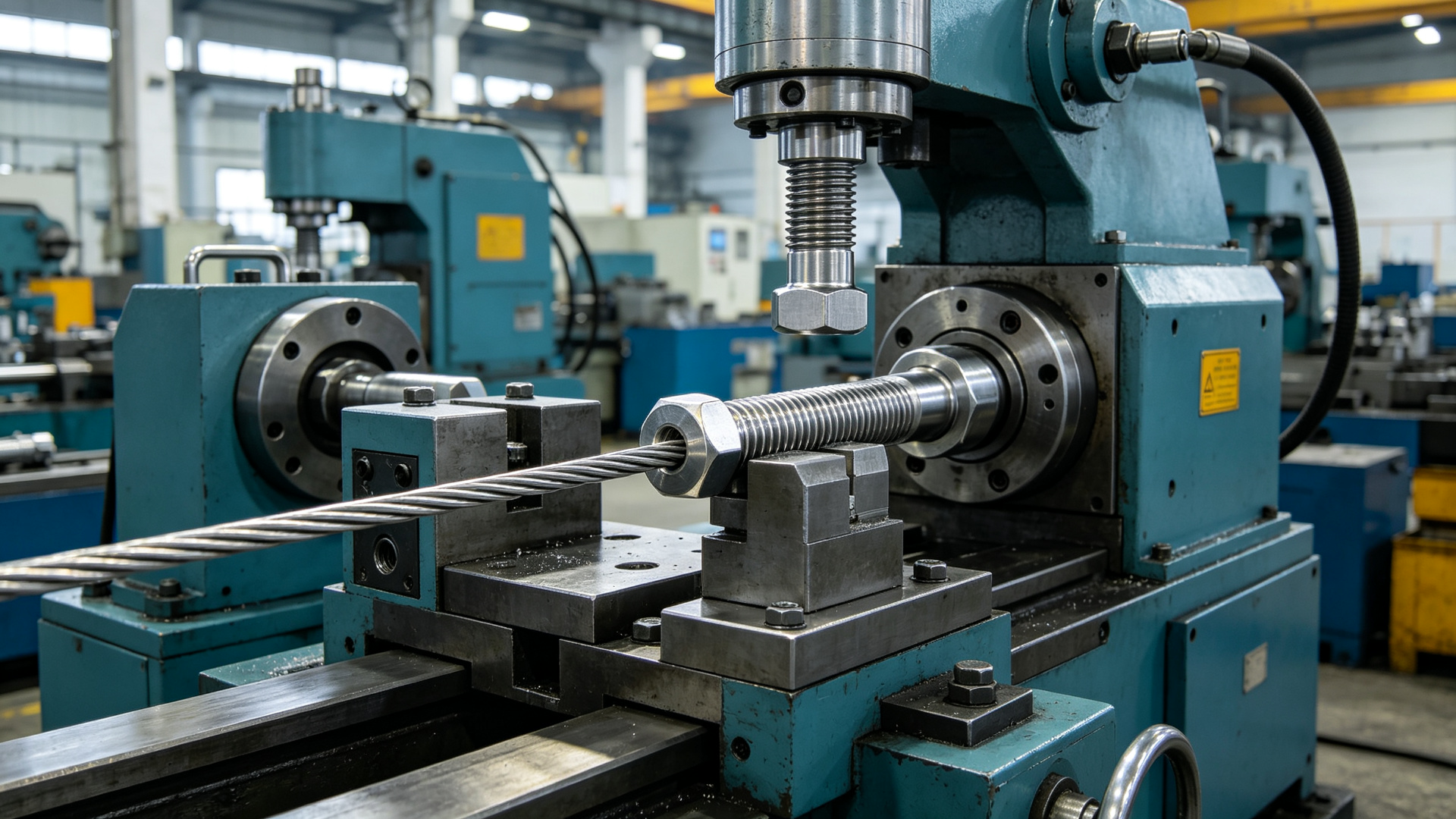
Cold heading is a manufacturing process that forms metal at room temperature using high-speed punches and dies.
Unlike hot forging, which heats the material above its recrystallization temperature, cold heading deforms the steel while it remains at ambient temperature.
The process begins with wire rod.
After drawing, heat treatment preparation, and surface conditioning, the wire is fed into a multi-station cold heading machine.
At each station:
1. The wire is cut to length.
2. The end is upset to form the bolt head.
3. Secondary dies refine the shape.
4. The flange and under-head geometry are formed.
5. The semi-finished bolt exits for further processing.
Because the metal is not heated, the grain flow follows the shape of the part rather than being cut through by machining.
This grain flow continuity is one reason cold headed fasteners typically have better strength and fatigue performance than fully machined equivalents.
---
# 2. Cold Heading vs Hot Forging vs Machining
For structural and industrial fasteners, three main production routes exist.
## 2.1 Cold Heading
Cold heading is the standard method for high-volume bolt and screw production.
Advantages:
- high material utilization
- excellent dimensional consistency
- improved surface finish
- continuous grain flow
- suitable for medium and high volume orders
Limitations:
- requires dedicated tooling
- material ductility must be controlled
- less suitable for extremely complex geometries
## 2.2 Hot Forging
Hot forging heats the steel before forming.
It is used when:
- material ductility at room temperature is insufficient
- part size is very large
- deformation requires high energy
However, hot forging usually results in:
- rougher surface
- larger tolerances
- higher material waste
- lower dimensional precision
## 2.3 Machining
Machining cuts material from a bar or rod to reach the final shape.
This process works well for:
- very low volume prototypes
- highly complex special shapes
- parts that cannot be formed
But machining interrupts grain flow. For fatigue-critical fasteners, this can reduce performance.
In most standard bolt applications, cold heading remains the preferred production route when volume and geometry allow it.
---
# 3. Key Quality Control Points in Cold Heading
A reliable cold heading supplier does more than run a machine.
Quality must be controlled across the entire production sequence.
## 3.1 Wire Rod Selection and Incoming Inspection
The foundation starts with raw material.
Before production:
- steel grade must match the required property class
- chemical composition must be verified
- surface quality must be checked for seams, laps, or decarburization
For Class 8.8 bolts, suppliers commonly use medium carbon steels.
For Class 10.9 bolts, alloy steels are typically required.
If incoming material is off-spec, even the best forming process cannot fully compensate.
## 3.2 Wire Drawing and Surface Preparation
Wire rod is drawn to the final diameter required for the fastener.
Proper surface preparation includes:
- cleaning
- phosphating or alternative coating
- lubrication control
Poor lubrication can lead to:
- die sticking
- surface scoring
- inconsistent forming loads
- premature tool wear
## 3.3 Forming Parameters and Tool Condition
During cold heading, the machine must maintain:
- proper punch alignment
- correct die clearance
- consistent stroke speed
- stable feed length
Tooling condition is equally important.
Worn dies can cause:
- head cracks
- dimensional inconsistency
- burr formation
- visual defects
A serious cold heading supplier regularly inspects and replaces tooling based on part count, not only when failure becomes visible.
## 3.4 In-Process Dimensional Inspection
After forming, the semi-finished bolt should be checked for:
- head height
- head diameter
- flange diameter
- under-head fillet radius
- overall length
Even small dimensional deviations can affect assembly, torque application, and load transfer.
For EPC projects, in-process inspection records matter. They show that production was controlled, not merely sampled at the end.