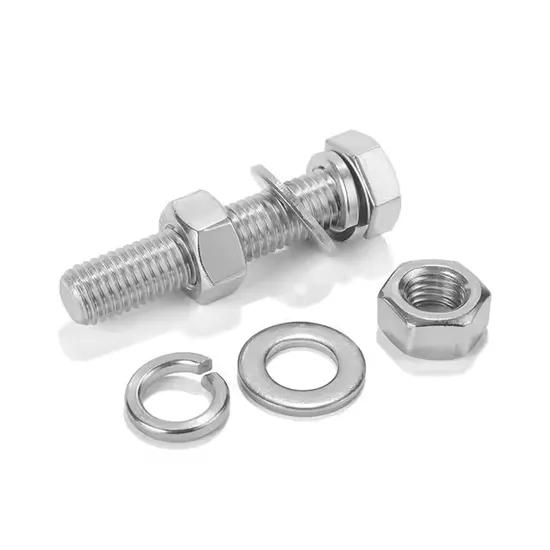
Hex Bolts, Nuts & Washers Manufacturer & Supplier: DIN, ISO & GB Metric Fasteners
Yuanpai manufactures metric hex bolts, nuts and washers in China, supporting OEM buyers, distributors and EPC contractors across the Middle East, Europe, Southeast Asia and Australia with DIN, ISO and GB compliant production. Our cold heading lines, in-house heat treatment and thread rolling plants cover the full DIN 933 / DIN 931, ISO 4014 / ISO 4017 and GB/T 5782 / 5783 programs, with plain, zinc-plated, hot-dip galvanized and zinc-flake finishes applied under the same roof, and EN 10204 material certificates with lot traceability as standard.
Yuanpai — Hex Bolts, Nuts & Washers Quick Reference:
- Product standards: DIN 933 (full thread), DIN 931 (partial thread), EN ISO 4017 / 4014, GB/T 5782 / 5783; nuts per DIN 934 / EN ISO 4032, washers per DIN 125 / ISO 7089
- Property classes: 4.8, 8.8, 10.9, 12.9 per ISO 898-1 (bolts) and ISO 898-2 (nuts)
- Sizes: M6 – M64 standard program; custom diameters, lengths and thread pitches on request
- Finishes: plain, electroplated zinc (ISO 4042), hot-dip galvanized (ISO 10684), zinc-flake (ISO 10683)
- Documentation: EN 10204 3.1 certificates, heat number traceability, lot test reports
What This Page Covers
For industrial buyers, three points normally decide whether a hex bolt supplier passes qualification: standard compliance, property-class control and documentation. This page is the engineering-buyer view of our hex bolt program This page is the engineering-buyer view of our hex bolt program — the standards we manufacture to, the strength classes we certify, the finishes we control, and the documentation that travels with every lot. If you need a specific size, grade or coating combination, send the drawing or the DIN/ISO/GB designation and our team will quote with the certification scope included.
Hex Bolts, Nuts and Washers: The Product Program
| Product | Typical Standards | Property Classes | Typical Applications |
|---|---|---|---|
| Hex bolts, full thread | DIN 933, EN ISO 4017, GB/T 5783 | 4.8, 8.8, 10.9, 12.9 | General bolting, machinery, OEM assemblies |
| Hex bolts, partial thread | DIN 931, EN ISO 4014, GB/T 5782 | 8.8, 10.9, 12.9 | Structural and high-load connections |
| Hex nuts | DIN 934, EN ISO 4032, GB/T 6170 | 4, 8, 10, 12 (ISO 898-2) | Matching all hex bolt assemblies |
| Flat washers | DIN 125, ISO 7089 / 7090, GB/T 97.1 | — | Load distribution under head and nut |
| Hex flange bolts and nuts | DIN 6921 / 6923, EN 1665 / 1663 | 8.8, 10.9 | Automotive and machinery joints |
Sizes start at M6 and run to M64 for the standard program. Fine thread (DIN 960 / DIN 961, or ISO 4014 / 4017 with fine pitch) and special lengths are produced on order, subject to rolling die availability and batch size.
DIN 933 vs DIN 931: What the Designation Tells You
Two designations cover most hex bolt orders. DIN 933 is a full-thread hex head bolt — the thread runs all the way to the head, so the same bolt can be cut to different grip lengths. DIN 931 is a partial-thread bolt with a plain shank under the head, specified when the connection carries shear loads and the thread must stay out of the shear plane. In the ISO system these map to EN ISO 4017 (full thread) and EN ISO 4014 (partial thread); the GB equivalents are GB/T 5783 and GB/T 5782. A buyer who writes "M16 x 80 DIN 933" gets a full-thread bolt, while "M16 x 80 DIN 931" gets a partial-thread bolt with roughly 38 mm of thread — the exact thread length follows the standard rule (for l ≤ 125 mm, b = 2d + 6), so confirm it on the drawing when the grip dimension is critical.
Property Classes 4.8, 8.8, 10.9 and 12.9
Strength classes follow ISO 898-1 for bolts and ISO 898-2 for nuts. The first digit is one hundredth of the nominal tensile strength in MPa, the second digit is the ratio of yield to tensile strength:
| Property Class | Material & Process | Min. Tensile Rm (MPa) | Yield Rp0.2, min. (MPa) | Typical Use |
|---|---|---|---|---|
| 4.8 | Low-carbon steel, cold forged | 400 | 320 | General duty, furniture, light machinery |
| 8.8 | Medium-carbon steel, quenched and tempered | 800 | 640 | Machinery, automotive, general structural |
| 10.9 | Alloy steel, quenched and tempered | 1000 | 900 | High-load connections, heavy equipment |
| 12.9 | Alloy steel, quenched and tempered | 1200 | 1080 | Tooling, high-precision specials, extreme-load applications |
The matching nut class must be at least the bolt class (e.g. 10.9 bolts with class 10 nuts). Mismatched classes — a 12.9 bolt with an 8 nut — transfer the failure mode to the nut, which is normally the safer direction, but the connection must be designed for it. For structural applications, verify the project's execution standard before substituting classes.
Finishes: Zinc, Hot-Dip Galvanized and Zinc-Flake
- Electroplated zinc (ISO 4042) — thin layer, good for indoor machinery; thickness classes range from Fe/Zn5 to Fe/Zn25, with optional passivation. For high-strength fasteners requiring electroplated zinc finishes, hydrogen embrittlement risk control and post-plating baking are performed according to applicable process requirements.
- Hot-dip galvanized (ISO 10684 / ISO 1461) — thick zinc layer, first choice for outdoor, coastal and utility structures; thread fit is restored by over-tapping after galvanizing, so bolt/nut fit must be verified with gauges before dispatch.
- Zinc-flake (ISO 10683) — thin, corrosion-resistant coating for high-strength classes where hydrogen embrittlement risk rules out acid electroplating; preferred for 10.9 and 12.9 in safety-critical service.
- Plain (no coating) — as-forged or bright finish, for clean indoor assemblies or where the project specifies a dedicated coating.
The coating is selected according to exposure conditions, corrosion category and assembly requirements: indoor machinery often runs plain or zinc-plated; outdoor structures, transmission lines and solar mounting frames typically specify HDG or zinc-flake. Where the project defines corrosion class per ISO 12944, the coating system follows the C-class requirement (e.g. C4/C5 coastal service).
Manufacturing: From Coil to Finished Hex Bolt
Hex bolts are cold forged from wire rod, headed, then thread rolled. In-house heat treatment (quench and temper) sets the mechanical properties for 8.8 and above, and hardness is verified per lot. Thread rolling is performed before or after heat treatment depending on bolt grade, diameter and production specification; final thread tolerance is verified according to ISO 965-1 / -2, and the work-hardened flank surface gives rolled threads their fatigue advantage over cut threads. Optical sorting and thread gauging run on the finished line, and each heat is documented with its test reports.
- Cold heading — multi-station headers for M6–M36 standard programs, plus long-bolt heading lines for special lengths
- Heat treatment — quench and temper lines with hardness testing per batch
- Thread rolling — flat-die and planetary rolling for 6g tolerance and consistent flank finish
- Finishing — automated plating lines, HDG with thread restoration, zinc-flake dip-spin lines
- Inspection — dimensional gauging, hardness testing, salt spray verification where specified, and EN 10204 3.1 documentation
Quality and Documentation
Each production lot ships with a material certificate and lot-level test reports covering chemical composition, hardness and, where specified, tensile testing. EN 10204 3.1 certificates are prepared from our in-house testing laboratory and quality documentation system — we do not outsource certificate fabrication. For project-critical lots, witness testing and third-party inspection (e.g. 3.2) can be arranged at the buyer's request, subject to the nominated inspection body and lead time.
Buyer Qualification Package
For buyers qualifying a new hex bolt supplier, we provide a qualification package covering: plant profile and production lines, heat treatment and testing equipment list, sample parts for dimensional and hardness verification, and a sample EN 10204 3.1 certificate format for review before the first order. Audits of the production floor can be arranged for project-critical programs, subject to scheduling.
Why Buyers Choose Yuanpai for Hex Bolts, Nuts and Washers
- Full standard coverage — DIN, ISO and GB programs under one roof, so mixed orders consolidate without splitting suppliers
- Class guarantee — continuous heat treatment logging and per-lot proof load and tensile testing (EN ISO 898-1) back the 8.8, 10.9 and 12.9 classes you order
- Finish control — zinc, HDG and zinc-flake lines in-house, with salt spray verification and thread-fit gauging after coating
- Documentation-ready — EN 10204 3.1 certificates, heat number traceability and lot test reports with every shipment
- Export packaging — plywood pallets and steel-strapped cartons for sea freight, with coating-protection paper for HDG and zinc-flake parts
Sourcing and Lead Times
- Stock sizes of DIN 933 / 931 hex bolts and DIN 934 nuts in 8.8 and 10.9 are available for rapid dispatch, subject to size, quantity and finish
- Production lots of 10,000–500,000 pieces typically ship in 2–4 weeks depending on class, finish and documentation scope
- Mixed-container consolidation with stainless steel or other fastener programs reduces freight cost for distributor orders
Consolidating carbon steel and stainless fasteners? Contact our sales team to calculate container volume and freight savings.
FAQ
Q: What is the difference between DIN 933 and DIN 931 hex bolts?
A: DIN 933 is a full-thread hex head bolt; the thread runs from the head to the tip. DIN 931 is a partial-thread bolt with a plain shank under the head, specified where the connection carries shear loads. The ISO equivalents are EN ISO 4017 (full thread) and EN ISO 4014 (partial thread).
Q: What does property class 10.9 mean?
A: Per ISO 898-1, 10.9 means a minimum tensile strength of 1000 MPa and a yield strength of 900 MPa, achieved by quenching and tempering an alloy steel. The matching nut must be class 10 or higher.
Q: Can you supply hot-dip galvanized hex bolts with the thread working?
A: Yes. HDG is applied per ISO 10684 / ISO 1461 and threads are over-tapped after galvanizing, with thread fit verified by gauges before dispatch. HDG is commonly specified for outdoor, coastal and utility structures.
Q: Do you provide EN 10204 3.1 certificates?
A: Yes. Each lot ships with an EN 10204 3.1 material certificate and lot test reports covering composition and hardness; tensile testing and third-party witness inspection can be added where the project requires them.
Q: What is your minimum order quantity?
A: Standard hex bolts and nuts in common sizes and classes start from about 5,000 pieces; special diameters, long lengths and documented lots are quoted by size and quantity. Send the specification and our team will confirm the MOQ and lead time within one working day.
Q: Can you make hex bolts to a drawing or a non-standard thread?
A: Yes. Drawing-based specials, fine threads, extra-long lengths and non-standard head configurations are produced on our cold heading and machining lines, subject to tooling availability and batch size.
Request a quote for your hex bolt package: send the standard designation or drawing with size, property class, finish and quantity, and our engineering team will confirm the material, certification scope and delivery schedule within one working day.
📄 Download the hex bolt RFQ checklist — designation, size, class, finish, tolerance and documentation requirements.
📦 Request sample bolts and MTC examples — evaluate head marking, thread finish and certificate format before ordering.
💬 WhatsApp engineering support — send the drawing or bolt specification directly to our team.