Project Details
Project overview
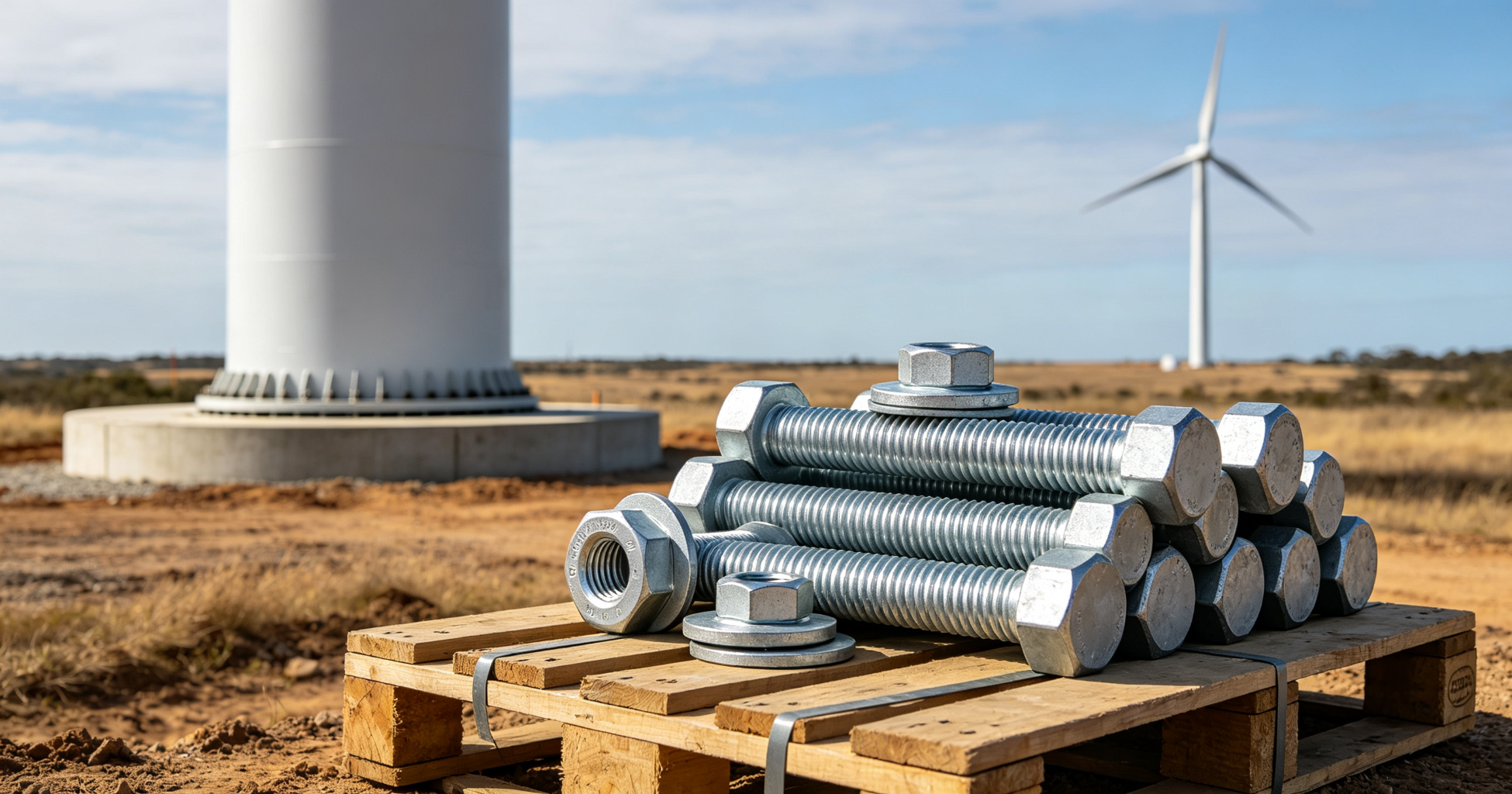
A 180 MW wind farm in Victoria, Australia, required 48 tons of M30×150 mm property class 10.9 heavy hex structural bolts for the tower-base foundation flange that ties the lowest steel tower section to the concrete foundation embedment ring. The fasteners had to arrive within 21 days to hold the erection schedule.
Why the project came to us
The buyer’s local supplier quoted 45 days and could not assemble the documentation the project engineer needed to release the foundation fasteners: material test certificates, galvanized-coating thickness records, a defined hydrogen-embrittlement control for the high-strength parts, and lot torque-tension data. Without that package, the lots could not be installed.
How we supplied it
Every bolt was delivered as a complete property class 10.9 high-strength structural bolting assembly for preloading — heavy hex bolt, matching nut and two hardened chamfered washers, one under the head and one under the turning nut. The bolt-and-nut sets were supplied to EN 14399-3 System HR (marked 10.9HR) with EN 14399-6 hardened chamfered washers — the complete preloading assembly accepted as deemed-to-satisfy AS/NZS 1252.1 under Australian Steel Institute and GANZ bolting guidance.
Hydrogen-embrittlement risk in the class 10.9 parts (320–380 HV) was controlled under ISO 10684 using mechanical abrasive surface preparation to minimise acid pickling, with any stress-relief or baking completed before fluxing and immersion rather than after coating. Normal-temperature galvanizing (a 455–480 °C bath) was used, because high-temperature galvanizing is not permitted for class 10.9 bolts in sizes M27 and above. Coating thickness was magnetic-gauge recorded per ISO 2178 against the ISO 10684 / AS/NZS 1214 requirements for threaded fasteners, with nuts tapped oversize so every assembly ran up freely.
Installation tension was set to the 465 kN minimum bolt tension for an M30 class 10.9 preloaded connection under AS 4100 — the proof load derived from the 830 MPa proof-load stress over the 561 mm² tensile stress area — using assemblies supplied to AS/NZS 1252.1. With wax-lubricated galvanized threads at a torque coefficient K = 0.13 established by batch preloading suitability testing to EN 14399-2, the corresponding wrench setting was T = K·F·d ≈ 0.13 × 465 kN × 0.030 m ≈ 1,810 N·m, and each lot was confirmed on a Skidmore–Wilhelm-type tension calibrator before site use. Every lot shipped with an EN 10204 3.1 certificate, hardness and coating records, the torque-tension calibration, and mill-to-part heat-number traceability — the package the engineer used to release the foundation connection.
Outcome
The fasteners cleared the EPC contractor’s incoming inspection on the first attempt, with zero non-conformance reports, and the towers were erected on schedule. Two months after delivery, the customer released a 22-ton repeat order for phase 2 and qualified us as the foundation-bolt supplier for the expansion.
Key takeaway
For wind and solar foundation fasteners, buyers are not only buying bolts. They are buying a releasable documentation package — correct preload and torque, a defensible hydrogen-control route, and lot-level traceability — delivered inside the erection window.
Work with us
Send your foundation bolt schedule and project specification to our engineering team. We return a reviewed quotation with the full certification package — EN 10204 3.1 MTCs, hardness and coating records, torque-tension calibration and heat-number traceability — typically within 24 hours.