
Key Takeaways
· ANSI (US inch) and DIN (European metric) fasteners are not interchangeable — different thread pitches, head sizes, and strength grades mean you can't substitute one for the other.
· DIN/ISO metric bolts are 20-40% cheaper than ANSI inch bolts when sourced from China, because metric production volumes are far higher.
· SAE Grade 5 ≈ ISO 8.8, SAE Grade 8 ≈ ISO 10.9 — but the mapping isn't exact; always verify mechanical properties before substitution.
· For global supply chains, standardizing on metric (DIN/ISO) reduces inventory complexity and lowers cost — but only if your engineering team can design in metric.
Quick Answer
ANSI/ASME (inch) and DIN/ISO (metric) bolts are not interchangeable — different head dimensions, thread pitches, and strength grade systems. A 1/2"-13 UNC bolt is not the same as an M12 x 1.75. When sourcing globally, specify the exact standard on every line item and verify head markings on receipt.
A US-based distributor calls: "Our customer in Germany needs M16 x 100mm bolts, but we only stock 5/8" x 4". Can we just send the inch bolts? They're about the same size, right?"
They're not the same size. Not even close. A 5/8" bolt has a 15.875mm diameter and 11 threads per inch (UNC). An M16 bolt has a 16mm diameter and 2mm pitch (coarse). The threads don't match, the nuts don't fit, and the head sizes are different. Sending inch bolts to a metric project is a recipe for disaster — and I've seen it happen more than once.
If you're sourcing fasteners for a global market, you need to understand the ANSI vs DIN divide. Here's a practical guide for buyers, distributors, and engineers who bridge both worlds.
A contractor in the UAE mixed ANSI 1/2" bolts with metric M12 nuts on a pipe rack project — they looked similar and both fit a 19mm wrench. During hydrostatic testing, 12 connections leaked because the thread engagement was wrong (13 TPI vs 1.75mm pitch). The rework cost AED 22,000 and delayed commissioning by 2 weeks. The fix: color-coded packaging by standard, and a receiving inspection that checks thread pitch with a gauge — not just a wrench fit.
ANSI vs DIN: The $6,000 Headache
A US buyer ordered "M20 hex bolts, grade 8.8" from a Chinese supplier. What arrived were ANSI B18.2.1 3/4"-10 bolts — same head size, but inch thread. None fit their metric nuts. Return freight: $6,000. We now label every box with both the standard and the thread specification, and we send a photo of the head marking before shipment. If you order metric, you get metric. If you order inch, you get inch. No guessing.
The Great Divide: Inch vs Metric
The world uses two fastener systems:
- ANSI/ASME (inch) — used primarily in the United States, Canada, and to some extent the UK and other historically US-influenced markets. Sizes in inches: 1/4", 5/16", 3/8", 7/16", 1/2", 9/16", 5/8", 3/4", 7/8", 1", and up. Threads in TPI (threads per inch): UNC (coarse), UNF (fine), UNEF (extra fine).
- DIN/ISO (metric) — used everywhere else: Europe, Asia, Middle East, Africa, South America, Australia. Sizes in millimeters: M3, M4, M5, M6, M8, M10, M12, M14, M16, M20, M24, and up. Threads in pitch (mm): coarse (standard), fine (e.g., M16 x 1.5).
The two systems are fundamentally incompatible. You cannot thread an M16 bolt into a 5/8" nut — the pitch is different (2mm vs 2.309mm for UNC), and the diameters are slightly different. Even if you force it, the thread engagement is wrong and the joint will fail.
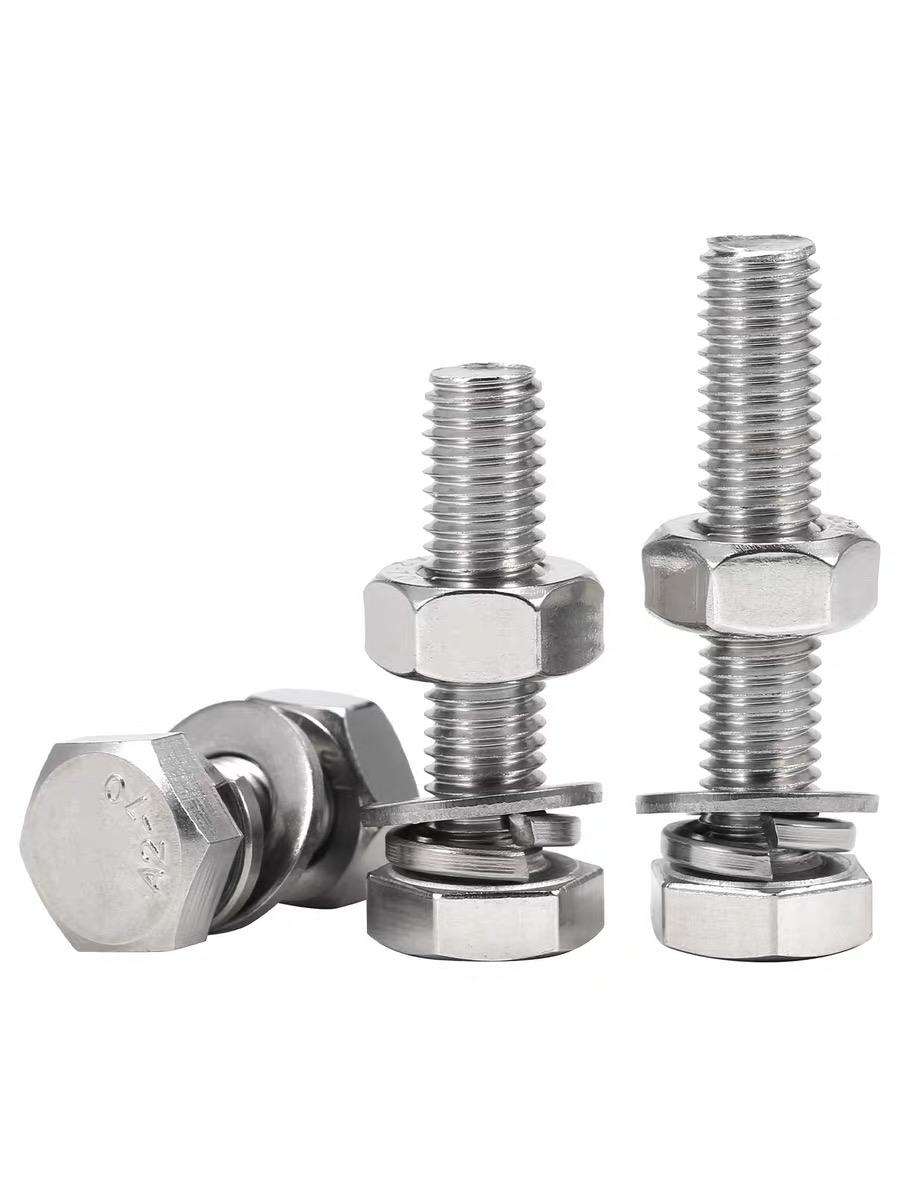
▲ Metric (DIN) and inch (ANSI) fasteners look similar but are completely incompatible — threads, heads, and strengths all differ
Strength Grade Mapping (Approximate)
Both systems use strength grades, but they're labeled differently. Here's the approximate mapping:
| ISO/DIN Grade | Tensile (MPa) | SAE Grade | Tensile (ksi) | ASTM Grade |
|---|---|---|---|---|
| 4.6 | 400 | Grade 2 | 60 (4.6=67) | A307 |
| 5.8 | 500 | Grade 2 | 60 (5.8=72) | A307 |
| 8.8 | 800 | Grade 5 | 120 | A449 |
| 10.9 | 1000 | Grade 8 | 150 | A354 BD |
| 12.9 | 1200 | Grade 8+ | 150+ | A354 BC |
Important: these are approximate mappings. ISO 8.8 and SAE Grade 5 have similar tensile strength, but the yield strength, hardness range, and testing methods differ. Never substitute one for the other in a critical application without engineering approval. For structural applications, ASTM A325 and A490 bolts have no direct ISO equivalent — they're US-specific standards with different mechanical properties and installation methods (turn-of-nut, direct tension indicators).
Head Size and Wrench Differences
Even when the bolt diameter is close, the head sizes differ. This matters because it determines which wrench fits:
| Nominal Size | DIN/ISO Head (mm) | ANSI Head (inch/mm) |
|---|---|---|
| M10 / 3/8" | 17mm | 9/16" = 14.3mm |
| M12 / 7/16" | 19mm | 5/8" = 15.9mm |
| M16 / 5/8" | 24mm | 15/16" = 23.8mm |
| M20 / 3/4" | 30mm | 1-1/8" = 28.6mm |
| M24 / 7/8" | 36mm | 1-5/16" = 33.3mm |
Notice that M16 and 5/8" have nearly the same head size (24mm vs 23.8mm) — a 15/16" wrench will almost fit an M16 head, and vice versa. This is where people get into trouble: the wrench fits, so they assume the bolt is compatible. But the threads are still wrong. Always verify the thread, not just the head size.
For a deeper dive into the most common metric standard, see our DIN 933 vs DIN 931 technical deep dive. And for a comprehensive comparison of all four standard families, see our DIN/ISO/GB/ANSI buyer checklist.
Cost and Availability
Here's where it gets interesting for buyers. Metric (DIN/ISO) fasteners are significantly cheaper than ANSI inch fasteners when sourced from China — typically 20-40% lower unit price. Why?
- Production volume — Chinese factories produce metric bolts in massive quantities (millions of tons per year). The economies of scale drive down cost.
- Tooling availability — Metric dies and thread rolling dies are standard inventory in every Chinese fastener factory. Inch dies may need to be special-ordered.
- Raw material — Chinese steel mills produce metric-sized wire rod as standard. Inch-sized wire may require special rolling.
- Competition — There are hundreds of metric bolt factories in the Yongnian district (Handan, China) alone. Inch bolt production is more concentrated and less competitive.
If you're a distributor serving both US and international markets, this creates an opportunity: source metric bolts from China at competitive prices, and source inch bolts either from US domestic suppliers or from Chinese factories that specialize in inch production. We produce both — our DIN 931 metric bolts and DIN 933 metric bolts are our core products, and we can also produce ANSI B18.2.1 inch bolts on request.
▲ Global sourcing — metric bolts from China are typically 20-40% cheaper than inch bolts due to production scale
Strategies for Global Buyers
Strategy 1: Standardize on Metric
If your engineering team can design in metric, standardizing on DIN/ISO fasteners is the most cost-effective approach. You get lower unit prices, wider supplier choice, and simpler inventory (one system instead of two). Many global companies — including some US-based multinationals — have already moved to metric for new designs.
Strategy 2: Dual Inventory
If you must serve both markets, maintain separate inventory for metric and inch. Never mix them in the same bin. Label everything clearly. Train your warehouse staff to check the thread pitch before shipping — a thread gauge costs $10 and prevents $10,000 mistakes.
Strategy 3: Conversion Kits
For customers converting from inch to metric (or vice versa), offer conversion kits with the correct fasteners for the specific application. This is a value-added service that distributors can provide — and it prevents the customer from trying to "make do" with the wrong fasteners.
For more on putting together accurate RFQs across standards, see our RFQ checklist.
FAQ
Q: Can I use an M16 bolt in a 5/8" hole?
A: The hole size is different — a 5/8" bolt typically uses a 11/16" (17.5mm) clearance hole, while an M16 bolt uses an 18mm clearance hole. The M16 bolt will fit through a 17.5mm hole with very tight clearance, but it's not recommended. The bolt may bind in the hole, and the bearing stress may be too high. Use the correct hole size for the bolt standard.
Q: Are SAE Grade 5 and ISO 8.8 interchangeable?
A: Mechanically similar (both ~800 MPa tensile), but not identical. SAE Grade 5 has a hardness range of HRC 25-34; ISO 8.8 has HRC 22-32. The yield strength ratios differ (Grade 5 = 92 ksi yield, 8.8 = 640 MPa = 93 ksi yield — very close). For non-critical applications, substitution is generally acceptable. For critical structural or automotive applications, consult an engineer and verify the specific properties.
Q: Why are inch bolts more expensive from Chinese suppliers?
A: Lower production volume = higher unit cost. Most Chinese fastener factories are set up for metric production. Inch bolts require special tooling, smaller batch sizes, and often different raw material sizes. Some factories specialize in inch production and can be competitive, but they're fewer in number. If you need inch bolts in volume, it's worth finding a factory that specializes in them rather than asking a metric factory to run a special batch.
Q: What about nuts — are metric and inch nuts compatible?
A: No. A metric nut has metric threads (e.g., M16 x 2mm pitch), an inch nut has inch threads (e.g., 5/8"-11 UNC). They won't thread onto each other. Always match the nut standard to the bolt standard. And remember: the nut strength grade must match or exceed the bolt grade (ISO 8 nut for 8.8 bolt, ISO 10 nut for 10.9 bolt; SAE Grade 5 nut for Grade 5 bolt, Grade 8 nut for Grade 8 bolt).
Q: How do I identify whether a bolt is metric or inch?
A: Three ways: (1) Check the head marking — metric bolts are marked with the ISO grade (8.8, 10.9, etc.), inch bolts with SAE grade (radial lines: 3 lines = Grade 5, 6 lines = Grade 8). (2) Measure the thread pitch with a thread gauge — metric gauges read in mm pitch, inch gauges in TPI. (3) Measure the diameter — metric sizes are round numbers (10, 12, 16, 20mm), inch sizes convert to odd decimals (9.53, 12.7, 15.88, 19.05mm). When in doubt, use a thread gauge — it's the definitive test.
The ANSI vs DIN divide isn't going away anytime soon. But with a clear understanding of the differences, you can source smartly, avoid costly mistakes, and serve customers on both sides of the metric/inch divide. The key rule: never assume compatibility. Verify the standard, the thread, and the grade — every time.