Key Takeaways
· Overseas buyers should hold 8-12 weeks of safety stock for standard fasteners — sea freight from China takes 4-6 weeks, plus production and customs.
· Mixed container loading (LCL consolidation) lets you order multiple sizes in one shipment, reducing freight cost per unit by 30-50%.
· Free warehouse storage at the supplier (we offer 180 days) lets you order in bulk for better pricing and release stock as needed.
· The 80/20 rule applies: 20% of your SKUs typically account for 80% of volume — focus inventory planning on those high-runner items.
Quick Answer
Overseas buyers should hold 8-12 weeks of safety stock for standard fasteners, use mixed-container ordering to reduce per-unit shipping cost, and leverage supplier warehouse programs (like our 180-day free storage) to decouple production from delivery. Running out of a $0.05 bolt can stop a $5M production line.
You place an order for M12 x 50mm bolts. The supplier quotes 15 days production. Then 5 days to the port. Then 35 days on the water. Then 7 days customs and inland transport. Total: about 8 weeks from PO to your warehouse.
And that's when everything goes smoothly. Add a port congestion delay, a customs inspection, or a production backlog, and you're looking at 10-12 weeks. If your inventory runs out in week 6, you've got a problem.
I've worked with buyers in over 50 countries, and inventory planning is the #1 source of stress — and the #1 area where small changes save real money. Here's how to get it right.
An automotive parts distributor in Germany ran out of M8 flange bolts during a peak production month. The minimum ocean freight order would take 5 weeks — their line needed them in 5 days. Air freight cost €3,200 for 50,000 bolts that normally cost €0.08 each. The total: €7,200 for a €4,000 order. If they had maintained a 12-week safety stock (about €1,600 tied up in inventory), the air freight never would have happened. Inventory carrying cost is real — but stockout cost is usually 5-10x higher.
How One Buyer Cut Inventory Costs by 34%
A Dutch distributor was stocking 230 SKUs of fasteners and running out of warehouse space. We analyzed their order history over 12 months and found that 80% of revenue came from 42 SKUs. We proposed a consignment model: we keep 180 days of stock for those 42 SKUs in our Yongnian warehouse, ship within 96 hours. They reduced their local inventory from 230 to 42 SKUs, cut holding costs by 34%, and never ran out of stock.
Understanding Your Lead Time
The first step is knowing exactly how long it takes from PO to delivery. Break it down:
- Production: 7-15 days for standard items, 20-30 days for custom or non-standard
- QC and packaging: 2-3 days
- Inland transport to port: 2-5 days (from Handan to Tianjin/Qingdao)
- Sea freight: 25-40 days depending on destination (Europe ~30 days, US West Coast ~15 days, US East Coast ~35 days, Middle East ~20 days)
- Customs clearance: 3-7 days
- Inland delivery to your warehouse: 2-5 days
Total: typically 6-10 weeks for standard sea freight. For urgent orders, air freight cuts this to 7-10 days but costs 5-10x more per kg.
▲ Port congestion can add 1-2 weeks to your lead time — build buffer into your inventory plan
How Much Safety Stock Do You Need?
Safety stock is the buffer you hold to cover unexpected delays or demand spikes. For fasteners sourced from China, I recommend:
- Standard high-volume items (M8-M20, common lengths): 8-12 weeks of average usage
- Low-volume or custom items: 12-16 weeks of average usage (longer production times)
- Critical single-source items: 16+ weeks — if this bolt is the only thing holding up your production line, carry extra
The formula is simple: Safety Stock = (Max Weekly Usage × Max Lead Time Weeks) - (Average Weekly Usage × Average Lead Time Weeks). But honestly, for most buyers, the 8-12 week rule of thumb works well enough.
The 80/20 Rule for Fastener Inventory
In almost every fastener inventory I've seen, 20% of the SKUs account for 80% of the usage volume. These are your "A items" — the M10 x 40, M12 x 50, M16 x 60 bolts that you use every day. These are the ones to focus on.
Your "B items" (next 30% of SKUs, 15% of volume) need regular but less frequent ordering. Your "C items" (bottom 50% of SKUs, 5% of volume) can be ordered as-needed or in minimum quantities — don't tie up warehouse space in slow-moving odd sizes.
Practical approach: categorize your SKUs by annual usage. Order A items on a regular schedule (every 4-6 weeks), B items every 8-12 weeks, and C items only when stock runs low.
Mixed Container Loading — The Biggest Cost Saver
Most buyers don't need a full container of one bolt size. But ordering LCL (less than container load) means your cargo shares space with other shippers — and it costs more per kg, takes longer, and has higher risk of damage.
The solution is mixed container loading: order multiple sizes and types from one supplier, and they consolidate everything into one container. We do this regularly — a single 20ft container might hold 8 different bolt sizes, 3 nut sizes, and washers, all packed and labeled separately.
Benefits:
- 30-50% lower freight cost per unit vs LCL
- Faster delivery (no consolidation warehouse wait)
- Less handling = less damage
- One customs clearance for the whole shipment
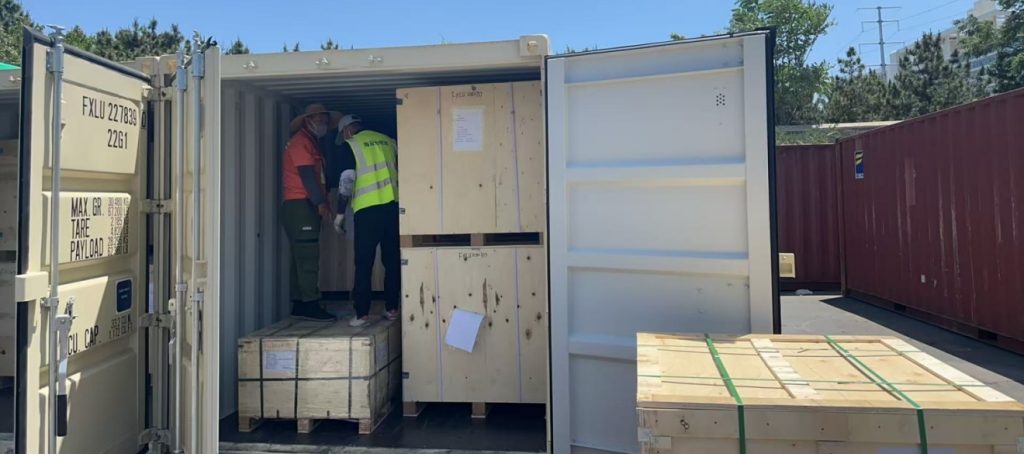
▲ Mixed container loading — multiple SKUs in one shipment saves freight and reduces handling
For example, a buyer in Germany regularly orders a mixed container: 5 tons of DIN 931 M16 bolts, 3 tons of DIN 933 M12 bolts, 2 tons of grade 10.9 structural bolts, plus nuts and washers. One container, one shipment, one customs entry — and the freight cost per kg is half what LCL would cost.
Free Supplier Warehouse Storage
Here's a trick many buyers don't know: some suppliers offer free warehouse storage. We offer 180 days (6 months) of free storage for paid orders. This means you can:
- Place a large order to get bulk pricing
- Have the supplier produce and inspect the full order
- Release stock in partial shipments as you need it
- Pay only for what's shipped, when it's shipped
This is essentially consignment inventory at the supplier's warehouse. You get bulk pricing without tying up your own warehouse space. And because the goods are already produced and inspected, lead time for each release is just shipping time — 4-6 weeks instead of 8-10.
For more on sourcing strategy, see our supplier evaluation guide. And if you're putting together an RFQ, our RFQ checklist ensures you get comparable quotes.
Reorder Point Formula
Set a reorder point for each SKU so you know when to place the next order:
Reorder Point = (Average Weekly Usage × Lead Time in Weeks) + Safety Stock
Example: 500 kg/week × 8 weeks + 4,000 kg safety = 8,000 kg reorder point
When inventory drops to the reorder point, place the order. Don't wait until you're almost out — by then it's too late to avoid a stockout.
FAQ
Q: How much inventory should a new buyer start with?
A: For a new business or new product line, start with 4-6 weeks of estimated usage for A items, and minimum order quantities for B and C items. You can always reorder — starting with too much inventory ties up cash in slow-moving stock.
Q: What's the minimum order quantity for mixed containers?
A: For standard bolts, our MOQ is typically 1 carton (25-50kg) per size. For a mixed container, the total should be at least 5-10 tons to make the freight worthwhile. Below that, LCL or air freight may be more economical.
Q: How do I handle seasonal demand spikes?
A: If you know your busy season (e.g., construction in spring/summer), place orders 12-16 weeks before the season starts. Suppliers get busy in Q1 for spring delivery — ordering early ensures you get production slots and avoids price increases.
Q: Can I use air freight for emergency restocks?
A: Yes, but it's expensive — typically 5-10x the cost of sea freight. Use air freight only for critical items that would stop production. For everything else, plan ahead and use sea freight. We can ship partial orders by air while the rest goes by sea.
Q: What about quality issues with bulk orders?
A: Always request pre-shipment inspection (PSI) for orders over 5 tons. A third-party inspector checks dimensions, hardness, coating, and packaging before the container leaves the factory. We welcome PSI and provide full documentation — material certs, test reports, and packing lists.
Inventory planning isn't about having everything in stock — it's about having the right things in stock at the right time. Get the lead times right, use mixed containers, and leverage supplier storage, and you'll cut both stockouts and carrying costs.