Key Takeaways
· A fastener supplier audit should cover 6 areas: quality system, production capability, inspection equipment, raw material control, traceability, and financial/operational stability.
· Don't rely on certificates alone — verify actual process control: furnace temperature charts, SPC charts, calibration records, and batch traceability from raw material to shipping.
· For high-strength bolts (10.9+), verify in-house heat treatment and MPI capability — suppliers that subcontract heat treatment have less control over quality and lead time.
· A factory visit is worth 100 audit questionnaires — walk the floor, talk to operators, check the maintenance logs, and see the actual production conditions with your own eyes.
Quick Answer
A fastener supplier audit should check: in-house heat treatment (not outsourced), calibrated lab equipment with current certificates, material traceability to the steel mill, actual production capacity (not just a showroom), and customer references in your industry. A factory with a nice website but no furnace is a trading company with a logo.
You receive a supplier's catalog. The prices look good. The website is professional. The sales rep is responsive. They claim ISO 9001 certification, "export quality," and "competitive prices." You place a trial order. The first shipment passes inspection. The second shipment has 15% out-of-tolerance bolts. The third shipment arrives three weeks late with mixed grades in the same carton.
This is the classic fastener sourcing trap: a supplier that looks good on paper but can't deliver consistent quality at volume. The problem isn't that the supplier is dishonest — it's that you didn't verify their actual capability before committing to volume.
After auditing dozens of fastener factories across China — from 5-person workshops to 500-employee automated plants — I've developed a systematic approach to supplier evaluation. Here's the checklist I use, and the red flags I look for.
A buyer in the UK visited a "fastener factory" in China that showed them a clean showroom, a quality lab, and 20 workers — then took them to a restaurant. The buyer placed a $80,000 order. The bolts arrived 6 weeks later, all from 3 different factories with inconsistent quality. The "factory" was a trading company that rented the showroom for the visit. We always invite buyers to the production floor — not just the showroom. If a supplier won't show you the heat treatment furnace running, walk away.
Supplier Audit: What We Check Before Recommending a Factory
A buyer asked us to source from a "cheaper" factory in another province. We visited: no in-house heat treatment (they outsourced), no salt spray chamber, no hardness tester, and the "ISO certificate" was from a company that didn't exist. We walked away. Our own factory has in-house everything — cold heading, heat treatment, plating, testing. That's why our prices aren't the cheapest, but our defect rate is 0.03%. Cheap bolts cost more in the long run.
1. Quality Management System
Start with the quality system, but don't stop at the certificate.
What to Ask
- ISO 9001 certificate — valid? Which certification body? (Avoid unaccredited "certificate mills" — look for IAF-accredited bodies like TUV, SGS, Bureau Veritas, DNV)
- IATF 16949 — if you're sourcing automotive fasteners, this is mandatory. Verify the certificate covers fastener manufacturing (not just "metal parts").
- Latest internal audit report — what findings were raised? Have they been closed?
- Latest external audit (certification body or customer) — any major non-conformances?
- Quality manual and procedures — are they actually followed, or just documents on a shelf?
Red Flags
- Certificate from an unknown accreditation body with no IAF recognition
- Can't produce internal audit records or corrective action reports
- Quality manager has been in the role less than 6 months (high turnover = unstable quality system)
- "We don't need written procedures — our workers know what to do"
2. Production Capability
A supplier can have a great quality system but lack the equipment to make your product consistently.
What to Verify
- Cold heading machines — brand? Age? Capacity range (minimum/maximum bolt diameter)? Multi-station (3-5 station) or single-station? Multi-station headers produce more consistent heads at higher speed.
- Thread rolling machines — flat die or cylindrical die? Can they roll fine threads? Die changeover time?
- Heat treatment — in-house or subcontracted? Continuous mesh-belt furnace or batch furnace? Temperature control accuracy? Quench media (oil, polymer, water)? Tempering furnace capacity?
- Surface treatment — in-house plating line? HDG? Zinc flake? If subcontracted, which plater? Do they control the plater's quality?
- Production capacity — actual monthly output vs. rated capacity. A factory running at 90%+ capacity has no buffer for your rush orders.
- Tooling shop — can they make and maintain heading dies and thread rolling dies in-house? Or do they outsource tooling (longer lead times, less control)?
Red Flags
- Heat treatment subcontracted to a small local shop with no quality control
- Machines over 20 years old with no evidence of maintenance or upgrade
- Only single-station headers (slower, less consistent than multi-station)
- No in-house tooling capability — every die change requires waiting for an external tool shop
- Factory running at 95%+ capacity — your order will be deprioritized when a larger customer needs a rush
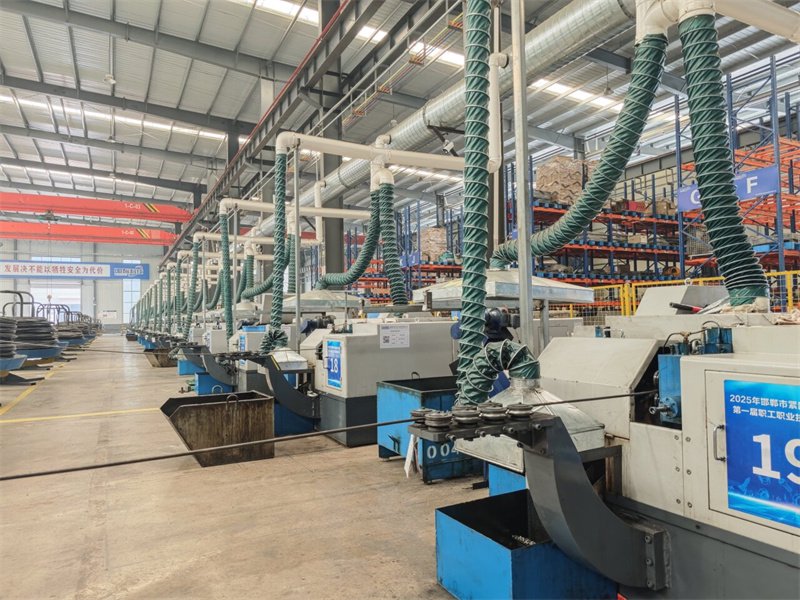
▲ Walk the production floor — look for machine condition, organization, and whether operators are actually following procedures
3. Inspection and Testing Equipment
A supplier can only guarantee what they can measure. Verify their inspection capability.
Essential Equipment
- Thread gauges — go/no-go gauges for all thread sizes they produce. Calibrated? How often?
- Calipers and micrometers — digital, calibrated annually. Do they have enough for the production floor (not just the QC lab)?
- Hardness tester — Rockwell (HRC) for high-strength bolts, Vickers (HV) for thin coatings. Calibrated? With test blocks?
- Tensile testing machine — capacity sufficient for their largest bolt? Can they do proof load, wedge load, and tensile tests?
- Coating thickness gauge — magnetic gauge for zinc/HDG, XRF for zinc flake and multi-layer coatings.
- Salt spray chamber — in-house? If not, do they use a third-party lab regularly?
Advanced Equipment (for critical applications)
- MPI (Magnetic Particle Inspection) — for grade 10.9+ bolts. Wet fluorescent or dry powder? Certified inspectors?
- Spectral analyzer — for verifying raw material chemistry. Portable XRF or bench-top OES?
- Impact tester — Charpy V-notch for low-temperature applications.
- Optical comparator / CMM — for complex geometry and precision parts.
Red Flags
- No hardness tester — they can't verify heat treatment results
- No tensile tester — they rely on the heat treatment shop's data (which may be fabricated)
- Calibration stickers expired or missing on inspection equipment
- "We send samples to a lab in Shanghai" — for every batch? That adds 1-2 weeks to lead time and means they can't do in-process control
4. Raw Material Control
The quality of a bolt starts with the steel. A supplier that doesn't control raw material can't control final quality.
What to Verify
- Approved steel mill list — which mills do they buy from? (Look for reputable mills: Xingtai Steel, Baosteel, Shagang, Xiangsteel. Avoid unknown "trading company" wire rod.)
- Material certificates — EN 10204 3.1 for every coil? Do they verify the chemistry with their own spectral analyzer?
- Raw material inspection — do they inspect every coil on arrival (diameter, surface, chemistry)? Or do they trust the mill cert?
- Material segregation — are different grades stored separately and clearly labeled? Can they show you a grade 8.8 coil and a grade 10.9 coil in separate, labeled locations?
- Traceability from coil to bolt — can they tell you which coil a specific bolt batch came from? This is critical for recalls and failure analysis.
Red Flags
- Buying wire rod from "the market" (traders) with no mill certificate
- No spectral analyzer — they can't verify the steel chemistry matches the cert
- Grades mixed in the same storage area with no physical separation
- "We don't track which coil each batch came from" — no traceability = no recourse if a material-related failure occurs
5. Process Control and Traceability
Consistent quality comes from controlled processes, not inspection at the end.
What to Look For
- Heat treatment records — every furnace load has a temperature chart record? Can they produce records for a specific batch?
- SPC (Statistical Process Control) — are critical dimensions (head height, thread pitch diameter, hardness) monitored with control charts? Or do they only do go/no-go inspection?
- Batch identification — every production batch has a unique batch number? It appears on the carton label, the inspection report, and the packing list?
- Non-conforming product control — how do they handle defective batches? Is there a quarantine area? Are defects analyzed for root cause (8D or 5-Why)?
- Calibration system — all measuring equipment has a calibration label with due date? Calibration records available?
Red Flags
- No heat treatment temperature records — "we set the controller and trust it"
- No SPC — only final inspection, which catches defects after they're made (too late)
- Cartons labeled with handwritten "OK" but no batch number or inspection date
- Defective bolts mixed in with good bolts in the same bin — no segregation
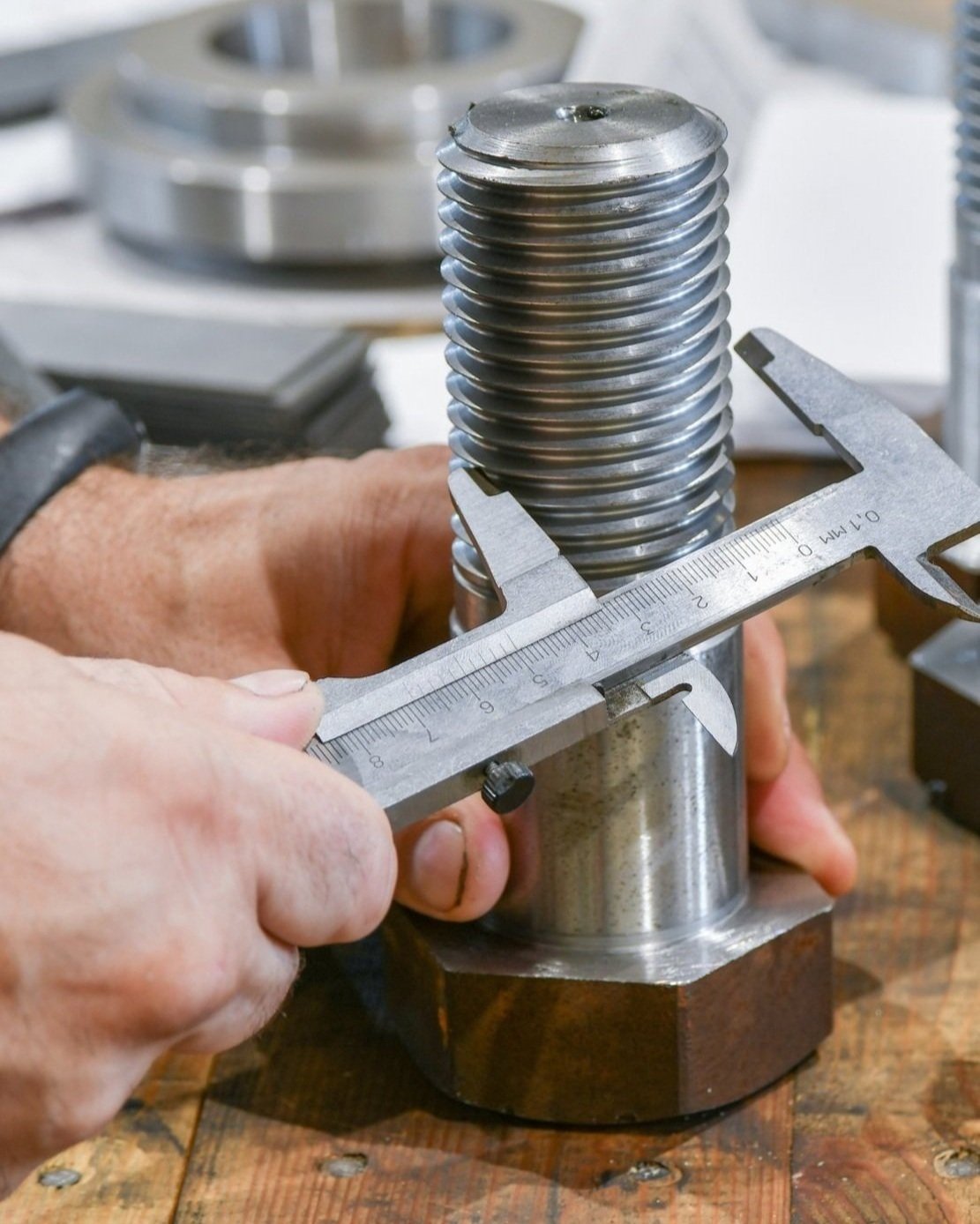
▲ In-process dimensional inspection with calibrated tools — verify that inspection happens during production, not just at the end
6. Operational and Financial Stability
A supplier with great quality but poor financial health may not be around to fulfill your long-term orders.
What to Assess
- Company history — how long have they been in business? (Under 3 years = higher risk. 10+ years = proven stability.)
- Ownership and management — is it a family business with succession planning? Or a single owner with no delegation?
- Export experience — how long have they exported? Which countries? Can they provide references from customers in your region?
- Financial health — are they investing in new equipment? Or running old machines with no capital expenditure? (Ask about recent equipment purchases.)
- Capacity for growth — can they scale up if your order volume doubles? Do they have floor space, equipment, and labor to grow?
Red Flags
- Company less than 3 years old with no experienced management team
- No export experience — they don't understand export packaging, documentation, or communication norms
- Factory looks neglected — broken windows, leaking roofs, piles of scrap everywhere (sign of financial distress or poor management)
- Owner is the only person who can make decisions — no empowered management team (risk if the owner is unavailable)
The Factory Visit: What to Look For
A factory visit is the single most valuable step in supplier evaluation. Here's what I look for when I walk through a fastener factory:
- Organization — is the factory clean and organized? Are tools and materials in designated locations? (5S is a basic indicator of management discipline.)
- Machine condition — are machines clean, maintained, and running? Or are they covered in oil, with visible leaks and broken guards?
- Operator behavior — are operators following procedures? Are they wearing PPE? Do they look engaged or just going through the motions?
- In-process inspection — are operators checking dimensions at the machine? Or do they just run parts and hope QC catches the bad ones?
- Maintenance logs — ask to see the maintenance log for a specific machine. If it's blank or out of date, the machine isn't being maintained.
- Finished goods storage — are finished bolts stored in clean, dry, labeled cartons? Or in open bins on the floor, exposed to dust and moisture?
- Talk to people — ask the production manager about their biggest quality challenge. Ask the QC inspector about the most common defect. Their answers tell you more than any audit checklist.
For more on manufacturing process and quality control, see our bolt manufacturing process guide and IATF 16949 quality control article.
We welcome customer audits at our Handan factory — DIN 931 bolts, grade 10.9 structural bolts, and flange bolts are all produced with full process control and batch traceability.
FAQ
Q: How do I audit a supplier without visiting the factory?
A: A remote audit is less effective than a visit but still valuable. Request: (1) a live video tour of the factory (not a pre-recorded video — ask to see specific machines and areas in real time), (2) copies of actual quality records (heat treatment charts, inspection reports, calibration certificates) for a recent batch, (3) customer references in your country or region — call them and ask about quality consistency, lead time, and communication, (4) a small trial order with third-party inspection (SGS, BV, Intertek) at the factory before shipment. If a supplier refuses any of these, that's a red flag.
Q: What's the minimum acceptable quality system for a fastener supplier?
A: For general industrial fasteners (grade 4.8-8.8, non-critical applications), ISO 9001 with actual process control (heat treatment records, in-process inspection, batch traceability) is sufficient. For high-strength bolts (grade 10.9+), add MPI capability and hardness testing. For automotive, IATF 16949 is mandatory. For structural (buildings, bridges), the supplier should be certified to the applicable structural fastener standard (e.g., ISO 15068, ASTM F3125) and have a documented quality plan for structural products. Never accept "we have ISO 9001" as sufficient without verifying the actual processes behind it.
Q: How many suppliers should I audit for a new product?
A: For a new product or new sourcing region, audit at least 3 suppliers before making a decision. This gives you a basis for comparison — you'll see what "good" looks like and what "average" looks like. Auditing only one supplier means you have no benchmark. After selecting a primary supplier, keep a qualified secondary supplier for backup — single-source dependency is a risk if the primary has quality issues, capacity constraints, or financial problems.
Q: What's the most common reason suppliers fail audits?
A: In my experience, the #1 audit failure is lack of traceability — suppliers can't trace a finished bolt batch back to the raw material coil. This happens because they mix coils from different mills in the same production run, or they don't record which coil was used for which batch. Without traceability, if a quality issue arises, you can't contain the problem (you don't know which other batches might be affected) and you can't do root cause analysis. The #2 failure is lack of in-process control — they only inspect finished goods, which means defects are caught after they're made (too late to prevent the cost of scrap and rework).
Q: How often should I re-audit an existing supplier?
A: For critical suppliers (high-volume, safety-critical parts), re-audit annually — either on-site or remote (document review + video tour). For non-critical suppliers, every 2-3 years is sufficient, plus ongoing performance monitoring (PPM defect rate, on-time delivery, corrective action responsiveness). If a supplier has a major quality issue, do a focused re-audit immediately — don't wait for the scheduled audit. And always do a re-audit if the supplier changes ownership, moves to a new facility, or makes a major process change (new heat treatment furnace, new plating line).
Supplier auditing isn't about checking boxes on a form — it's about verifying that a supplier can consistently deliver the quality you need, at the volume you need, for the long term. The certificate on the wall is the starting point, not the conclusion. Walk the floor, check the records, talk to the people, and verify the processes. Do that, and you'll avoid the sourcing trap that traps so many buyers — a supplier that looks good on paper but can't deliver when it matters.