Key Takeaways
· A standard hex bolt goes through 8+ manufacturing steps: wire rod drawing → annealing → cold heading → thread rolling → heat treatment → surface treatment → inspection → packaging.
· Cold heading forms the bolt head at room temperature in milliseconds — no material is removed, so the grain flow follows the bolt shape, making it stronger than a machined bolt.
· Heat treatment (quenching + tempering) is what transforms a soft formed bolt into a grade 8.8/10.9/12.9 high-strength bolt — without it, the bolt is only grade 4.8.
· Every step affects quality: a defect in raw material, a slight temperature error in heat treatment, or a plating bath out of spec can all lead to field failure months or years later.
Quick Answer
A bolt goes through 7 core steps: wire rod drawing → cold heading → thread rolling → heat treatment → surface coating → inspection → packaging. Skipping or shortcutting any step — especially heat treatment — is where cheap bolts fail.
You hold a bolt in your hand. It's a simple thing — a head, a shank, some threads. But how did it get here? What happened between the iron ore in the ground and this finished piece of hardware?
The answer is more complex than you might think. A single grade 10.9 hex bolt passes through at least 8 manufacturing stages, each with its own parameters, quality checks, and potential failure modes. Skip or shortcut any one of them, and the bolt that looks perfect on the outside may fail catastrophically in service.
Having walked through dozens of fastener factories across China — from small family shops to fully automated plants — I've seen every step of the process. Here's what really happens when a bolt is made.
In 2022, a buyer in Poland received a container of M16 grade 8.8 bolts that passed dimensional inspection but failed hardness testing — 40% of the batch measured HRC 15 instead of the required HRC 22-32. The supplier had skipped the quenching and tempering step, selling as-formed medium-carbon bolts as heat-treated grade 8.8. The buyer had already paid 30% upfront. We traced the issue: the factory had outsourced heat treatment to a third party that cut corners to save €0.02 per bolt. The full batch was rejected. Lesson: always request hardness test reports with every shipment — dimensions alone don't prove the grade.
Cold Heading: Why a $5 Die Saves $5,000
A customer needed M16 flange bolts with a special washer face configuration. Our standard die produced a 0.5mm radius on the flange edge — the customer needed 0.2mm. We made a custom carbide die for $5,200. First sample: perfect. They ordered 200,000 pieces that year. The die paid for itself in the first order. Custom tooling isn't a cost — it's an investment in consistent quality. We keep all customer dies in a dedicated storage area with maintenance records.
Step 1: Raw Material — Wire Rod
It starts with steel wire rod, produced at a steel mill by hot rolling steel billets into coils of 5.5-42mm diameter rod. The wire rod arrives at the fastener factory in coils weighing 1-3 tons each.
The steel grade is critical at this stage:
- Grade 4.8/5.8 — low carbon steel (ML08Al, ML10Al, SWRCH 10A)
- Grade 8.8 — medium carbon steel (ML35, ML37Cr, SWRCH 35K)
- Grade 10.9 — boron steel or medium carbon alloy (ML35VB, 40Cr, SCM435)
- Grade 12.9 — alloy steel (42CrMo, SCM440, ML42CrMo)
Every coil comes with a material certificate (EN 10204 3.1) showing the chemical composition and mechanical properties. Reputable factories test every coil with spectral analysis to verify the chemistry before it enters production. A coil with wrong chemistry — too much carbon, too little manganese — will produce bolts that fail heat treatment or have inconsistent strength.
Common raw material defects: seams (longitudinal cracks from the rolling process), inclusions (non-metallic particles trapped in the steel), and inconsistent diameter. These defects become visible later — during cold heading (seams open up) or in service (inclusions become crack initiation points).
Step 2: Wire Drawing
The wire rod is too thick and too rough for cold heading. It's pulled through a series of tungsten carbide dies to reduce the diameter to the exact size needed for the bolt shank. Each die reduces the diameter by 10-20%, so a 16mm bolt might require 3-4 drawing passes from 22mm rod.
Drawing also work-hardens the wire, increasing its strength but making it more brittle. For high-strength bolts, the wire may need intermediate annealing (softening) between drawing passes to prevent cracking.
The final drawn wire must have a diameter within ±0.05mm of the target. Too thick and it won't fit in the heading dies; too thin and the bolt head won't form properly (underfilled head) or the threads will be undersized.
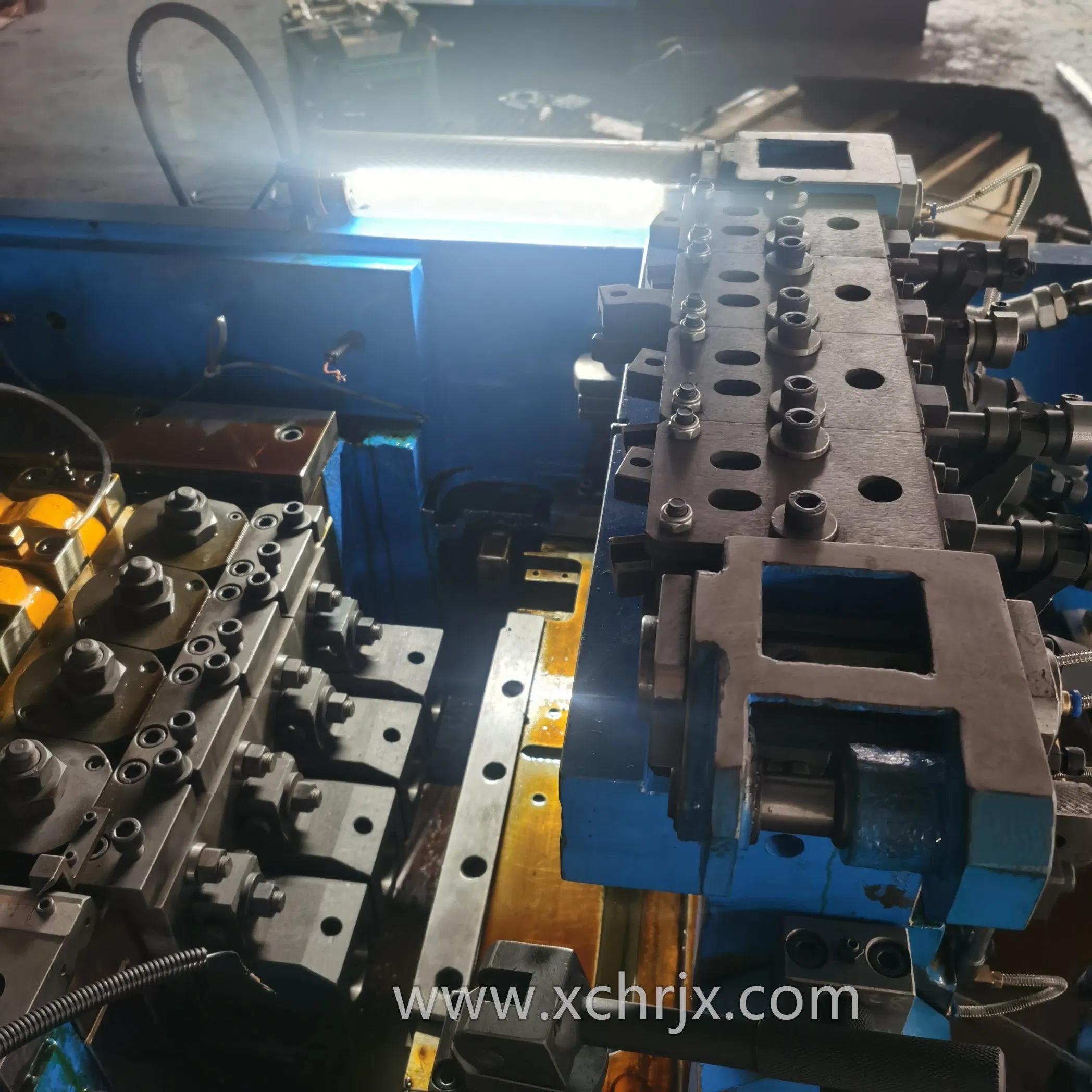
▲ Multi-station cold heading machine — each station performs one forming operation, completing a bolt head in 3-5 steps at 60-200 pieces per minute
Step 3: Cold Heading — Forming the Head
Cold heading is the heart of bolt manufacturing. The drawn wire is cut to length, fed into a multi-station header, and struck with punches at room temperature to form the head. A typical 4-station header does:
- Upsetting — the end of the wire is squashed to form a preliminary head shape
- Pre-forming — the preliminary head is shaped closer to the final hex form
- Final forming — the hex head is formed to final dimensions in a die
- Trimming / piercing — excess material is trimmed (for some bolt types) or the head is pierced (for socket head bolts)
The entire process takes 0.3-1 seconds per bolt, with modern headers running at 60-200 pieces per minute. The force involved is enormous — a header forming M20 bolts applies 200-400 tons of force.
Cold heading is preferred over machining because:
- No material waste — the head is formed by moving material, not cutting it. A machined bolt wastes 30-40% of the material as chips.
- Better grain flow — the steel's grain structure follows the bolt's shape, creating a stronger, more fatigue-resistant part. Machining cuts across the grain, weakening the part.
- Higher production speed — a header makes 60-200 bolts per minute; a CNC lathe makes 2-5 per minute.
Common cold heading defects: underfilled head (insufficient material or wrong die), folded material (lap), cracks (from brittle wire or excessive reduction), and eccentric head (misaligned dies). These are caught by visual inspection and dimensional checks after heading.
Step 4: Thread Rolling
With the head formed, the bolt moves to thread rolling. Two hardened steel dies (flat or cylindrical) press against the shank, displacing material to form the threads. Like cold heading, thread rolling is a cold-forming process — no material is removed.
Thread rolling produces threads that are stronger than cut threads because:
- The grain flow follows the thread profile, not cut across it
- The thread surface is work-hardened, increasing hardness and wear resistance
- The thread root has a smooth, compressive residual stress layer, improving fatigue resistance
The dies must be matched to the thread specification: metric coarse (M), metric fine (MF), UNC, UNF, etc. Die wear is monitored — after 50,000-200,000 pieces, the dies start to wear and produce out-of-tolerance threads. Thread rolling dies are checked regularly with thread gauges and replaced when worn.
After thread rolling, the bolt is now dimensionally complete — but it's still soft (grade 4.8 at best). It needs heat treatment to become a high-strength bolt.
Step 5: Heat Treatment — Quenching and Tempering
This is the step that transforms a soft formed bolt into a grade 8.8, 10.9, or 12.9 high-strength bolt. It's also the step where the most damage can be done if not controlled precisely.
The process:
- Austenitizing — bolts are heated in a continuous mesh-belt furnace to 830-880°C (depending on steel grade) for 30-60 minutes. At this temperature, the steel transforms to austenite, a face-centered cubic structure that can dissolve carbon.
- Quenching — the hot bolts are rapidly cooled by dropping into oil (or polymer quenchant) at 40-80°C. The rapid cooling transforms the austenite to martensite — a hard, brittle phase. The bolts are now very hard (HRC 50+) but also very brittle.
- Tempering — the quenched bolts are reheated to 400-650°C (depending on target grade) for 60-120 minutes. Tempering reduces hardness and brittleness while increasing toughness. The exact tempering temperature determines the final grade: lower temper = higher hardness (grade 12.9), higher temper = lower hardness but better toughness (grade 8.8).
Heat treatment parameters must be controlled within tight limits:
- Temperature ±5°C — too hot and the steel grain grows (weakening); too cold and the austenitizing is incomplete
- Quench oil temperature and agitation — affects cooling rate and hardness uniformity
- Tempering time and temperature — determines final hardness and toughness balance
- Atmosphere control — prevents decarburization (loss of carbon from the surface, which reduces hardness and strength)
The most dangerous heat treatment defect is quench cracking — if the bolt cools too fast or has a stress concentration, thermal stress can cause cracks. These cracks are invisible to the naked eye but can cause catastrophic failure in service. Magnetic Particle Inspection (MPI) after heat treatment catches them. See our MPI inspection guide for details.
▲ Hot-dip galvanizing — bolts are dipped in molten zinc at 450°C, creating a thick corrosion-resistant layer that can last 20-40 years outdoors
Step 6: Surface Treatment
Heat-treated bolts are bare steel — they'll rust in days if not coated. Surface treatment applies a protective layer:
Electroplating (Zinc)
Bolts are cleaned (degreased, acid pickled), then plated in a zinc electrolytic bath. The zinc layer is 5-15 microns thick, followed by a passivate (clear, yellow, or black) to improve corrosion resistance. Total process time: 2-4 hours per batch.
Risk: hydrogen embrittlement — the pickling and plating process introduces hydrogen into the steel. For grade 10.9+ bolts, mandatory post-plating baking (190-230°C for 8-24 hours) removes the hydrogen. See our hydrogen embrittlement guide.
Hot-Dip Galvanizing (HDG)
Bolts are pickled, fluxed, then dipped in molten zinc at 450°C for 1-5 minutes. The zinc reacts with the steel to form a thick alloy layer (45-85 microns). HDG provides excellent corrosion resistance (20-40 years outdoors) but the thick coating can affect thread fit — HDG nuts are typically over-tapped to accommodate.
Zinc Flake (Dacromet, Geomet, Magni)
Bolts are sprayed or dipped in a water-based zinc-aluminum flake coating, then cured at 200-300°C. The coating is 8-15 microns thick, provides 500-1,500 hours salt spray resistance, and introduces no hydrogen (safe for high-strength bolts). Increasingly specified for automotive and wind energy applications.
For a detailed coating comparison, see our fastener coatings guide.
Step 7: Inspection and Quality Control
Before packaging, every batch of bolts undergoes inspection:
- Dimensional inspection — thread go/no-go gauges, length, head height, head diameter, wrench size. AQL 2.5 sampling for standard bolts, 100% for critical applications.
- Hardness testing — Rockwell (HRC) or Vickers (HV) on sample bolts. Verifies heat treatment achieved the target grade.
- Tensile testing — destructive test on sample bolts to verify ultimate tensile strength, yield strength, and elongation.
- Coating thickness — magnetic gauge or XRF to verify plating/coating meets specification.
- Salt spray testing — for coated bolts, verify corrosion resistance per ASTM B117.
- MPI (Magnetic Particle Inspection) — for grade 10.9+ critical bolts, detect quench cracks.
- Head marking verification — ensure grade marking and manufacturer logo are present and correct.
We supply DIN 931 hex bolts and grade 10.9 structural bolts with full inspection reports and material certificates for every batch.
Step 8: Packaging and Shipping
The final step: bolts are counted, packed in cartons (typically 25kg per carton for M12-M20), labeled with part number, grade, quantity, batch number, and production date, and palletized for shipping. For export, cartons are strapped and stretch-wrapped on wooden pallets, with a packing list and commercial invoice for customs.
A Day on the Cold Heading Floor
Our cold heading shop has 28 multi-station bolt formers, ranging from 5mm to 24mm capacity. The biggest is a 6-station machine that runs M24 bolts at 75 pieces per minute. Each station has a carbide die — the first station upsets the head, the second pre-forms, the third finishes the hex, and so on. A die set costs $3,000-$8,000 and lasts about 500,000 pieces. When a die starts to wear, you see it in the head profile — a slight rounding on the hex corners. Our operators do a visual check every 30 minutes and pull the first piece off each machine for dimensional inspection every 2 hours.
Thread rolling happens next — on flat-die or cylindrical die machines, depending on size. The dies are hardened to HRC 62 and the rolling pressure is calibrated to produce a thread with proper flank angle. We check thread profile with an optical comparator on the first article, and keep the overlay chart signed by the operator and QC. If the pitch diameter drifts more than 0.02mm, we stop and re-dress the dies.
FAQ
Q: Why are cold-headed bolts stronger than machined bolts?
A: Cold heading forms the bolt by moving material at room temperature, which preserves and redirects the steel's grain flow to follow the bolt's shape — especially around the head-to-shank transition, the highest stress area. Machining cuts across the grain structure, creating stress concentrations and reducing fatigue strength. Cold-headed bolts also have a smooth, work-hardened surface that resists corrosion initiation. For the same material and heat treatment, a cold-headed bolt has 10-30% better fatigue resistance than a machined bolt. This is why all high-volume standard bolts are cold-headed — machining is only used for very large bolts (above M48-M64) or custom parts where cold heading tooling isn't economical.
Q: What happens if heat treatment temperature is wrong?
A: If the austenitizing temperature is too low, the steel doesn't fully transform to austenite, and after quenching the bolt will have a mixture of hard martensite and soft untransformed ferrite — inconsistent hardness and low strength. If too high, the steel grains grow excessively, making the bolt brittle. If the tempering temperature is too low, the bolt is too hard and brittle (risk of hydrogen embrittlement and impact failure). If too high, the bolt is too soft (below the target grade). Modern continuous furnaces have temperature controlled to ±5°C with chart recorders, but older or poorly maintained furnaces can have hot spots or temperature drift that produce out-of-spec bolts. Always request hardness test data for high-strength bolts.
Q: Can you tell the manufacturing quality by looking at a bolt?
A: Partially. A well-made bolt has clean, sharp hex corners, smooth threads with no torn or folded material, a clear and deep grade marking, and a uniform coating with no bare spots or drips. A poorly made bolt may have rounded hex corners (worn heading dies), torn threads (worn rolling dies), faint or missing grade markings (worn stamping), and uneven coating (poor plating process). But visual inspection can't catch internal defects — inclusions, quench cracks, decarburization, or wrong material grade. For critical applications, always request test reports (hardness, tensile, material cert) and consider third-party inspection.
Q: How long does it take to manufacture a bolt from raw material?
A: For standard bolts (DIN 931, grade 8.8, zinc plated) in a factory with all processes in-house: wire drawing 1-2 days, cold heading + thread rolling 1 day, heat treatment 1 day, plating 1-2 days, inspection + packaging 1 day. Total: 5-7 working days for a standard production run. For custom bolts (new tooling), add 5-10 days for die making and first article samples. For HDG coating, add 2-3 days (HDG is often done by a subcontractor). For large orders (full container), the production may be spread over 2-3 weeks due to furnace and plating capacity.
Q: What's the difference between a bolt made in a modern automated factory vs. a small workshop?
A: The raw material and basic processes are similar, but the control and consistency differ dramatically. Modern factories use continuous mesh-belt furnaces with computer-controlled temperature and atmosphere, automated thread rollers with die wear monitoring, in-line inspection with vision systems, and full batch traceability. Small workshops may use batch furnaces with manual temperature control, manual thread rolling with less frequent die changes, and visual-only inspection. The result: a modern factory's bolts have consistent hardness (±2 HRC), consistent dimensions, and full traceability. A small workshop's bolts may have wider hardness variation (±5 HRC), more dimensional variation, and limited traceability. For non-critical applications, both may work. For structural, automotive, or safety-critical applications, the factory's process control is as important as the bolt's material spec.
A bolt is a simple-looking object with a surprisingly complex manufacturing story. Every step — from the chemistry of the steel to the temperature of the quench oil to the thickness of the zinc coating — affects whether that bolt will hold for 30 years or fail in 3 months. When you buy fasteners, you're not just buying metal — you're buying the process control and quality discipline of the factory that made them. Choose accordingly.