
Key Takeaways
· Hydrogen embrittlement (HE) is a delayed fracture mechanism in high-strength steel — a bolt can break weeks or months after plating, with no warning and at loads below its rated capacity.
· HE risk increases with strength: grade 8.8 is low risk, grade 10.9 is moderate, grade 12.9 is high risk. Above HRC 39, HE becomes a serious concern for any plated fastener.
· Electroplating (zinc, cadmium) and acid pickling introduce hydrogen. The fix is post-plating baking at 190-230°C for 8-24 hours, started within 4 hours of plating.
· Zinc flake coatings (Dacromet, Geomet, Magni) introduce no hydrogen and are the preferred coating for grade 10.9+ bolts — eliminating HE risk at the source.
Quick Answer
Hydrogen embrittlement (HE) is the #1 cause of unexplained high-strength bolt failures. It happens when hydrogen from plating/acid processes diffuses into hardened steel (grade 10.9+), causing delayed fracture days or weeks after installation — at loads below rated capacity. Prevention: bake after plating, or use zinc flake coating.
A grade 12.9 bolt is installed in a mining machine. It passes inspection. It's torqued to spec. Three weeks later, it snaps — cleanly, with no visible deformation, no warning, at 60% of its rated load. The failure analysis comes back: hydrogen embrittlement.
This is the nightmare scenario for high-strength fastener users. Hydrogen embrittlement (HE) is insidious — it doesn't show up in standard inspection, it doesn't cause visible damage, and it can strike weeks or months after the bolt is installed. The bolt that passed every quality check can fail catastrophically without warning.
Having investigated multiple HE failures in the field — from construction equipment to oil and gas pipelines to wind turbine bolts — I've learned that HE is preventable, but only if every step in the process is controlled. Here's what you need to know.
A wind farm in Denmark installed 4,000 grade 10.9 HDG bolts on turbine foundations in 2021. The plater skipped the post-galvanizing bake to save time. Four months later, 17 bolts fractured at the thread runout — classic intergranular HE fracture. Each bolt replacement required lifting the turbine nacelle (€28,000 per turbine). The plater's "time savings"? About 4 hours per batch. The total remediation cost exceeded €475,000. Mandatory baking at 200°C for 16 hours would have prevented every failure.
Hydrogen Embrittlement: The 6-Week Time Bomb
A customer in Korea used electroplated 12.9级 bolts for a crane boom. Six weeks after installation, 3 bolts snapped — no warning, no overload. Hydrogen embrittlement: the electroplating process introduced atomic hydrogen, which diffused to the grain boundaries over 6 weeks. We re-supplied with zinc-flake coating (zero hydrogen process) and added a 200°C 16-hour bake for any electroplated high-strength bolts. Hydrogen embrittlement doesn't fail at installation — it fails when you least expect it.
What Is Hydrogen Embrittlement?
Hydrogen embrittlement is a process where atomic hydrogen diffuses into high-strength steel and reduces its ductility and fracture toughness. The hydrogen atoms accumulate at grain boundaries and inclusions, creating internal pressure that, combined with tensile stress, causes the steel to fracture along grain boundaries (intergranular fracture).
Key characteristics of HE:
- Delayed failure — the bolt may not fail immediately. Hydrogen takes time to diffuse and accumulate at critical locations. Failure can occur hours, days, weeks, or even months after the hydrogen is introduced.
- Static load dependence — HE requires tensile stress. A bolt under no load (sitting in a box) won't fail from HE. A bolt under sustained tensile load (installed and torqued) is at risk. The higher the stress, the faster the failure.
- No plastic deformation — HE fractures are brittle — the bolt snaps cleanly with no necking or bending. This is how you distinguish HE from overload failure (which shows necking and deformation).
- Intergranular fracture — under a scanning electron microscope (SEM), HE fractures show a characteristic "rock candy" intergranular pattern — the crack follows the grain boundaries rather than cutting through grains.
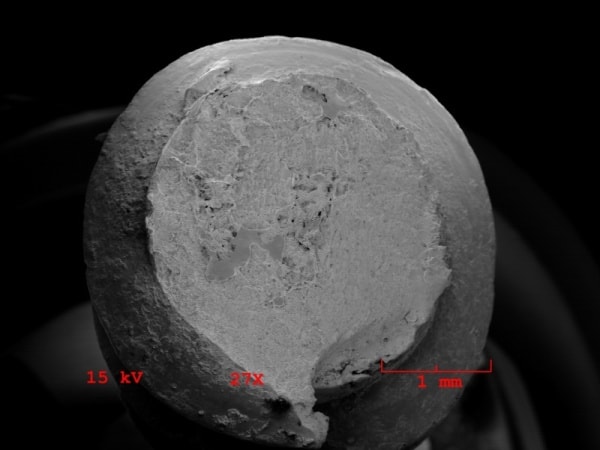
▲ Intergranular fracture surface under SEM — the "rock candy" pattern is characteristic of hydrogen embrittlement, distinct from ductile overload fracture
Where Does the Hydrogen Come From?
Hydrogen can enter the steel at several stages of the fastener's life:
1. Pickling (Acid Cleaning)
Before plating or coating, bolts are cleaned in acid (hydrochloric or sulfuric acid) to remove rust and scale. This acid cleaning generates atomic hydrogen that can diffuse into the steel. The longer the pickling time and the stronger the acid, the more hydrogen enters.
2. Electroplating
Zinc electroplating, cadmium plating, and nickel plating all involve electrolytic processes that generate hydrogen at the cathode (the bolt). This is the most significant source of hydrogen in plated fasteners. The hydrogen is generated during plating and can be trapped under the coating.
3. Phosphating
Zinc or manganese phosphating (used as a paint base or lubricant coating) involves acid solutions that can introduce hydrogen, though less than electroplating.
4. Corrosion in Service
Once installed, a steel bolt corrodes (rusts). The corrosion reaction generates hydrogen, which can diffuse into the steel. This is called "environmental hydrogen embrittlement" and is a concern for high-strength bolts in corrosive environments (coastal, industrial, road salt).
5. Welding and Heat Treatment
Welding near high-strength bolts can introduce hydrogen from the welding consumables. Improper heat treatment (wet furnace atmosphere, contaminated quench oil) can also introduce hydrogen.
Which Bolts Are at Risk?
HE risk is directly related to the steel's strength (hardness):
| Bolt Grade | Typical Hardness | HE Risk | Required Action |
|---|---|---|---|
| 4.6 / 4.8 / 5.8 | HRC < 25 | Very low | None |
| 8.8 | HRC 22-32 | Low | Baking recommended for electroplated |
| 10.9 | HRC 32-39 | Moderate | Mandatory baking after plating; consider zinc flake |
| 12.9 | HRC 39-44 | High | Mandatory baking; zinc flake preferred; avoid electroplating |
| 14.9 / specialty | HRC > 44 | Very high | No electroplating; zinc flake or mechanical plating only |
The industry rule of thumb: above HRC 39 (roughly grade 12.9), any electroplated fastener is at serious risk of HE unless properly baked. Many standards (ASTM F1941, ISO 4042, ASTM B633) mandate baking for plated fasteners above HRC 31-36 depending on the standard.
Prevention: The Baking Process
The primary defense against HE from plating is post-plating baking — heating the plated bolts to drive hydrogen out of the steel.
Baking Parameters
- Temperature: 190-230°C (375-450°F). Too low and hydrogen doesn't diffuse out; too high and the coating may be damaged (zinc plating can peel or discolor above 250°C).
- Duration: 8-24 hours depending on hardness and coating. Grade 10.9: minimum 8 hours. Grade 12.9: minimum 12-24 hours.
- Timing: baking must begin within 4 hours of plating completion (some standards say within 1 hour for grade 12.9). Hydrogen starts causing damage immediately — the longer you wait, the more likely irreversible damage has occurred.
- Oven type: forced-air convection oven for uniform temperature. The oven must have temperature chart recording for every batch.
Why Baking Works
At 190-230°C, hydrogen atoms in the steel gain enough energy to diffuse out to the surface, where they combine into H₂ molecules and escape. The longer the bake, the more hydrogen is removed. For high-strength steel, 8-24 hours at temperature removes 90%+ of the diffusible hydrogen.
Baking Verification
How do you know baking was done correctly?
- Request the baking oven temperature chart for your specific batch — it should show the oven reached and maintained the required temperature for the full duration.
- Verify the timing — the plating completion time and baking start time should be within 4 hours.
- For critical applications, specify hydrogen embrittlement testing (e.g., ASTM F519 sustained load test, or ISO 15330 incremental step loading).
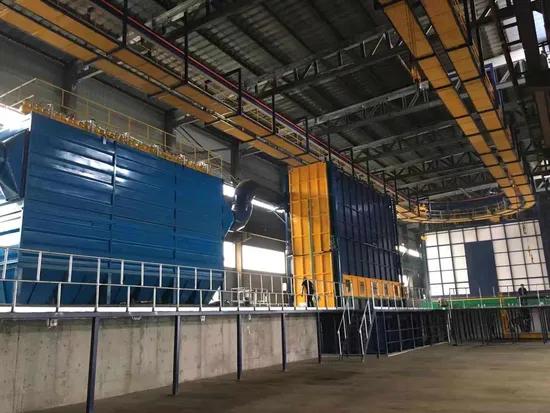
▲ Zinc flake coating lines — these coatings are applied by spraying or dipping and cured at 200-300°C, introducing no hydrogen and eliminating HE risk
Better Prevention: Avoid Hydrogen Altogether
Baking is a mitigation — it removes hydrogen after it's been introduced. A better approach is to use coating processes that don't introduce hydrogen in the first place:
Zinc Flake Coatings (Dacromet, Geomet, Magni, Delta Tone)
Zinc flake coatings are applied by spraying or dipping the bolts in a water-based zinc-aluminum flake slurry, then curing at 200-300°C. There's no acid pickling and no electrolytic process — so no hydrogen is introduced. These coatings provide 500-1,500 hours salt spray resistance and are the preferred choice for grade 10.9+ bolts in automotive, wind energy, and construction.
We supply grade 10.9 flange bolts and grade 10.9 structural bolts with zinc flake coating (Geomet or equivalent) — no hydrogen, no baking required.
Hot-Dip Galvanizing (HDG)
HDG involves acid pickling (which introduces hydrogen) but the subsequent immersion in molten zinc at 450°C effectively bakes the hydrogen out. But here's the catch: for grade 12.9 bolts, HDG can still cause HE because the pickling introduces hydrogen and the zinc bath temperature may not fully remove it before the zinc coating seals it in. For grade 12.9, specify post-HDG baking or use zinc flake instead.
Mechanical Plating
Mechanical plating uses glass beads to cold-weld zinc powder onto the bolt surface — no electrolysis, no acid pickling (only mild acid activation), so minimal hydrogen. It's an option for small fasteners but less common for structural bolts.
Zinc-Nickel Plating
Zinc-nickel (ZnNi) plating introduces hydrogen like other electroplatings, but the alloy is more resistant to hydrogen trapping. Baking is still required for high-strength bolts, but the HE risk is lower than with pure zinc plating.
For more on coating selection, see our fastener coatings guide.
HE in Service: Environmental Hydrogen
Even if a bolt is properly coated and baked, it can still suffer from HE in service if exposed to corrosive environments. The corrosion reaction (rusting) generates hydrogen at the steel surface, which can diffuse into high-strength steel.
This is called "hydrogen stress cracking" or "environmental hydrogen embrittlement." It's a concern for:
- Grade 10.9+ bolts in coastal areas (salt spray accelerates corrosion)
- Grade 10.9+ bolts in areas with road salt (de-icing chemicals)
- Grade 10.9+ bolts in acidic environments (chemical plants, mines)
- Cathodically protected structures (the cathodic protection current generates hydrogen at the bolt surface)
Prevention for service HE:
- Use a coating with excellent corrosion resistance (zinc flake, HDG, or stainless steel) to minimize the corrosion rate
- Limit the operating stress to below 60% of yield for grade 12.9 bolts in corrosive environments
- Consider using A4-80 stainless steel instead of carbon steel for very corrosive environments — stainless isn't susceptible to HE (it's not high-strength martensitic steel)
- For cathodically protected structures, limit the protection potential to -850mV (Cu/CuSO4) to avoid excessive hydrogen generation
How to Identify HE Failures
If a high-strength bolt fails in service, here's how to determine if HE is the cause:
- Visual inspection — HE fractures are brittle with no necking or plastic deformation. The fracture surface is flat and granular. Overload failures show necking and a shear lip.
- Fracture location — HE typically initiates at the thread root (highest stress concentration) or under the head. The fracture origin is often at a corrosion pit or plating defect.
- SEM analysis — the gold standard. HE fractures show intergranular (rock candy) morphology near the origin, possibly transitioning to transgranular ductile fracture further from the origin.
- Hardness testing — if the bolt hardness exceeds HRC 39, HE is a likely cause. If below HRC 32, HE is unlikely (look for other causes like overload or fatigue).
- Hydrogen measurement — specialized tests (thermal desorption analysis, TDA) can measure residual hydrogen in the steel. Values above 1-2 ppm are concerning for high-strength steel.
For more on high-strength bolt failures, see our article on unexplained high-strength bolt failures and MPI inspection guide.
Our Hydrogen Bake Process — Step by Step
After electroplating, every grade 10.9 and 12.9 bolt goes into a forced-air bake oven at 200°C for 16 hours. Not 4 hours. Not 8 hours. 16 hours. The oven has 6 thermocouples at different heights, and we require all six to read within ±5°C of setpoint. If one thermocouple reads 192°C, the batch doesn't pass — we extend the bake and re-document.
Why so strict? Hydrogen diffusion in boron steel follows an exponential curve. At 200°C, the first 4 hours remove about 60% of diffusible hydrogen. The next 12 hours remove another 30%. That last 10% is what causes the bolt to snap 6 weeks after installation — when your customer's crane is lifting a 40-ton load. We also avoid electroplating entirely for grade 12.9 — we use zinc flake coating instead, which introduces zero hydrogen. It costs more, but the alternative is a failure that makes the news.
FAQ
Q: Can hydrogen embrittlement be reversed once it occurs?
A: If the bolt hasn't fractured yet, baking at 190-230°C for 8-24 hours can remove diffusible hydrogen and restore most of the ductility. But here's the catch: if micro-cracks have already formed (even sub-microscopic cracks that aren't visible), baking won't repair them — the bolt has been permanently damaged and should be replaced. This is why baking must happen immediately after plating, before the hydrogen has time to cause cracking. For installed bolts suspected of HE exposure, replacement is the safest option — don't try to bake them in place.
Q: Are stainless steel bolts susceptible to hydrogen embrittlement?
A: Austenitic stainless steel (304, 316) is generally not susceptible to HE because it's not high-strength martensitic steel — it has a face-centered cubic structure that doesn't trap hydrogen easily. But here's the catch: cold-worked stainless (A4-80, which is work-hardened) can be slightly susceptible in very severe hydrogen environments, but this is rare. Martensitic stainless (410, 420) and precipitation-hardening stainless (17-4 PH) ARE susceptible to HE when heat treated to high hardness (above HRC 35). For most fastener applications, austenitic stainless (A2-70, A4-80) is HE-safe.
Q: What's the difference between hydrogen embrittlement and stress corrosion cracking (SCC)?
A: Both are delayed fracture mechanisms in high-strength steel under tensile stress, but the mechanisms differ: HE is caused by hydrogen atoms diffusing into the steel and reducing ductility — the hydrogen can come from plating, pickling, or corrosion. SCC is caused by a corrosive environment (e.g., chloride, H2S) attacking the steel at stress concentrations, causing crack initiation and propagation. In practice, they often occur together — corrosion generates hydrogen (HE) and also causes direct corrosion cracking (SCC). The prevention is similar: use corrosion-resistant coatings, limit operating stress, and avoid high-strength steel in severe corrosive environments.
Q: How do I specify HE prevention on my purchase order?
A: For grade 10.9+ bolts with electroplating, specify: "Post-plating baking per ASTM F1941 / ISO 4042: 190-230°C for minimum 8 hours (grade 10.9) or 12 hours (grade 12.9), commenced within 4 hours of plating completion. Provide baking oven temperature chart for each batch." Better yet, specify zinc flake coating instead: "Zinc flake coating (Geomet 500B or equivalent), 8-15 microns, minimum 500 hours salt spray per ASTM B117. No electroplating — coating must be hydrogen-free per ASTM F3149." Always specify the bolt hardness limit: "Hardness not to exceed HRC 39 for grade 10.9, HRC 44 for grade 12.9."
Q: Can I test bolts for hydrogen embrittlement before installation?
A: Yes — several standardized tests can verify HE resistance: (1) ASTM F519 — sustained load test using a notched specimen loaded to 75% of yield for 200 hours; if it doesn't break, it passes. (2) ISO 15330 — incremental step loading test, faster than F519 (takes ~24 hours). (3) ASTM F1624 — incremental step loading for high-strength steel. These tests are destructive (they test sample bolts, not the whole batch) and are typically specified for critical applications (aerospace, oil and gas, wind energy). For most industrial applications, verifying the baking process (temperature chart, timing, oven calibration) is sufficient.
Hydrogen embrittlement is the silent killer of high-strength fasteners. It doesn't announce itself, it doesn't show up in routine inspection, and it can cause catastrophic failure at loads the bolt was designed to handle. But it's entirely preventable: know your hardness limits, specify the right coating (zinc flake for 10.9+), mandate and verify post-plating baking, and limit operating stress in corrosive environments. Do that, and your high-strength bolts will perform as designed — for decades, not weeks.
Need a Quote? Talk to Our Fastener Engineers
Email: [email protected]
WhatsApp / Phone: +86 185 3100 9807
Factory: No. 668 Longyuan Street, Yongnian District, Handan City, Hebei Province, China
✅ 180-day free warehouse storage | ✅ 96-hour stock delivery | ✅ Mixed container small orders | ✅ ISO 9001 / 14001 / 45001 certified