Key Takeaways
· Magnetic Particle Inspection (MPI) detects surface and near-surface cracks in ferromagnetic fasteners — it's the most effective NDT method for catching quench cracks in high-strength bolts.
· MPI only works on ferromagnetic materials (carbon steel, alloy steel grades 8.8/10.9/12.9). It cannot inspect stainless steel (304/316), aluminum, or titanium fasteners.
· Quench cracks form during heat treatment when the bolt cools too fast — they're invisible to the naked eye but can cause catastrophic failure under load. MPI catches them.
· For critical applications (structural, automotive, aerospace), specify 100% MPI on grade 10.9+ bolts. The cost is typically 3-8% of unit price, but it prevents field failures.
Quick Answer
Magnetic Particle Inspection (MPI) detects surface and near-surface cracks in ferromagnetic bolts. It's mandatory for grade 10.9+ structural bolts and should be specified after heat treatment (before plating) to catch quench cracks — the most dangerous defect in high-strength fasteners.
You receive a shipment of grade 10.9 bolts. They look perfect — shiny zinc plating, clean threads, proper head markings. You install them in a structural connection. Three months later, one snaps. The failure analysis reveals a quench crack — a tiny fissure that formed during heat treatment, invisible to the naked eye, that propagated under load until the bolt fractured.
This is the scenario that Magnetic Particle Inspection (MPI) is designed to prevent. MPI is a nondestructive testing method that finds surface and near-surface cracks in ferromagnetic materials — cracks that you can't see, can't feel, and can't detect with dimensional inspection. For high-strength fasteners, it's one of the most important quality checks you can specify.
I've seen MPI save projects from disaster. I've also seen buyers skip it to save a few cents per bolt, only to pay thousands in field failures. Here's what you need to know.
A bridge project in Canada once skipped MPI on grade 10.9 bolts to save $0.08 per bolt (100% MPI adds about 5-15% to unit cost). Eighteen months after opening, a routine inspection found a 3mm crack in a primary connection bolt. Further MPI of 500 bolts revealed 7 with quench cracks — all from the same heat treatment batch. The emergency closure and bolt replacement cost CAD 2.3 million. The MPI savings? About CAD 4,800. Every structural engineer I know calls MPI "cheap insurance" — because it is.
MPI Caught a $25,000 Failure Before It Left the Factory
We run magnetic particle inspection on 100% of grade 10.9 structural bolts. One Tuesday morning, the reject rate jumped from 0.5% to 2.1%. We traced it to furnace #3 — a thermocouple had drifted 15°C low, causing incomplete quenching. We held the entire batch (12,000 bolts), re-heat-treated them, and re-inspected. The customer never knew, but if those bolts had reached a bridge site, the failure could have cost $25,000 or worse. MPI isn't optional for high-strength bolts.
How MPI Works
MPI exploits a fundamental property of ferromagnetic materials: when a crack interrupts the magnetic field, the field "leaks" out at the crack location. Here's the process:
- Magnetize — The bolt is magnetized, either by passing an electric current through it (direct magnetization) or by placing it in a magnetic field (indirect magnetization). This creates a magnetic flux through the bolt.
- Apply particles — Fine iron particles (dry powder or wet suspension in a liquid carrier) are applied to the bolt surface. These particles are often coated with a fluorescent dye for UV inspection.
- Indication — If there's a surface or near-surface crack, the magnetic field leaks out at the crack. The iron particles are attracted to this leakage field, building up a visible "indication" that traces the crack shape.
- Inspect — The inspector examines the bolt under white light (for visible particles) or UV black light (for fluorescent particles). Any crack indications are measured, recorded, and evaluated against acceptance criteria.
- Demagnetize — After inspection, the bolt is demagnetized to remove residual magnetism, which could interfere with subsequent operations (e.g., plating, welding, or attracting metal chips in service).
The whole process takes a few seconds per bolt for a trained operator on a production MPI machine. For high-volume production, automated MPI machines can inspect hundreds of bolts per hour.
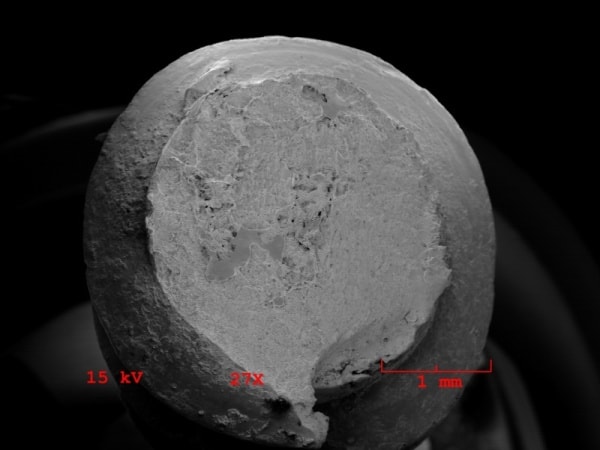
▲ A crack like this — visible only under a scanning electron microscope — is exactly what MPI detects before the bolt reaches the field
What MPI Finds (and What It Doesn't)
What MPI Detects
- Quench cracks — formed during heat treatment when the bolt cools too rapidly. The most common and most dangerous defect in high-strength bolts.
- Forging laps and folds — defects from the cold heading process where material folds over on itself.
- Grinding cracks — formed during thread grinding or surface grinding due to excessive heat.
- Seams and inclusions — elongated defects from the raw material (steel wire rod) that become exposed during heading.
- Fatigue cracks — for used bolts being inspected during maintenance, MPI detects cracks that have initiated from cyclic loading.
What MPI Cannot Detect
- Internal defects — MPI only finds surface and near-surface cracks (up to ~2mm deep). Internal voids, inclusions, or cracks deeper in the material require ultrasonic testing (UT) or radiographic testing (RT).
- Non-ferromagnetic materials — MPI doesn't work on stainless steel (304/316 austenitic), aluminum, titanium, brass, or plastic. For these, use dye penetrant inspection (PT) or eddy current (ET).
- Non-crack defects — MPI doesn't measure dimensional accuracy, hardness, coating thickness, or material composition. It's a crack detection tool, not a comprehensive inspection.
Why Quench Cracks Matter
Quench cracks are the #1 reason to specify MPI for high-strength fasteners. Here's how they form:
During heat treatment, a grade 10.9 bolt is heated to ~850°C (austenitizing) and then rapidly quenched in oil or polymer to harden it. If the cooling rate is too fast — or if the bolt has a stress concentration (sharp corner under the head, thread root, or a material inclusion) — thermal stress can exceed the material's tensile strength, and a crack forms.
These cracks are typically:
- Very fine (hairline width, often less than 0.01mm)
- Located at stress concentrations (underhead radius, thread runout, first engaged thread)
- Invisible to the naked eye, especially after plating
- Oriented longitudinally or transversely depending on the stress pattern
A bolt with a quench crack may pass dimensional inspection, hardness testing, and even proof load testing — because the crack hasn't propagated yet. But once in service, under cyclic load or stress corrosion, the crack grows. Eventually, the remaining cross-section can't carry the load, and the bolt fractures — often with no warning.
This is why MPI is mandatory for grade 10.9 and 12.9 bolts in structural, automotive, and aerospace applications. For more on high-strength bolt failures, see our article on unexplained high-strength bolt failures.
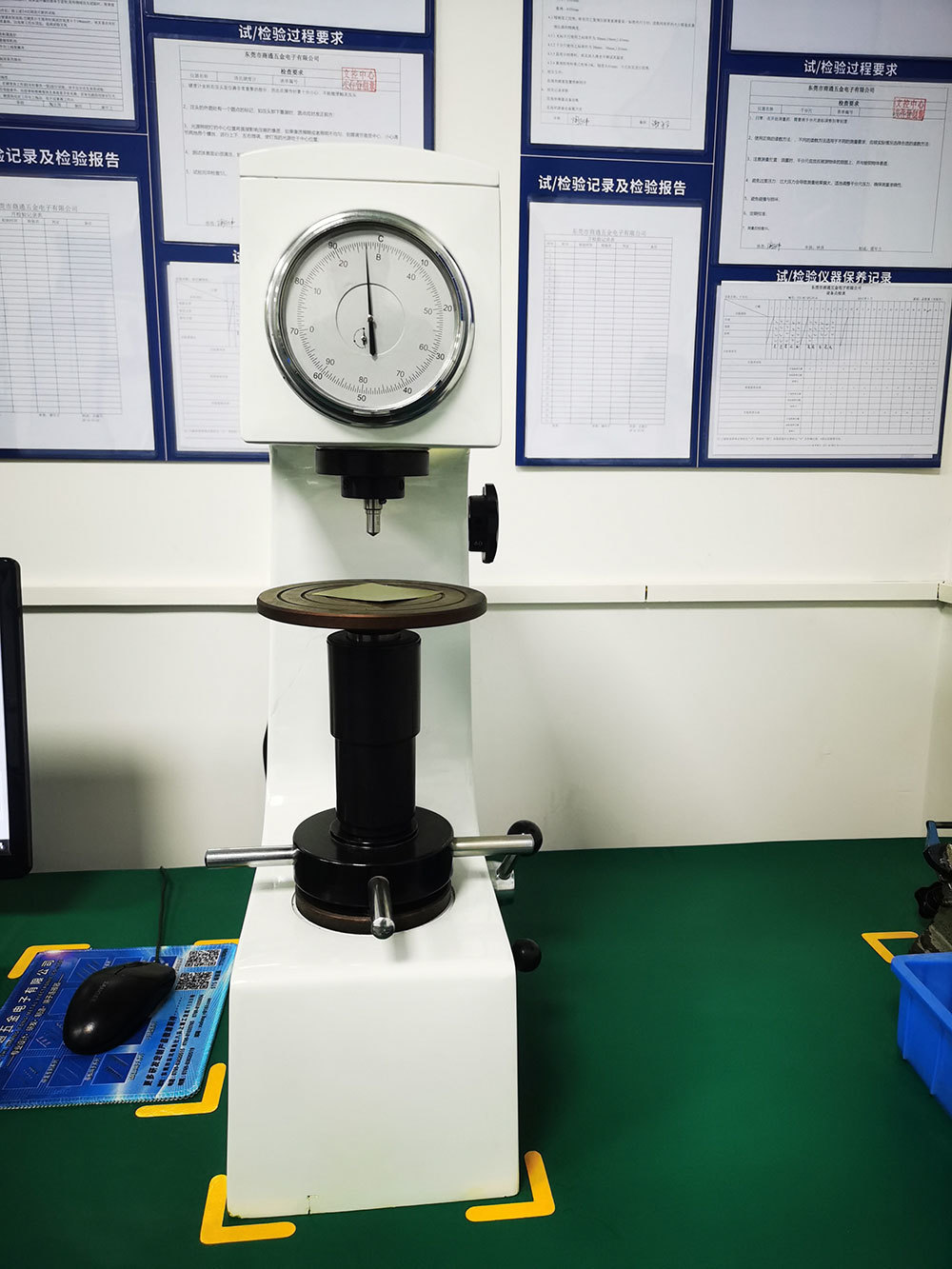
▲ Hardness testing verifies the heat treatment worked — MPI verifies it didn't create cracks. Both are needed for grade 10.9+ bolts
MPI Standards and Acceptance Criteria
MPI for fasteners is typically performed to one of these standards:
- ASTM E1444 / E1444M — Standard Practice for Magnetic Particle Testing (US standard)
- ISO 9934 — Non-destructive testing — Magnetic particle testing (international standard, parts 1-3)
- EN 1369 — Founding — Magnetic particle inspection (European, often referenced for castings but applicable to fasteners)
- API 20E — Carbon and alloy steel bolting for the petroleum industry (includes MPI requirements)
- Customer-specific standards — Many automotive OEMs and aerospace companies have their own MPI specifications (e.g., VW PV 601, BMW GS 95011)
Acceptance criteria vary by application, but generally:
- Any linear indication > 1.5mm is rejectable for critical fasteners
- Any indication at the thread root or underhead radius is rejectable (high stress area)
- Rounded indications (non-linear) may be acceptable depending on size and location
- No indications allowed in the first three engaged threads (highest stress)
Always specify the MPI standard and acceptance criteria on your purchase order. "MPI inspected" isn't enough — you need to know which standard and what's acceptable.
When to Specify MPI
| Application | MPI Recommendation | Why |
|---|---|---|
| Grade 4.6/4.8 general purpose | Not required | Low strength, no quench cracking risk |
| Grade 8.8 standard | Sampling (AQL) | Moderate quench crack risk; sampling usually sufficient |
| Grade 10.9 structural | 100% MPI | High quench crack risk; safety-critical |
| Grade 12.9 critical | 100% MPI + UT | Very high quench crack risk; also check internal defects |
| Automotive (IATF 16949) | Per customer spec (often 100%) | Safety-critical; PPAP requires NDT plan |
| Stainless steel (304/316) | Use PT (dye penetrant), not MPI | Non-ferromagnetic; MPI doesn't work |
For our grade 10.9 structural bolts and grade 10.9 special structural bolt sets, we offer 100% MPI as an option. For automotive customers requiring IATF 16949 compliance, MPI is part of our standard control plan — see our IATF 16949 quality control article for details.
The Cost of MPI
MPI adds cost, but it's modest compared to the risk:
- 100% MPI (wet fluorescent): typically $0.02-0.08 per bolt for M10-M20 sizes, or 3-8% of unit price
- Sampling MPI (AQL): included in most inspection costs, no separate charge
- MPI certification/report: $50-150 per batch for a formal inspection report
For a shipment of 10,000 M16 grade 10.9 bolts at $0.50 each, 100% MPI adds $200-800. A single field failure — with replacement, downtime, and potential liability — can cost $10,000+. The math is clear: for critical applications, MPI is cheap insurance.
How We Run MPI on the Production Floor
Our MPI station uses a wet fluorescent magnetic particle inspection system — the bolt is magnetized with a 1,500-amp current, then sprayed with a fluorescent particle suspension. Under UV light, any surface crack shows up as a bright green line. We inspect 100% of grade 10.9 structural bolts and 10.9+ flange bolts. The operator runs each bolt through the coil in two orientations — longitudinal and circular magnetization — because cracks can run in any direction.
A typical 8-hour shift inspects about 8,000 bolts. The reject rate is usually 0.3-0.8% — mostly quench cracks from heat treatment. Every rejected bolt is photographed, the crack location logged, and the heat treatment batch flagged for review. If the reject rate jumps above 1.5%, we stop production and audit the furnace temperature profile. Last year, a 2.1% reject rate on a Tuesday morning traced back to a furnace thermocouple that had drifted 15°C low. We caught it before the bolts reached the customer.
FAQ
Q: Can MPI be done after plating?
A: Yes, but zinc plating can mask fine cracks if it's too thick (over 15 microns). For best sensitivity, MPI should be performed after heat treatment and before plating. If MPI must be done after plating, use wet fluorescent method with high sensitivity, and verify that the plating thickness doesn't exceed the standard's limit. Always demagnetize after MPI and before plating — residual magnetism can cause uneven plating.
Q: What's the difference between dry powder and wet fluorescent MPI?
A: Dry powder uses visible iron particles applied to a magnetized part — good for large, rough surfaces and field inspection. Wet fluorescent uses iron particles coated with fluorescent dye suspended in liquid, inspected under UV light — much more sensitive for fine cracks, used in production inspection of fasteners. Wet fluorescent is the standard for high-strength bolt inspection; dry powder is used for field maintenance and large structures.
Q: How deep can MPI detect cracks?
A: Surface cracks are detected with high sensitivity. Near-surface cracks up to about 1-2mm deep can be detected, but sensitivity decreases with depth. Cracks deeper than 2mm require ultrasonic testing (UT). For fasteners, most dangerous cracks (quench cracks, fatigue cracks) initiate at the surface, so MPI is effective.
Q: Do all fastener factories have MPI capability?
A: No. Many smaller factories rely on visual inspection and hardness testing only. MPI requires specialized equipment (magnetizing machine, UV light, darkroom) and certified inspectors (ASNT Level I/II or ISO 9712). When specifying MPI, verify the factory has the equipment and certified personnel — ask for the MPI procedure and inspector certifications. We have in-house wet fluorescent MPI for grade 10.9+ bolts.
Q: Can a bolt pass MPI and still fail?
A: Yes. MPI detects surface and near-surface cracks at the time of inspection. It doesn't detect internal defects (requires UT), and it doesn't prevent cracks from forming later due to fatigue, stress corrosion, or hydrogen embrittlement. MPI is one part of a comprehensive quality program — it should be combined with hardness testing, dimensional inspection, material certification, and (for high-strength bolts) hydrogen embrittlement prevention. See our hydrogen embrittlement prevention guide for the other critical quality control for high-strength bolts.
MPI isn't glamorous. It doesn't show up in the product catalog or the marketing materials. But for high-strength fasteners in critical applications, it's the difference between a bolt that holds and a bolt that breaks — and the cost of getting it wrong is far higher than the cost of the inspection. Specify it, verify it, and sleep better at night.