
Key Takeaways
· IATF 16949 is the automotive industry's quality management standard — it's not optional if you supply to OEMs or Tier-1 suppliers.
· Automotive fasteners require PPAP (Production Part Approval Process) documentation — 18 elements including design records, FMEA, control plans, and MSA studies.
· 100% sorting is common for automotive fasteners — dimensional, hardness, and coating checks on every piece, not just sampling.
· Traceability is mandatory: every batch must be traceable to raw material heat number, production date, and inspection records — back to the steel mill if needed.
Quick Answer
IATF 16949 isn't a certificate — it's a system. Automotive fasteners need PPAP documentation (18 elements), 100% sorting for critical parts, full batch traceability back to the steel mill, and continuous improvement with 8D corrective actions. A factory with the certificate but no real implementation will get audited out eventually.
A bolt in a car doesn't look special. It's the same M8 hex bolt you'd find on a fence or a machine. But if that bolt fails at 120 km/h on the highway, it's not just a warranty claim — it's a recall, a safety investigation, potentially lives at risk.
That's why automotive fasteners are held to a completely different standard than general industrial fasteners. IATF 16949 isn't just a certificate on the wall — it's a way of doing business that touches every step from raw material to final shipment.
Having supplied fasteners to automotive supply chains, I can tell you: the factories that get IATF 16949 right are the ones that never get audited out. The ones that treat it as a paperwork exercise? They get caught, eventually.
A Tier-1 automotive supplier in Mexico was sourcing bolts from a factory with a valid IATF 16949 certificate — until a PPAP audit revealed the factory had no calibration records for their torque wrenches (required by IATF 7.1.5.2). The certificate was real, but the system wasn't. The supplier was put on 90-day probation and lost 30% of their orders. We hold monthly calibration records for all measurement equipment — it's not optional in automotive.
PPAP Level 3: What an Automotive Customer Actually Checks
A German Tier-1 supplier audited our facility for IATF 16949 compliance. They spent 2 days reviewing: control plans for each process, FMEA documents, gauge R&R studies, material certifications from every heat, and traceability from raw wire to finished bolt. They found one minor gap — our hardness test records didn't include the operator's signature. We fixed it in 48 hours. We passed the audit and now supply 3 automotive programs.
What Is IATF 16949?
IATF 16949 is the International Automotive Task Force's quality management standard. It replaced ISO/TS 16949 in 2016 and is built on top of ISO 9001. If you supply fasteners to any major automaker (VW, BMW, Mercedes, GM, Ford, Toyota, etc.) or their Tier-1 suppliers, you need IATF 16949 certification — full stop.
But certification is just the entry ticket. What really matters is how the standard is implemented in daily production. Here's what it means for fastener manufacturing:
PPAP — The Production Part Approval Process
Before any automotive fastener goes into production, the supplier must complete PPAP — a package of 18 documents proving the part can be made consistently. The key elements for fasteners:
- Design records — drawings with all dimensions, tolerances, material specs, and coating requirements
- Engineering change documentation — history of any changes to the part or process
- Customer engineering approval — signed off by the OEM or Tier-1
- DFMEA and PFMEA — Design and Process Failure Mode Effects Analysis — what could go wrong, and how it's prevented
- Control plan — step-by-step inspection and process controls from raw material to shipping
- MSA (Measurement System Analysis) — proof that your calipers, gauges, and hardness testers are accurate and repeatable
- Process capability studies — Cpk ≥ 1.33 for critical dimensions (statistical proof that the process stays within tolerance)
- Initial sample inspection report — full dimensional and material test results from a production run
- Material certificates — EN 10204 3.1 or 3.2 for every heat of steel
PPAP Level 3 (the most common) requires all 18 elements. Some customers require Level 4 or 5, which adds on-site audits and customer-specific requirements.
▲ Automotive production lines don't tolerate fastener failures — every bolt must meet IATF 16949 traceability and quality requirements
100% Sorting — Not Just Sampling
In general industrial fasteners, AQL sampling (e.g., 2.5% inspection) is standard. In automotive, critical fasteners get 100% sorting — every single bolt is checked.
What gets checked 100%?
- Dimensions — thread go/no-go gauges, length, head height, wrench size
- Hardness — 100% hardness testing for grade 10.9 and 12.9 (some customers require eddy current sorting instead of destructive Rockwell)
- Coating thickness — magnetic gauge or XRF on every batch
- Visual defects — cracks, folds, thread damage, plating defects
- Marking — grade marking and manufacturer logo must be present and legible
100% sorting adds cost — typically 5-15% on top of the unit price. But it's non-negotiable for automotive. A single defective bolt reaching the assembly line can stop a production line costing €10,000+ per minute.
Traceability — Every Bolt Tells a Story
IATF 16949 requires full batch traceability. Here's what that means in practice:
- Each batch of bolts is labeled with a unique batch number
- The batch number links to: raw material heat number (from the steel mill), production date, machine number, operator, heat treatment batch, plating batch, and inspection records
- If a defect is found, the manufacturer can trace exactly which other batches used the same steel, the same machine setting, or the same plating bath
- Records must be kept for a minimum of 15 years (some OEMs require longer)
I've seen traceability save a supplier from disaster. A customer found a hardness issue in one batch. The supplier traced it to a specific heat treatment cycle, identified three other batches from the same cycle, and recalled them before they reached the assembly line. Without traceability, they'd have been guessing — and possibly facing a full recall.
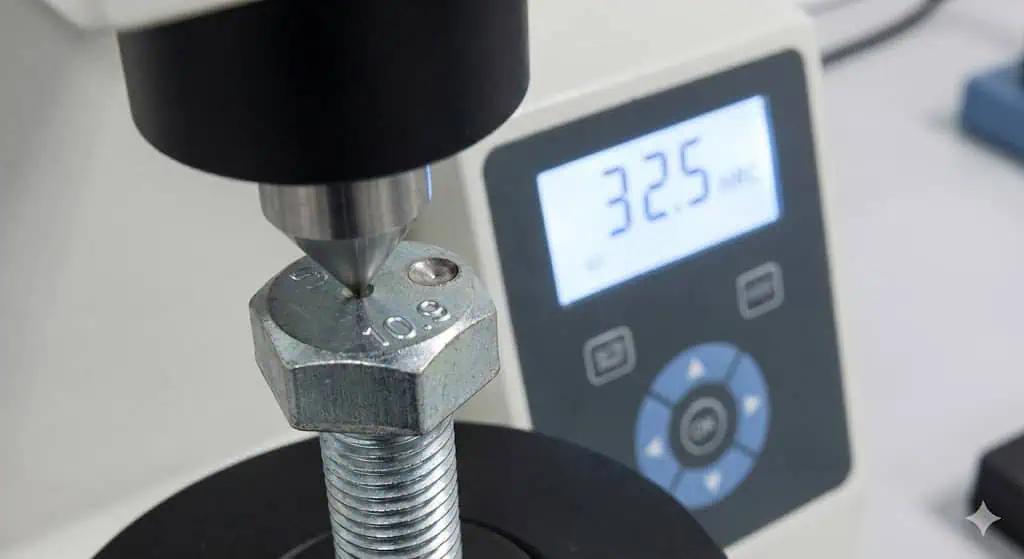
▲ Hardness testing is a critical control for automotive fasteners — 100% sorting is common for grade 10.9 and above
Special Processes — Heat Treatment and Plating
IATF 16949 has special requirements for "special processes" — processes where the result can't be fully verified by subsequent inspection. For fasteners, that means heat treatment and plating.
For heat treatment:
- Pyrometry (temperature measurement) must be calibrated per AMS 2750 or equivalent
- Temperature uniformity surveys (TUS) every 6 months — proving the furnace is ±10°C across the working zone
- System accuracy tests (SAT) monthly — proving the controller reads the actual temperature
- Thermocouples replaced at defined intervals (typically every 3-6 months)
- Every load must have a temperature chart record
For plating:
- Bath chemistry analyzed daily (zinc concentration, pH, additives)
- Hydrogen embrittlement prevention — mandatory baking for grade 10.9+ within 4 hours of plating (see our hydrogen embrittlement guide)
- Coating thickness measured per batch (XRF or magnetic gauge)
- Salt spray testing per ASTM B117 or ISO 9227 — minimum hours specified by the customer (typically 240-1000 hours)
For more on salt spray testing and coating selection, see our salt spray testing guide.
Continuous Improvement — The IATF Mindset
IATF 16949 isn't a one-time certification — it requires continuous improvement. Every audit (internal or external) finds findings. Every customer complaint triggers a corrective action (8D report). Every process is monitored with statistical process control (SPC) charts.
The factories that thrive under IATF 16949 are the ones that embrace this. They don't see audits as a burden — they see them as a way to find problems before the customer does. They invest in training, in equipment, in process control.
For buyers, this means: don't just ask for the IATF certificate. Ask to see the latest audit report. Ask about corrective actions. Ask about process capability data. A factory that can show you real SPC charts and Cpk values is a factory that takes quality seriously.
For more on evaluating fastener suppliers, see our supplier audit checklist.
Yuanpai's Automotive Fastener Capability
We supply automotive-grade fasteners with full PPAP documentation and IATF 16949 traceability: grade 10.9 flange bolts (DIN 6921, the most common automotive chassis fastener), grade 10.9 structural bolts for body-in-white and suspension, and DIN 931 hex bolts in grades 8.8 and 10.9 with zinc flake coating. All batches include material certificates, hardness test reports, and full traceability records back to the steel mill.
FAQ
Q: Is IATF 16949 required for all automotive fasteners?
A: For fasteners used in safety-critical or structural applications (engine, chassis, brake, steering), yes — IATF 16949 and PPAP are mandatory. For non-critical interior fasteners (trim, clips), some customers may accept ISO 9001 only. But if you're supplying to an OEM or Tier-1, assume IATF 16949 is required.
Q: How long does IATF 16949 certification take?
A: For a factory already operating with good quality systems, 6-12 months from gap analysis to certification audit. For a factory starting from scratch, 12-18 months. Certification is valid for 3 years, with annual surveillance audits.
Q: What's the difference between PPAP Level 3 and Level 5?
A: Level 3 requires all 18 PPAP elements submitted to the customer. Level 5 requires all elements plus an on-site customer audit at the supplier's facility. Level 5 is typically used for new suppliers or high-risk parts.
Q: Can a Chinese factory be IATF 16949 certified?
A: Absolutely. Many Chinese fastener factories are IATF 16949 certified and supply to global automakers. The key is verifying that the certification is real (check with the certification body) and that the implementation is genuine — not just paperwork. Ask for process capability data and audit reports.
Q: What happens if a defective automotive fastener reaches the field?
A: The supplier is responsible for containment (sorting all potentially affected stock), root cause analysis (8D report), corrective action, and possibly recall costs. In severe cases, the supplier may be removed from the approved supplier list. This is why 100% sorting and traceability are non-negotiable — they catch problems before they reach the customer.
Automotive fasteners don't look different from any other bolt. But the system behind them — PPAP, 100% sorting, traceability, continuous improvement — makes all the difference. If you're sourcing for automotive, don't compromise on these. The cost of getting it wrong is too high.