Key Takeaways
· Salt spray testing (ASTM B117 / ISO 9227) measures corrosion resistance by exposing fasteners to a continuous salt fog — hours to first red rust is the standard metric.
· Electroplated zinc: 24-96 hours to red rust. Hot-dip galvanizing (HDG): 200-500 hours. Zinc flake (Dacromet/Geomet): 500-1,500 hours. Stainless 316: 1,000+ hours (often no rust in testing).
· Salt spray hours don't directly translate to real-world years — a coating with 500 hours salt spray may last 10-20 years in rural atmosphere but only 3-5 years in coastal splash zones.
· For high-strength bolts (10.9+), zinc flake coatings are preferred over electroplating because they don't introduce hydrogen — eliminating hydrogen embrittlement risk.
Quick Answer
Salt spray test hours don't equal real-world years. Zinc plating = 48-200h, HDG = 500-1000h+, zinc flake = 500-1500h+. But coastal exposure is 5-10x more aggressive than a rural roof. Specify coating by environment, not by test hours alone.
"How long will these bolts last in salt spray?" This is the question every buyer asks when comparing coatings. And the answer is always a number: 240 hours, 500 hours, 1,000 hours. But what does that number actually mean? And how does it translate to real-world performance?
I've sat through dozens of coating comparison meetings where buyers fixate on salt spray hours as if they're the only metric that matters. A coating with 1,000 hours must be better than one with 500 hours, right? Not necessarily. Salt spray testing is a useful comparative tool, but it has limitations — and understanding those limitations is the difference between making a smart coating choice and wasting money on over-specified coatings.
After years of specifying coatings for fasteners used in everything from desert solar farms to North Sea oil platforms, here's what I've learned about salt spray testing and coating selection.
A solar developer in Spain specified zinc-plated bolts (96h salt spray) for a coastal solar farm because the test report "looked good." Fourteen months later, 15% of the mounting bolts showed red rust — the salt-laden coastal air consumed the thin zinc layer in a fraction of the lab time. The replacement program cost €47,000, including crane rental for panel removal. HDG bolts (500h+ salt spray) would have cost 20% more upfront but lasted 15-20 years. The salt spray test passed; the real-world environment didn't.
Salt Spray 500 Hours: What It Really Means in the Field
A solar farm in Qatar needed mounting bolts for coastal desert — 50°C heat, salt-laden wind, occasional sandstorms. Standard zinc plating showed red rust at 200 hours in our salt spray chamber. HDG lasted 800+ hours. We supplied HDG bolts with a 65μm coating. After 3 years in service, inspection showed only minor white rust, no red rust. The customer's maintenance team stopped replacing bolts. Salt spray testing isn't just a certificate — it predicts real service life.
How Salt Spray Testing Works
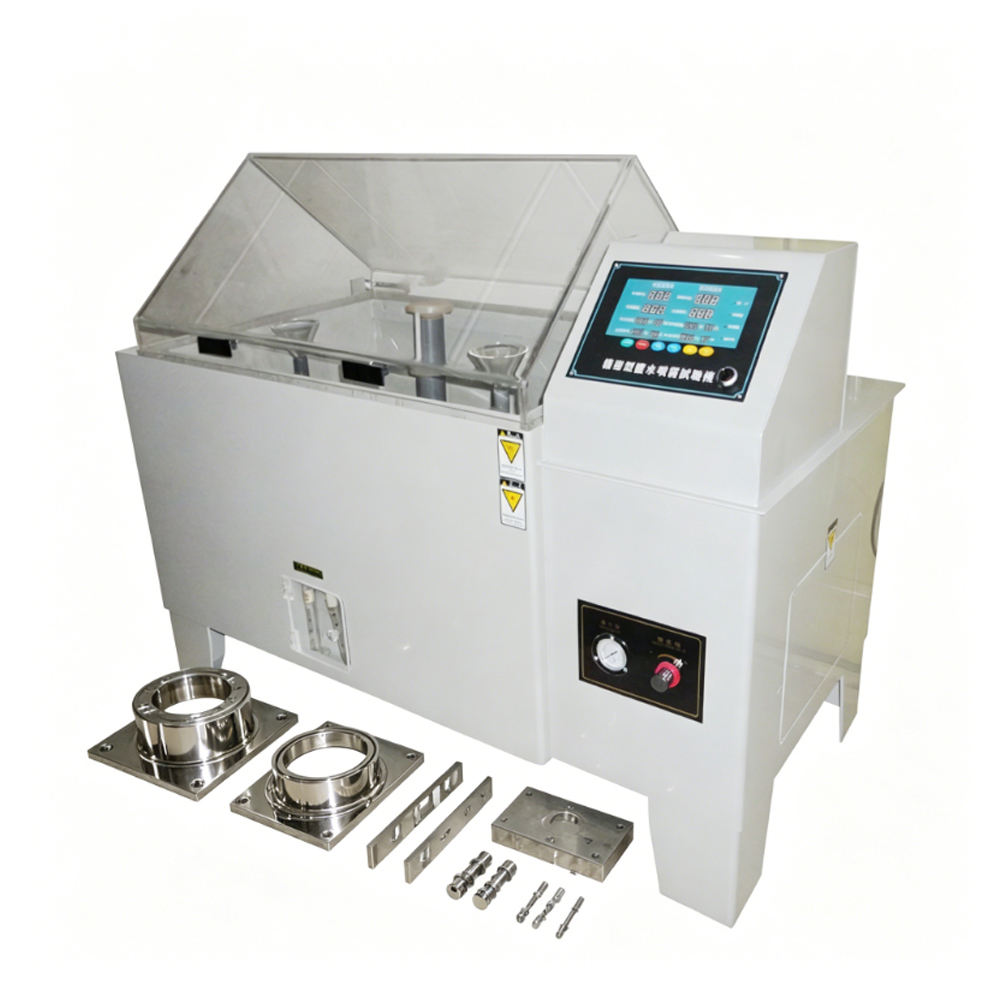
The salt spray test (also called the fog test) is straightforward in concept:
- Fasteners are placed in a sealed chamber at 35°C (95°F)
- A 5% NaCl (salt) solution is atomized into a continuous fog, settling on the samples at a rate of 1-2 ml per hour per 80 cm²
- Samples are inspected at regular intervals (24, 48, 96, 240, 500, 1000 hours)
- The time to first "red rust" (iron oxide, indicating base steel corrosion) is recorded
Two standards govern the test:
- ASTM B117 — US standard, most widely referenced in North America
- ISO 9227 — international standard, essentially identical to ASTM B117 for neutral salt spray (NSS)
There are also variants: acetic acid salt spray (AASS) for decorative coatings, and copper-accelerated acetic acid salt spray (CASS) for more aggressive testing. But for industrial fasteners, neutral salt spray (NSS) per ASTM B117 / ISO 9227 is the standard.
▲ Salt spray chamber — continuous 5% salt fog at 35°C accelerates corrosion for comparative coating testing
Coating Performance Comparison
Here's how common fastener coatings perform in neutral salt spray testing:
| Coating | Thickness | Salt Spray (hrs to red rust) | Typical Outdoor Life |
|---|---|---|---|
| Plain (uncoated) | — | < 6 hours | Weeks-months |
| Black oxide | 1-2 μm | < 12 hours | Indoor only |
| Zinc electroplate (clear) | 5-15 μm | 24-96 hours | 1-3 years (rural) |
| Zinc electroplate (yellow passivate) | 5-15 μm | 96-240 hours | 2-5 years (rural) |
| Zinc nickel (ZnNi) | 8-15 μm | 240-720 hours | 5-10 years |
| Hot-dip galvanizing (HDG) | 45-85 μm | 200-500 hours | 15-40 years (rural) |
| Zinc flake (Dacromet/Geomet) | 8-15 μm | 500-1,500 hours | 10-25 years |
| Stainless steel 304 (A2) | — | 200-1,000 hours* | 15-30 years (inland) |
| Stainless steel 316 (A4) | — | 1,000+ hours* | 25-50+ years (coastal) |
*Stainless steel doesn't typically develop "red rust" in salt spray — it may develop pitting or crevice corrosion. The hours listed are for first visible corrosion, which may be pitting rather than red rust.
What Salt Spray Hours Don't Tell You
This is the part most buyers miss. Salt spray hours are a comparative metric, not a direct prediction of service life. Here's why:
1. Test Conditions ≠ Real World
Salt spray testing uses a continuous 5% salt fog at constant 35°C and 100% humidity. The real world has rain, UV radiation, temperature cycling, drying periods, pollution, and varying chloride levels. A coating that performs well in continuous salt fog may perform poorly in real-world conditions where wet-dry cycling actually accelerates corrosion (the drying cycle concentrates salts on the surface).
Some coatings (like zinc flake) perform exceptionally well in salt spray but may degrade faster in real-world UV exposure. Others (like HDG) have moderate salt spray performance but excellent long-term atmospheric corrosion resistance because the thick zinc layer provides sacrificial protection over decades.
2. White Rust vs Red Rust
Salt spray reports often distinguish between "white rust" (zinc corrosion product) and "red rust" (base steel corrosion). White rust on a zinc coating is normal and doesn't indicate failure — the zinc is doing its job by sacrificing itself to protect the steel. Red rust means the zinc has been consumed and the base steel is now corroding — that's the real failure point.
Always ask whether the reported hours are to white rust or red rust. A coating might show 1,000 hours to white rust but only 200 hours to red rust — and red rust is what matters for structural integrity.
3. Coating Damage
Salt spray testing is typically done on pristine, undamaged coatings. In real use, fasteners get scratched during installation, nicked during shipping, and abraded by vibration. A coating with excellent salt spray performance on pristine samples may corrode rapidly at a scratch site if it doesn't provide sacrificial (galvanic) protection. HDG and zinc flake provide sacrificial protection; paint and powder coating don't — a scratch in paint leads to underfilm corrosion.
▲ Hot-dip galvanizing — the thick zinc layer (45-85μm) provides both barrier and sacrificial protection, making it the standard for outdoor structural fasteners
Selecting the Right Coating
Instead of chasing salt spray hours, select coatings based on the actual service environment:
Rural / Inland, Low Humidity
Zinc electroplate (yellow passivate) or HDG. Salt spray: 96-500 hours. Expected life: 5-25 years. For interior or dry environments, zinc electroplate is sufficient and most economical.
Urban / Industrial, Moderate Pollution
HDG or zinc flake. Salt spray: 200-1,000 hours. Expected life: 10-30 years. Industrial pollution (SO₂, NOx) accelerates zinc corrosion, so HDG's thick layer is an advantage.
Coastal / Marine, Within 5 km of Saltwater
HDG (heavy coating, 85μm+), zinc flake, or A4-80 stainless steel. Salt spray: 500-1,000+ hours. Expected life: 15-50+ years. For splash zones (direct seawater contact), use A4-80 stainless or super duplex — HDG will corrode through in 5-10 years in direct splash.
Road Salt / De-icing Areas
HDG or zinc flake. Salt spray: 200-1,000 hours. Expected life: 10-25 years. Road salt (NaCl, CaCl₂) is particularly aggressive because it stays wet on the surface for extended periods. HDG is the standard for bridges and parking garages in cold climates.
High-Strength Bolts (10.9+) — Any Environment
Zinc flake (Dacromet, Geomet, Magni) is preferred over electroplating because it doesn't introduce hydrogen. Electroplating high-strength bolts risks hydrogen embrittlement — delayed fracture that can occur weeks or months after installation. If electroplating is specified, mandatory post-plating baking (190-230°C for 8-24 hours) is required. See our hydrogen embrittlement prevention guide for details.
For a comprehensive coating comparison, see our fastener coatings guide. For marine-specific selection, see our marine fastener comparison.
We supply DIN 931 bolts and grade 10.9 flange bolts with zinc plating, HDG, or zinc flake coating — specify your salt spray requirement and we'll recommend the right coating system.
Beyond Salt Spray: Better Corrosion Tests
For critical applications, salt spray alone isn't sufficient. More realistic cyclic corrosion tests (CCT) better simulate real-world conditions:
- ASTM D5894 / ISO 11997 — cyclic test with salt spray, UV, humidity, and freezing cycles. More predictive for outdoor coatings.
- SAE J2334 — automotive cyclic test with salt, humidity, and drying cycles. Used by automakers for underbody and chassis fasteners.
- ISO 16701 — cyclic test with chloride, SO₂, humidity, and temperature cycling. More aggressive and realistic than neutral salt spray.
If your application is safety-critical or has a long design life (20+ years), ask for cyclic corrosion test data in addition to salt spray. It's more expensive and slower (weeks vs days), but it's far more predictive of real-world performance.
Our Salt Spray Lab — What We Actually Test
We run a 270-liter salt spray chamber per ASTM B117 — 5% NaCl solution, 35°C, pH 6.5-7.2, continuous spray at 1-2ml per hour per 80cm². For each coating batch, we hang 10 sample bolts in the chamber and inspect at 24, 48, 96, 200, and 500 hours. We record the first appearance of white rust (zinc corrosion) and red rust (base metal corrosion). A zinc-plated bolt typically shows white rust at 48-96h and red rust at 200h. HDG doesn't show red rust until 500-1000h+.
The test isn't just for certification — it's a process control tool. If a zinc plating batch shows white rust at 24h instead of 96h, we know the plating thickness is too thin or the passivation was skipped. We can trace it back to the plating line, the operator, and the chemical bath concentration. Our lab technician has been running this chamber for 11 years. She knows by the smell when the solution is off — before the pH meter tells her.
FAQ
Q: Is a coating with 1,000 hours salt spray always better than one with 500 hours?
A: Not necessarily. Salt spray hours measure one thing: resistance to continuous neutral salt fog. A coating with 1,000 hours may have poor UV resistance, poor scratch resistance, or poor real-world wet-dry cycle performance. Always consider the full service environment, not just salt spray hours. For most atmospheric applications, HDG (200-500 hours salt spray) outlasts zinc electroplate with high-performance passivate (240-720 hours) because the thick zinc layer provides more sacrificial protection over time.
Q: How do salt spray hours convert to real-world years?
A: There's no reliable conversion formula — it depends entirely on the environment. As a rough rule of thumb for rural/urban atmospheres: 100 hours salt spray ≈ 1-2 years real-world. For coastal: 100 hours ≈ 3-6 months. For desert: 100 hours ≈ 3-5 years. But these are rough estimates — actual performance varies by coating type, local pollution, rainfall, and maintenance. Always consult the coating manufacturer for environment-specific life predictions.
Q: Can I specify a minimum salt spray requirement on my PO?
A: Yes — and you should. Specify "minimum 500 hours neutral salt spray per ASTM B117, no red rust" on your purchase order. But also specify the coating type (e.g., "zinc flake coating, Geomet 500B or equivalent") because different coatings achieve the same salt spray hours through different mechanisms. And request a salt spray test report with each batch — don't just take the supplier's word for it.
Q: Why do some zinc plated bolts show white rust but no red rust after 500 hours?
A: White rust is zinc oxide/hydroxide — it forms when the zinc coating corrodes. This is normal and expected; the zinc is sacrificing itself to protect the steel. Red rust (iron oxide) forms only after the zinc is consumed and the base steel starts corroding. A coating with 500 hours to white rust but only 100 hours to red rust is less protective than one with 200 hours to white rust and 400 hours to red rust. Always specify "hours to red rust" as the acceptance criterion, not "hours to white rust."
Q: Do I need salt spray testing for indoor fasteners?
A: For indoor, dry, climate-controlled environments, salt spray testing is overkill. Zinc electroplate (clear or yellow) with 24-96 hours is sufficient. Salt spray testing becomes relevant for outdoor, humid, coastal, or industrial environments — anywhere the fastener will be exposed to moisture and corrosive agents. For indoor fasteners in high-humidity areas (food processing, pharmaceuticals, swimming pools), specify 240+ hours or use stainless steel.
Salt spray testing is a tool — a useful one, but not the only one. Use it to compare coatings under standardized conditions, but always interpret the results in the context of your actual service environment. The coating with the highest salt spray number isn't always the best choice for your application — the coating that matches your environment, your bolt grade, and your budget is. Choose wisely, and your fasteners will outlast the structure they hold together.