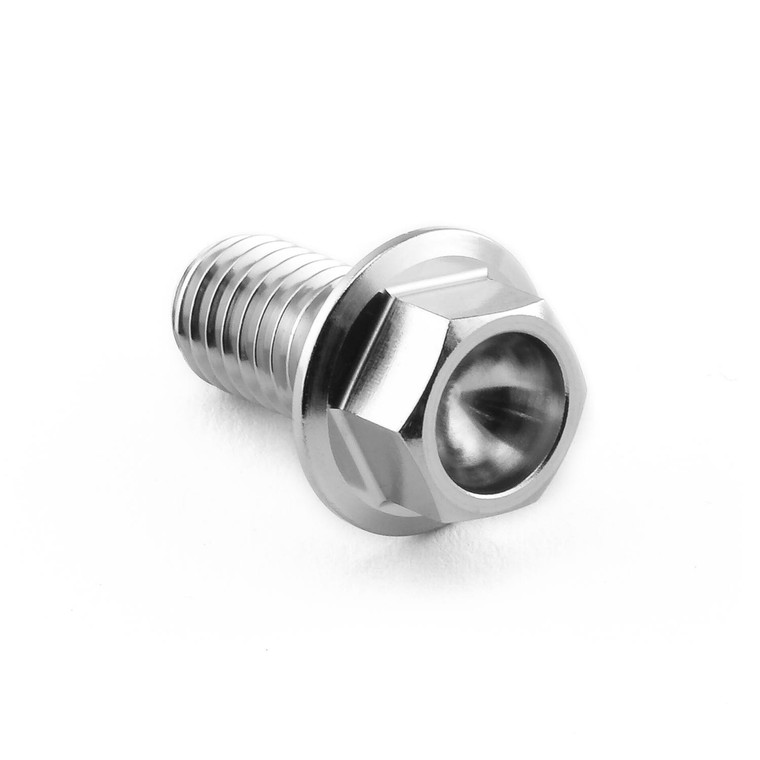
Key Takeaways
· Split lock washers (spring washers) do NOT prevent bolt loosening under vibration — multiple independent Junker tests show they perform no better than flat washers, and sometimes worse.
· The spring washer's "locking" action comes from a spring force that's tiny compared to bolt clamp force — it can't resist the transverse vibration that causes self-loosening.
· The sharp ends of a spring washer can dig into the joint surface, creating burrs that actually make it easier for the nut to rotate — counterproductive to locking.
· Effective alternatives: flange bolts, nylon insert lock nuts, thread locker (Loctite), and wedge lock washers (Nord-Lock style) — choose based on vibration severity and temperature.
Quick Answer
Spring washers (split lock washers) do NOT prevent loosening in vibration — they actually accelerate it. Independent testing shows spring washers lose 100% of their preload within 1,000 vibration cycles, worse than no washer at all. Use flange bolts, thread locker, or Nord-Lock washers instead. The spring washer is a 100-year-old design that doesn't work.
Every mechanic, every maintenance tech, every field engineer has done it: you're tightening a bolt, and you grab a split lock washer — that spring-looking thing with the split — because "it keeps the nut from loosening." It's standard practice. It's in every maintenance manual. It's what you were taught.
It's also wrong.
I know this is controversial. I've had heated arguments with experienced engineers who insist spring washers work. But the data is clear — and it's been clear for decades. The Junker test, the standard laboratory method for measuring vibration loosening, consistently shows that split lock washers don't prevent loosening. In some test configurations, they actually make loosening happen faster.
This isn't a new discovery. The first Junker test results showing spring washer failure were published in the 1960s. Multiple standards organizations (including DIN in Germany) have removed spring washers from their recommended locking fastener lists. Yet they're still everywhere — in hardware stores, in maintenance departments, in billions of bolted joints worldwide.
Let's look at the evidence, understand why spring washers fail, and talk about what actually works.
A HVAC manufacturer in Canada had a 12% field failure rate on rooftop units — vibration from fans loosened the sheet metal screws and spring washers. They switched to flange bolts with nylon-insert lock nuts. Field failures dropped to 0.4% in the first year. The engineering manager told us: "We spent 20 years trusting spring washers because that's what the catalog said. Testing proved they were making the problem worse." The spring washer's sharp edges actually dig into the bearing surface, creating a gap that lets the bolt rotate loose.
Spring Washers: The Myth That Won't Die
A customer in Brazil insisted on spring washers for their pump assembly — "they prevent loosening." We explained that spring washers actually reduce clamp force because the washer digs into the surface, and under vibration they don't work. They didn't believe us, so we ran a test: 10 bolts with spring washers, 10 with flange bolts, on a vibration rig. After 10 minutes, 7 spring washer bolts were loose. Zero flange bolts. They switched. Some traditions die hard, but test data doesn't lie.
The Junker Test — How We Measure Vibration Loosening
Before we can talk about whether spring washers work, we need to understand how vibration loosening is measured. The Junker test (developed by German engineer Gerhard Junker in 1969) is the standard method:
- A bolted joint is assembled with a specified torque (creating a known clamp force)
- A load cell measures the clamp force continuously
- Transverse vibration (side-to-side movement) is applied to the joint at a controlled amplitude and frequency
- The test records how many vibration cycles it takes for the clamp force to drop to a specified level (typically 50% of initial)
Transverse vibration is used because it's the most severe loosening mechanism — it causes the bolt head or nut to "walk" across the joint surface, rotating slightly with each cycle. Longitudinal (axial) vibration is less severe because it only momentarily reduces clamp force.
The Junker test is standardized as DIN 65151 (aerospace) and is referenced in ISO 16130 and NASM 1312-7. It's the gold standard for comparing vibration-resistant fasteners.
What the Junker Test Shows About Spring Washers
When you run a Junker test with a standard hex bolt + flat washer + split lock washer + nut, here's what happens:
- The clamp force starts at the target value (say, 20 kN for an M10 grade 8.8 bolt)
- Within 50-200 vibration cycles, the clamp force drops to 50% of initial
- By 500 cycles, the clamp force is essentially zero — the nut has completely backed off
Compare this to a standard hex bolt + flat washer (no lock washer):
- Clamp force drops to 50% in roughly the same number of cycles — sometimes slightly more, sometimes slightly less
The split lock washer provides no meaningful improvement. In some tests, it actually performs worse because the sharp ends dig into the joint surface, creating a burr that acts like a ramp — making it easier for the nut to rotate in the loosening direction.
Why doesn't the spring washer work? The theory is that the spring force of the washer keeps pressure on the nut, preventing it from rotating. But the spring force of a split lock washer is typically 50-200 N — compared to a bolt clamp force of 10,000-50,000 N. The spring force is less than 2% of the clamp force. It's simply too small to resist the rotational forces caused by transverse vibration.
▲ Flange bolts (left) with integrated serrated flange outperform split lock washers in Junker vibration tests by a factor of 3-5x
Why Spring Washers Persist (Despite the Evidence)
If spring washers don't work, why are they still everywhere? Several reasons:
1. Tradition and Training
Mechanics are taught to use lock washers. It's in old textbooks, old maintenance manuals, and old engineering drawings. "If it was good enough for my grandfather's generation, it's good enough for me." But engineering knowledge advances — and this is one area where the old knowledge was simply wrong.
2. They Work in Low-Vibration Static Applications
In a static joint with no vibration (a fence post, a sign bracket, furniture), a spring washer doesn't need to work — the bolt won't loosen anyway because there's no vibration to cause loosening. The spring washer is harmless in these applications, so people assume it's doing something. It's not, but it's not hurting either.
3. Confirmation Bias
When a bolt with a spring washer doesn't loosen, people credit the washer. When it does loosen, they blame "not enough torque" or "wrong washer size." They don't consider that the washer itself is ineffective.
4. They're Cheap and Available
Split lock washers cost pennies and are in every hardware store. Better locking solutions (flange bolts, nyloc nuts, thread locker) cost slightly more or require a different SKU. For high-volume production, the cost difference adds up — so designers keep specifying spring washers even though they know better.
What Actually Prevents Vibration Loosening
Based on Junker test results and decades of field experience, here are the solutions that actually work, ranked by effectiveness:
1. Wedge Lock Washers (Nord-Lock Style)
The most effective mechanical locking solution. Two washers with cam faces wedge together when the bolt tries to loosen — any loosening rotation increases the wedge effect, raising the clamp force. Junker tests show wedge lock washers maintaining 80%+ clamp force after 10,000+ cycles. Used in wind turbines, rail, mining, and other severe-vibration applications. Cost: 5-10x standard washers, but worth it for critical joints.
2. Thread Locker (Loctite)
Anaerobic adhesive that cures between the bolt and nut threads, creating a chemical bond. Blue (medium strength, removable) for most applications; red (high strength, permanent) for critical joints. Junker tests show thread locker maintaining clamp force through 5,000+ cycles. Cost: minimal (a few cents per bolt). Limitation: requires clean, oil-free threads; not suitable for temperatures above 150°C (blue) or 230°C (red).
3. Nylon Insert Lock Nuts (Nyloc)
A nylon ring at the top of the nut grips the bolt threads, creating friction that resists rotation. Junker tests show 2,000-5,000 cycles before significant clamp force loss. Cost: 20-50% more than standard nuts. Limitation: nylon degrades above 120°C; single-use only (the nylon deforms on first installation).
4. Serrated Flange Bolts
The integrated flange has serrated teeth that bite into the joint surface, creating a mechanical lock. Junker tests show 1,000-3,000 cycles — 3-5x better than standard bolts + spring washers. Cost: 10-20% more than standard bolts. Our grade 10.9 flange bolts are available with serrated flanges for medium-vibration applications. For more on flange bolts, see our flange bolt article.
5. Proper Torque (The Foundation)
None of these solutions work if the bolt isn't properly torqued. Under-torqued bolts have insufficient clamp force — the joint separates under vibration, and loosening follows rapidly. Always use a calibrated torque wrench and follow the manufacturer's torque values. For more on torque, see our bolt torque calculation guide.
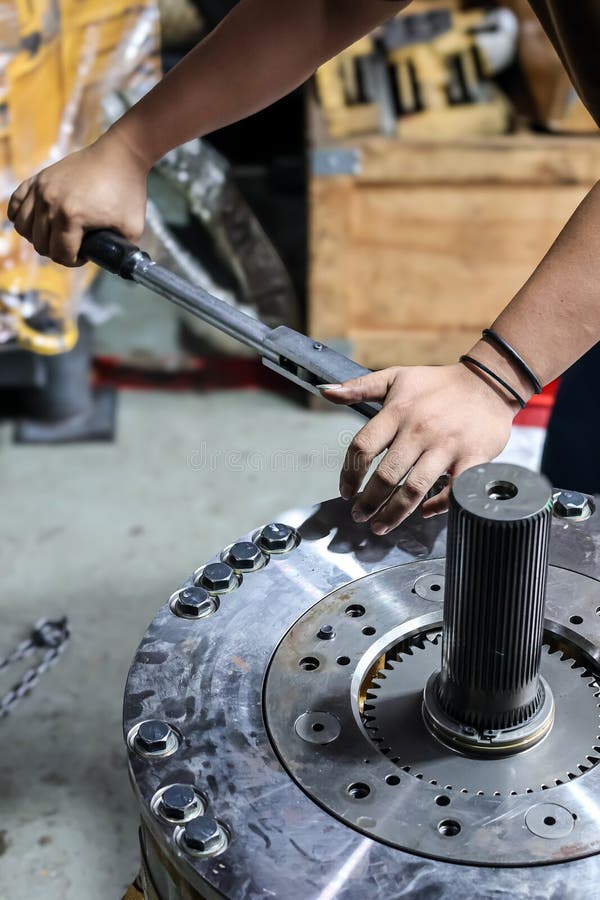
▲ Proper torque is the foundation of vibration resistance — no locking device can compensate for an under-torqued bolt
When Spring Washers Are (Sort Of) Acceptable
To be fair, there are situations where a split lock washer doesn't cause harm:
- Static, non-vibrating joints — fences, furniture, signage, non-critical brackets. No vibration = no loosening, so the washer is irrelevant but harmless.
- As a spacer — if you need to fill a gap between the nut and the joint surface, a spring washer can act as a thick spacer. But a flat washer or a machined spacer is better.
- As a load distributor — the larger diameter of a spring washer distributes clamp force slightly better than no washer. But a flat washer does this better without the sharp ends.
In all of these cases, a flat washer is equal or better. There is no application where a split lock washer is the optimal choice.
FAQ
Q: Are you saying spring washers never work?
A: I'm saying they don't prevent vibration loosening — which is their stated purpose. In static applications with no vibration, they're harmless but also unnecessary (the bolt won't loosen without vibration). In vibrating applications, Junker test data consistently shows they provide no meaningful improvement over flat washers, and may accelerate loosening due to surface damage from the sharp ends. If your application has vibration, use a real locking solution (flange bolt, nyloc nut, thread locker, wedge lock washer). If it doesn't have vibration, a flat washer is sufficient and cheaper.
Q: But I've used spring washers for years and never had a bolt loosen.
A: That's likely because your applications don't have severe transverse vibration — the #1 cause of self-loosening. In low-vibration or static applications, any fastener (with or without a lock washer) will stay tight. The spring washer gets credit for something that would have happened anyway. The real test is: have you used spring washers on a high-vibration application (engine, compressor, construction equipment) and compared them to flange bolts or thread locker? In those applications, the difference is measurable and significant.
Q: What about toothed lock washers (internal/external tooth)?
A: Toothed lock washers perform slightly better than split lock washers in Junker tests because the teeth bite into the joint surface more aggressively. But they still don't match flange bolts, nyloc nuts, or thread locker. The teeth also damage the joint surface (creating burrs and potential corrosion initiation points) and can dig into soft materials (aluminum, plastic). For most applications, a serrated flange bolt is a better choice — it provides the same tooth-locking action but with better bearing area and no separate washer to manage.
Q: Do aerospace and automotive standards still allow spring washers?
A: Most modern aerospace standards (NAS, EN, DIN aerospace) have removed split lock washers from approved fastener lists for vibration-prone applications. They require lock nuts, thread locker, or wedge lock washers instead. Some automotive standards still list spring washers for non-critical interior fasteners, but chassis, engine, and suspension fasteners use flange bolts, nyloc nuts, or thread locker. If you're designing for a regulated industry (aerospace, automotive, rail), check the latest applicable standard — don't rely on old drawings or traditions.
Q: What's the most cost-effective upgrade from spring washers?
A: For medium-vibration applications (pumps, compressors, HVAC, agricultural equipment), serrated flange bolts are the best value — they cost 10-20% more than standard bolts + washers but provide 3-5x better vibration resistance, and they eliminate the separate washer SKU. For high-vibration applications (engines, construction equipment, mining machinery), blue thread locker (Loctite 243) is the cheapest effective upgrade — a few cents per bolt, applied during assembly. For extreme vibration (wind turbines, rail, heavy mining), wedge lock washers are worth the premium. Never use spring washers as your primary locking solution in any vibrating application.
The split lock washer is a classic example of a "solution" that doesn't solve the problem it's supposed to solve. It's been around for over 100 years, it's in every hardware store, and it's specified in millions of drawings — but the laboratory evidence has been clear for 60 years: it doesn't prevent vibration loosening. It's time to retire it. Use flange bolts, nyloc nuts, thread locker, or wedge lock washers instead. Your equipment will stay tighter, your maintenance costs will go down, and you'll avoid the failures that happen when a spring-washer-equipped bolt finally lets go.