Key Takeaways
· Torque is not clamp force — it's an indirect measurement. The same torque on a dry bolt vs. a lubricated bolt produces very different clamp forces.
· The standard formula T = K × F × D works for estimates, but the K factor (nut factor) varies from 0.10 (lubricated) to 0.20 (dry, rough finish).
· Under-torquing causes loosening and joint failure; over-torquing causes bolt yield, permanent stretch, and sudden fracture — both are dangerous.
· For critical structural joints, use torque-angle tightening (turn-of-nut method) instead of torque-only — it's 2-3x more accurate for achieving target clamp force.
Quick Answer
Bolt torque T = K × F × d, where K is the nut factor (0.10-0.20 depending on lubrication and coating), F is target preload, and d is bolt diameter. The K-factor is the biggest variable — same torque, different coating, can produce 40% different clamp force.
You've got a stack of M20 grade 10.9 bolts, a torque wrench, and a spec that says "tighten to 450 Nm." You do it. The inspector checks. Everything passes. Six months later, the joint fails. What went wrong?
More often than not, the problem isn't the bolt. It's the torque. Torque is the most misunderstood parameter in fastening. People treat it like a direct measurement of bolt tightness — it's not. It's an indirect estimate, and the error margin can be ±30% or more.
After years of working with structural engineers and field crews, I've seen every torque mistake in the book. Here's what you need to know.
A steel fabricator in the US used the same torque value for both zinc-plated and HDG bolts on a warehouse project. The HDG bolts had a K-factor of 0.18 vs 0.14 for zinc-plated — so the same torque produced 22% less clamp force on the HDG bolts. During a wind storm, three connections slipped because the bolts weren't tight enough. The repair required re-torquing 1,200 bolts at $15 each = $18,000, plus engineering sign-off. The torque spec should have been adjusted for the HDG coating's higher friction.
The Torque Mistake That Cracked a $2M Bridge
A contractor in Canada used an impact gun to tighten M20 grade 10.9 structural bolts. The gun delivered 420 Nm instead of the specified 280 Nm — 50% over-torque. Three bolts fractured during stress testing, and the entire joint had to be replaced: $2M bridge section, 6-week delay. We always recommend calibrated torque wrenches for structural bolts, and we provide a torque spec sheet with every order. Impact guns are for removing, not installing.
The Torque Formula — and Why It's an Estimate
The standard formula for calculating tightening torque is:
Where:
- T = tightening torque (Nm)
- K = nut factor (dimensionless, typically 0.10-0.20)
- F = target clamp force / preload (N)
- D = nominal bolt diameter (m)
Looks simple, right? The problem is K — the nut factor. K accounts for all the friction in the joint: friction under the bolt head, friction in the threads, friction under the nut. And it's not a constant. It changes based on:
- Lubrication (oil, grease, dry film lubricant, or nothing)
- Surface finish (smooth zinc plating vs. rough black oxide vs. HDG)
- Thread condition (new, slightly rusty, galling)
- Washer type (flat, hardened, serrated)
- Temperature (friction changes with temperature)
A dry, unplated bolt might have K=0.20. The same bolt with oil on the threads might have K=0.12. That's a 40% difference in clamp force for the same torque. If your spec says 450 Nm and assumes K=0.15, but the bolts are dry (K=0.20), you're only getting 75% of the target clamp force. The joint will loosen.
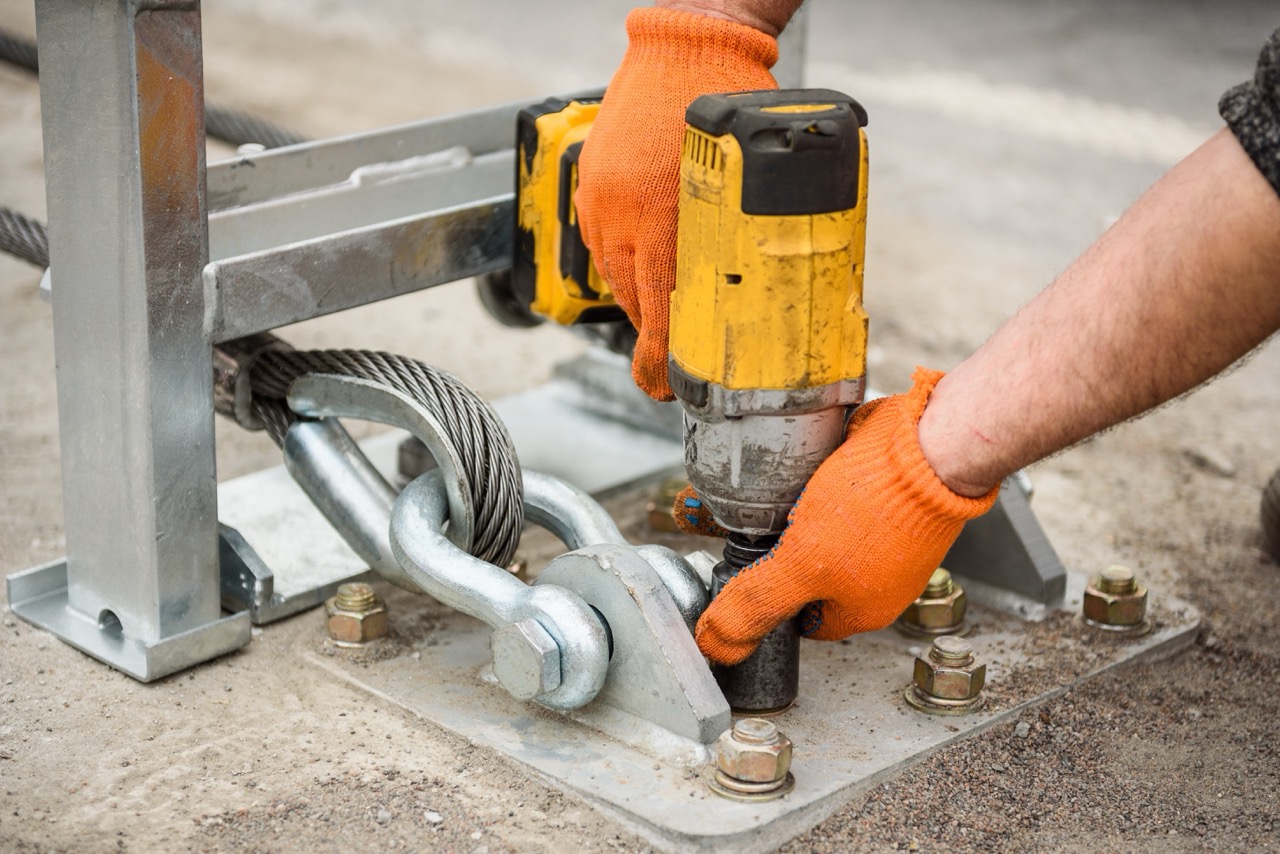
▲ Torque wrenches are essential — but the torque value only matters if the K factor is correct for your actual installation conditions
Common Torque Mistakes
Mistake 1: Using Generic Torque Tables
Every bolt supplier publishes a "recommended torque" table. Most of them assume K=0.15 (lightly oiled, zinc plated). If your bolts are HDG, black oxide, or installed dry, the table is wrong.
Always check what K factor the table assumes. If it doesn't say, assume K=0.15 and adjust accordingly. For HDG bolts, use K=0.18-0.20. For dry unplated bolts, K=0.20. For lubricated bolts, K=0.10-0.12.
Mistake 2: Ignoring Bolt Grade
A grade 8.8 M20 bolt and a grade 10.9 M20 bolt have the same dimensions but very different strength. The 10.9 bolt can take 35% more clamp force. If you use the 8.8 torque value on a 10.9 bolt, you're under-tightening. If you use the 10.9 value on an 8.8 bolt, you'll yield it.
Always calculate torque based on the actual bolt grade and the target preload (typically 70-75% of proof load for permanent joints, 50-60% for joints that may be disassembled).
For more on bolt grades and their properties, see our grade 8.8 / 10.9 / 12.9 guide.
Mistake 3: Using Impact Guns for Final Tightening
Impact guns are great for running bolts down quickly. They're terrible for accurate torque. An impact gun's output torque varies with air pressure, operator technique, and the number of impacts. I've seen "450 Nm" impact settings produce anywhere from 250 to 600 Nm actual torque.
Rule: use impact guns for snugging only. Always finish with a calibrated torque wrench or a calibrated tension control wrench (TC wrench for twist-off bolts).
Mistake 4: Not Calibrating the Torque Wrench
A torque wrench that's out of calibration is worse than no torque wrench — it gives you false confidence. Torque wrenches should be calibrated every 12 months or after 5,000 cycles, whichever comes first. Drop a torque wrench? Recalibrate before using it again.
Torque-Angle Tightening — The Better Method
For critical structural joints, torque-only tightening isn't accurate enough. The solution is torque-angle (turn-of-nut) tightening:
- Snug the bolt to a low "snug torque" (typically 20-30% of final torque) to bring the joint together
- Mark the bolt and nut with a reference line
- Rotate the nut by a specified angle (e.g., 180° for M20, 120° for M16) to achieve the target preload
Why is this better? Because the angle directly correlates with bolt elongation (stretch), which directly correlates with clamp force. Friction variations affect the torque needed to reach the angle, but once you've reached the angle, the clamp force is consistent no matter friction.
Torque-angle tightening achieves ±10-15% accuracy in clamp force, compared to ±25-35% for torque-only. For steel structures, bridges, and heavy machinery, this is the standard method.
Our grade 10.9 structural bolt sets (bolt + nut + washer) are designed for torque-angle tightening and come with installation instructions.
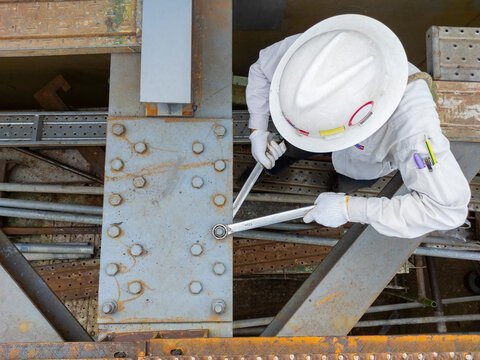
▲ Structural steel erection — torque-angle tightening is mandatory for most building codes
Quick Torque Reference (K=0.15, 70% Proof Load)
| Size | Grade 8.8 (Nm) | Grade 10.9 (Nm) | Grade 12.9 (Nm) |
|---|---|---|---|
| M10 | 55 | 75 | 90 |
| M12 | 95 | 130 | 160 |
| M16 | 230 | 320 | 390 |
| M20 | 450 | 620 | 760 |
| M24 | 780 | 1,080 | 1,320 |
Note: These values assume K=0.15 (lightly oiled zinc plating) and 70% of proof load. Adjust K for your actual conditions. For HDG bolts, multiply by 1.2-1.3. For dry unplated bolts, multiply by 1.3.
How We Calibrate Torque in Our QC Lab
Our torque lab has three calibrated torque analyzers — 0-50 Nm, 0-500 Nm, and 0-2,000 Nm. Each is calibrated annually by an ISO 17025 lab, and we verify daily with a known torque wrench. When a customer asks "what torque should I use for an M16 grade 10.9 bolt?" we don't just quote the standard table — we test it. We mount the bolt in a load cell, apply torque with a calibrated wrench, and measure the actual preload. The difference between calculated and actual preload can be 20-30% depending on coating and lubrication.
For zinc-plated bolts, the K-factor (nut factor) is typically 0.14-0.18. For HDG, it's 0.16-0.22 because the zinc coating is thicker and rougher. For waxed or lubricated bolts, it drops to 0.10-0.12. If you use the same torque for all three, your clamp force varies by 40%. We provide a torque recommendation sheet with every order — based on the actual coating on your bolts, not a generic table.
Torque Wrench Calibration — Don't Skip This
A torque wrench that reads 200 Nm but actually delivers 240 Nm is a disaster waiting to happen. We calibrate our torque wrenches every 5,000 cycles or every 6 months — whichever comes first — against a calibrated torque analyzer traceable to ISO 17025. A click-type wrench can drift 10-15% after 10,000 cycles without any visible sign. If your crew is using the same torque wrench for 3 years without calibration, your bolt preload is a guessing game.
Also: never use a torque wrench as a breaker bar. The ratchet mechanism is designed for controlled tightening, not for breaking loose rusted bolts. Using it as a breaker bar damages the internal spring and throws off the calibration. We keep separate breaker bars in our workshop — cheap insurance against a $50,000 joint failure.
FAQ
Q: How do I know what K factor to use?
A: The most accurate way is to measure it — use a load cell or ultrasonic bolt tester to measure actual clamp force at a given torque. For estimates: dry/unplated = 0.20, zinc plated = 0.15-0.18, oiled = 0.12-0.14, waxed/dry film lube = 0.10-0.12. When in doubt, use a higher K (more conservative) and verify with a torque-angle method.
Q: Can I re-torque bolts after they've been in service?
A: For permanent joints, re-torquing is generally not recommended — the bolt may have relaxed (lost preload) and re-torquing could over-yield it. For joints designed for disassembly, re-torque to the original spec. If a bolt has been in service for more than a few years, replace it rather than re-torque — fatigue and corrosion may have reduced its strength.
Q: What's the difference between torque and tension?
A: Torque is the rotational force applied to the nut (Nm). Tension (preload) is the axial stretch force in the bolt (kN). Torque is used to create tension, but the relationship depends on friction. Tension is what actually holds the joint together. For critical joints, measure tension directly (ultrasonic testing, load cells) rather than relying on torque.
Q: Why do bolts sometimes break during tightening?
A: Usually because of over-torquing — the bolt exceeds its yield strength and fractures. Other causes: wrong grade bolt (8.8 used where 10.9 was specified), hydrogen embrittlement in high-strength bolts (see our hydrogen embrittlement article), or thread galling in stainless steel bolts. Always verify the bolt grade before tightening.
Q: Should I lubricate bolts before tightening?
A: Only if the spec calls for it. Lubrication reduces friction, which means the same torque produces more clamp force. If you lubricate a bolt that was spec'd for dry installation, you may over-torque and yield it. Conversely, if the spec assumes lubrication and you install dry, you'll under-torque. Always match the lubrication condition to what the torque spec assumes.
Torque is a tool, not a truth. Use it wisely — know your K factor, use the right method for the application, and verify critical joints. A properly tightened bolt is invisible; an improperly tightened one is a disaster waiting to happen.
Need a Quote? Talk to Our Fastener Engineers
Email: [email protected]
WhatsApp / Phone: +86 185 3100 9807
Factory: No. 668 Longyuan Street, Yongnian District, Handan City, Hebei Province, China
✅ 180-day free warehouse storage | ✅ 96-hour stock delivery | ✅ Mixed container small orders | ✅ ISO 9001 / 14001 / 45001 certified