Key Takeaways
· Bolt grade numbers (8.8, 10.9, 12.9) encode two properties: the first digit × 100 = tensile strength in MPa; the first digit × second digit × 10 = yield strength in MPa.
· Grade 8.8 = 800 MPa tensile / 640 MPa yield (medium carbon steel, quenched and tempered). Grade 10.9 = 1000 MPa / 900 MPa (boron or alloy steel). Grade 12.9 = 1200 MPa / 1080 MPa (alloy steel, highest strength).
· Higher grade = higher strength but also higher risk: grade 12.9 is more susceptible to hydrogen embrittlement, stress corrosion cracking, and fatigue notch sensitivity.
· Don't over-specify: grade 8.8 is sufficient for 80% of applications. Use 10.9 for high-load structural, 12.9 only when weight or space constraints demand the absolute highest strength.
Quick Answer
Grade 8.8 covers 80% of applications (800 MPa tensile). Grade 10.9 is for structural and high-load joints (1000 MPa). Grade 12.9 is only for weight/space-critical applications (1200 MPa) and carries significant hydrogen embrittlement risk — don't over-specify.
"We need high-strength bolts." That's what the buyer says. But what does "high-strength" mean? Grade 8.8? 10.9? 12.9? And what's the actual difference between them — besides the price?
I've seen buyers specify grade 12.9 bolts for a fence bracket (massive overkill, and a hydrogen embrittlement risk). I've also seen grade 4.8 bolts used in a structural connection (under-specified, and a safety hazard). Getting the grade right is one of the most fundamental decisions in fastener sourcing — and one of the most commonly misunderstood.
After years of supplying fasteners across industries — from construction to automotive to wind energy — here's a practical guide to bolt grades: what the numbers mean, how they're made, where each grade is appropriate, and the risks of getting it wrong.
Last year, a machinery manufacturer in Germany ordered M12 grade 12.9 bolts for a conveyor system frame. They thought "higher grade is safer." The bolts cost 40% more than grade 8.8, and six months after installation, three bolts fractured without warning — hydrogen embrittlement from the zinc plating process. The replacement cost: €12,400 in labor and downtime. Grade 8.8 bolts would have cost less and lasted the full service life. The design load only required 640 MPa yield — grade 8.8 delivers exactly that.
The Grade 12.9 Mistake That Cost €12,400
A German buyer ordered 12.9级 bolts because "stronger is better" for a wind turbine flange. But 12.9 is more susceptible to hydrogen embrittlement, and the electroplated coating introduced hydrogen. 14 bolts snapped during assembly — €12,400 in downtime and rework. We recommended 10.9 with zinc-flake coating (zero hydrogen) — 90% of the strength, zero embrittlement risk. He's ordered 8 containers since. Higher grade isn't always better — it's about matching the grade to the application.
Decoding the Grade Number
The ISO 898-1 grade designation (e.g., 8.8, 10.9, 12.9) is a two-part code that tells you the bolt's mechanical properties:
First digit × 100 = Minimum Tensile Strength (MPa)
First digit × Second digit × 10 = Minimum Yield Strength (MPa)
So for a grade 8.8 bolt:
- Tensile strength = 8 × 100 = 800 MPa (minimum)
- Yield strength = 8 × 8 × 10 = 640 MPa (minimum)
- Yield-to-tensile ratio = 640/800 = 0.80 (80%)
For grade 10.9:
- Tensile = 10 × 100 = 1000 MPa
- Yield = 10 × 9 × 10 = 900 MPa
- Yield ratio = 0.90 (90%)
For grade 12.9:
- Tensile = 12 × 100 = 1200 MPa
- Yield = 12 × 9 × 10 = 1080 MPa
- Yield ratio = 0.90 (90%)
The yield-to-tensile ratio matters because it tells you how much the bolt can stretch before it permanently deforms (yields) relative to its breaking point. A higher ratio means the bolt has less "stretch reserve" — it's closer to its breaking point when it yields. Grade 12.9 bolts, with a 90% yield ratio, are more notch-sensitive and more prone to sudden fracture than grade 8.8 (80% yield ratio).
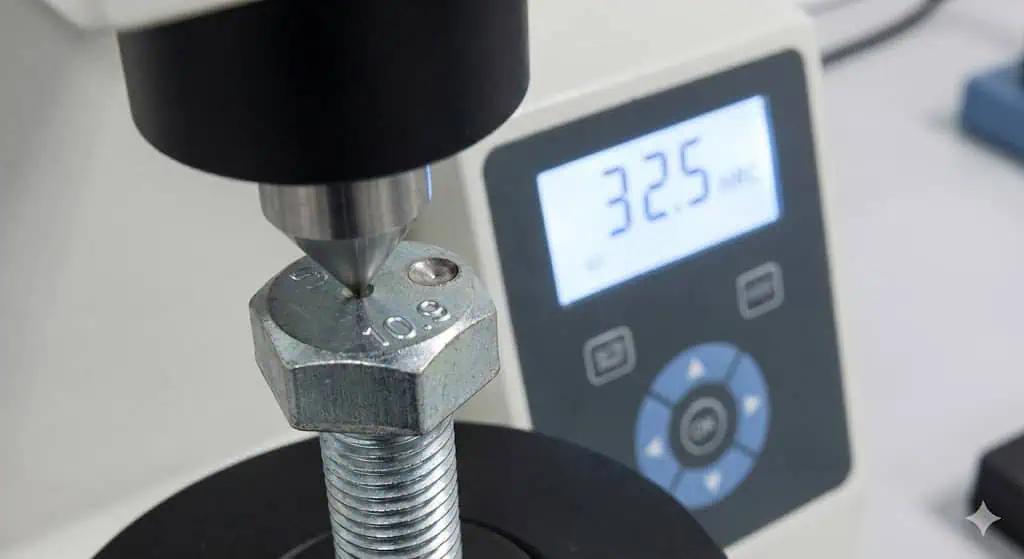
▲ Hardness testing verifies the heat treatment achieved the target grade — grade 8.8 = HRC 22-32, 10.9 = HRC 32-39, 12.9 = HRC 39-44
Material and Heat Treatment by Grade
The grade isn't just a number — it's achieved through specific material chemistry and heat treatment:
Grade 4.6 / 4.8 / 5.8 (Low Strength)
- Material: Low carbon steel (ML08Al, ML10Al, SWRCH 10A, Q195)
- Heat treatment: None (as-formed, or stress-relieved only)
- Hardness: HRB 50-85 (too soft for HRC scale)
- Use: General purpose, non-structural — furniture, signage, light fixtures, sheet metal, low-load applications
- Cost: Lowest
Grade 8.8 (Medium Strength)
- Material: Medium carbon steel (ML35, ML37Cr, SWRCH 35K, C35)
- Heat treatment: Quenched (oil) and tempered at ~550-650°C
- Hardness: HRC 22-32
- Use: The workhorse grade — automotive chassis, machinery, general structural, pipe flanges, agricultural equipment. 80% of industrial fasteners are grade 8.8.
- Cost: Moderate (20-40% premium over grade 4.8)
Grade 10.9 (High Strength)
- Material: Boron steel (ML35VB, SWRCH 35VB) or medium carbon alloy (40Cr, SCM435)
- Heat treatment: Quenched (oil) and tempered at ~450-550°C
- Hardness: HRC 32-39
- Use: Structural steel (buildings, bridges), heavy machinery, automotive suspension, wind turbine foundations, high-load connections
- Cost: High (30-50% premium over grade 8.8)
- Special requirements: MPI inspection recommended, hydrogen embrittlement prevention required for electroplated bolts
Grade 12.9 (Very High Strength)
- Material: Alloy steel (42CrMo, SCM440, ML42CrMo, 4140/4142)
- Heat treatment: Quenched (oil) and tempered at ~400-500°C
- Hardness: HRC 39-44
- Use: Aerospace, racing, high-performance automotive, heavy equipment pins, applications where weight or space is critical and maximum strength is required
- Cost: Highest (50-100% premium over grade 8.8)
- Special requirements: 100% MPI mandatory, no electroplating (use zinc flake or mechanical plating), strict hydrogen embrittlement control, limited to temperatures below 150°C (temper embrittlement risk)
Mechanical Properties Comparison
| Property | 4.8 | 8.8 | 10.9 | 12.9 |
|---|---|---|---|---|
| Tensile (MPa) | 400 | 800 | 1000 | 1200 |
| Yield (MPa) | 320 | 640 | 900 | 1080 |
| Hardness (HRC) | — (HRB 70) | 22-32 | 32-39 | 39-44 |
| Elongation (%) | 18 | 12 | 9 | 8 |
| Reduction of area (%) | — | 35 | 40 | 35 |
| HE risk | None | Low | Moderate | High |
| Fatigue notch sensitivity | Low | Moderate | High | Very high |
How to Choose the Right Grade
Start with the Load
Calculate the required clamp force and shear/tensile load for the joint. Then select the smallest bolt grade (and diameter) that provides a safety factor of 2:1 or higher (per most design codes). Don't just specify the highest grade available — that's overkill and introduces unnecessary risk.
Consider the Environment
- Corrosive environment (coastal, chemical): higher strength steel is more susceptible to stress corrosion cracking and hydrogen embrittlement. If corrosion is a concern, grade 8.8 with HDG or zinc flake coating may be more durable than grade 12.9 with a thin coating.
- Low temperature (below -30°C): higher strength steel has a higher ductile-to-brittle transition temperature. Grade 12.9 may become brittle at -40°C, while grade 8.8 in the right steel (35CrMoA) remains ductile. See our low-temperature fastener guide.
- High temperature (above 150°C): grade 12.9 can suffer from temper embrittlement. Grade 8.8 or 10.9 with appropriate tempering is safer above 150°C.
Consider the Coating
Grade 12.9 bolts should NOT be electroplated (zinc, cadmium) — the hydrogen introduced during plating can cause catastrophic delayed fracture. Use zinc flake (Dacromet/Geomet), mechanical plating, or hot-dip galvanizing with post-bake. Grade 10.9 can be electroplated but requires mandatory post-plating baking. Grade 8.8 can be electroplated with low risk. See our hydrogen embrittlement guide.
Consider the Application Type
- Static, non-critical (furniture, signage, light fixtures): grade 4.8 or 5.8 is sufficient
- General industrial (machinery, pipe flanges, automotive non-structural): grade 8.8 — the default choice
- Structural / high-load (buildings, bridges, heavy equipment, wind towers): grade 10.9
- Critical / weight-sensitive (aerospace, racing, high-performance): grade 12.9 — only when specifically required by the design
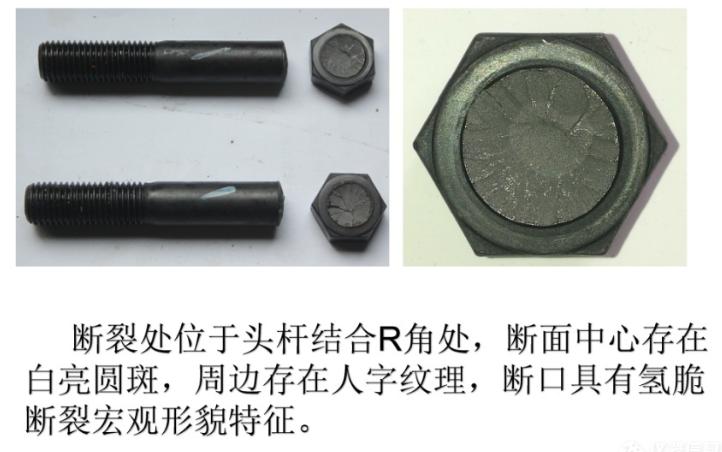
▲ Fracture surfaces tell the story — brittle intergranular fracture (HE) vs ductile overload fracture. Higher grade bolts are more susceptible to HE and brittle failure.
Common Grade-Related Mistakes
Mistake 1: Over-Specifying (12.9 for Everything)
Some buyers think "stronger is better" and specify grade 12.9 for all applications. This is a mistake. Grade 12.9 is more expensive, more susceptible to hydrogen embrittlement, more notch-sensitive, and has a narrower safe operating range. For 80% of applications, grade 8.8 is the right choice — it provides ample strength with better toughness and lower risk.
Mistake 2: Under-Specifying (4.8 for Structural)
Using low-strength bolts in structural connections is a safety hazard. Grade 4.8 bolts have 400 MPa tensile — half the strength of grade 8.8. In a structural joint, they will yield and deform at loads well below the design capacity, potentially causing catastrophic failure. Always follow the engineer's grade specification for structural applications.
Mistake 3: Ignoring Head Markings
Every high-strength bolt must have the grade marked on the head (e.g., "8.8", "10.9", "12.9") plus the manufacturer's logo. If a bolt has no grade marking, assume it's grade 4.8 or lower — don't use it in a high-strength application. Counterfeit bolts (marked "10.9" but actually grade 4.8 or 8.8) are a known problem in some markets — always buy from reputable suppliers and request material certificates.
Mistake 4: Mixing Grades in the Same Connection
Never mix bolt grades in the same connection. If you have 4 grade 10.9 bolts and 2 grade 8.8 bolts in the same joint, the grade 8.8 bolts will yield first, transferring all the load to the grade 10.9 bolts — which may then overload. All bolts in a connection must be the same grade (and the same diameter, coating, and installation method).
Mistake 5: Using the Wrong Nut Grade
The nut must match the bolt grade — class 8 nut for grade 8.8 bolt, class 10 nut for grade 10.9, class 12 nut for grade 12.9. A lower-class nut will strip (thread shear) before the bolt reaches its rated load. See our bolt-nut grade matching guide.
We supply DIN 931 bolts in grades 4.8, 8.8, and 10.9, grade 10.9 structural bolts, and grade 10.9 flange bolts, with full material certificates and hardness test reports for every batch.
What This Looks Like on Our Factory Floor
Walk through our heat treatment shop in Yongnian, and you'll see 12 continuous mesh-belt furnaces running 24/7. Each furnace holds a specific temperature profile — for grade 8.8 bolts, we quench at 850°C and temper at 580°C. The operator logs every batch: furnace number, charge weight, dwell time, oil temperature. No batch leaves without a Rockwell hardness reading — we test 5 pieces per 1,000, and if any one falls outside HRC 22-32, the whole batch goes back for re-treatment.
For grade 10.9, the steel changes — we use 40Cr or 35VB boron steel, and the quench oil is agitated to prevent soft spots. Grade 12.9 uses 42CrMo alloy and requires a stricter tempering window. Our QC manager has been doing this for 18 years. He can tell you which furnace runs slightly hot on Tuesday mornings. That kind of experience doesn't show up in a spec sheet — but it shows up in your bolt's fatigue life.
FAQ
Q: What's the difference between property class and grade?
A: In ISO terminology, bolts have "grades" (8.8, 10.9, 12.9) defined in ISO 898-1, while nuts have "property classes" (8, 10, 12) defined in ISO 898-2. In everyday usage, people often say "grade" for both, but technically bolts have grades and nuts have property classes. The numbering system is designed to match: a grade 8.8 bolt pairs with a property class 8 nut, a grade 10.9 bolt with a class 10 nut, etc. The first digit of the bolt grade corresponds to the nut property class number.
Q: Can I replace a grade 8.8 bolt with a grade 10.9 bolt?
A: Generally yes — a higher-grade bolt can replace a lower-grade bolt, as long as the nut and washer are also upgraded to match (class 10 nut, hardened washer). The higher-grade bolt has more strength, so it won't be overloaded. But here's the catch: there are exceptions: (1) if the original grade 8.8 bolt was electroplated and the grade 10.9 replacement is also electroplated, the 10.9 requires post-plating baking (the 8.8 may not have needed it). (2) If the application involves hydrogen exposure (corrosion, cathodic protection), the higher-grade 10.9 is more susceptible to hydrogen embrittlement. (3) If the bolt is in a low-temperature environment, verify the 10.9 material has sufficient low-temperature toughness. When in doubt, consult the design engineer.
Q: How do I verify a bolt's grade if the marking is unclear?
A: Three methods: (1) Hardness test — grade 8.8 = HRC 22-32, 10.9 = HRC 32-39, 12.9 = HRC 39-44. A portable Rockwell hardness tester can verify on site. (2) Tensile test — destructive test on a sample bolt to measure actual tensile and yield strength. (3) Spectral analysis — verify the material chemistry matches the expected grade (e.g., 42CrMo for grade 12.9, ML35VB for grade 10.9). For critical applications, request the manufacturer's material certificate (EN 10204 3.1) which includes both chemistry and mechanical test results. Never rely on head marking alone for critical applications — counterfeit marking is a known issue.
Q: Are there grades higher than 12.9?
A: ISO 898-1 defines grades up to 12.9 for standard fasteners. There are specialty grades (14.9) used in aerospace and racing, but they're not covered by ISO 898-1 and require special manufacturing and inspection. Grade 14.9 bolts have 1400 MPa tensile but are extremely susceptible to hydrogen embrittlement and stress corrosion — they're only used in highly controlled applications with rigorous quality assurance. For industrial and structural use, 12.9 is the practical maximum.
Q: What's the typical price difference between grades?
A: As a rough guide for M16 x 80mm hex bolts (zinc plated, ex-factory China): grade 4.8 = $0.08-0.12/pc, grade 8.8 = $0.12-0.18/pc (50% premium), grade 10.9 = $0.18-0.28/pc (100-130% premium over 4.8), grade 12.9 = $0.25-0.40/pc (200%+ premium over 4.8). The premium increases with larger sizes and higher coating requirements (HDG, zinc flake). For structural bolt sets (bolt + nut + washer), the grade 10.9 set is typically 2-3x the price of a grade 8.8 set due to the hardened washer and class 10 nut.
Bolt grade selection is one of those fundamentals that's easy to get wrong but critical to get right. Understand what the numbers mean, match the grade to the actual load and environment, don't over-specify (12.9 isn't always better), and always verify with head markings and material certificates. Do that, and your bolts will perform as designed — safely, reliably, and for their full service life.
Need a Quote? Talk to Our Fastener Engineers
Email: [email protected]
WhatsApp / Phone: +86 185 3100 9807
Factory: No. 668 Longyuan Street, Yongnian District, Handan City, Hebei Province, China
✅ 180-day free warehouse storage | ✅ 96-hour stock delivery | ✅ Mixed container small orders | ✅ ISO 9001 / 14001 / 45001 certified