Key Takeaways
· At low temperatures, carbon steel becomes brittle — the ductile-to-brittle transition temperature (DBTT) for standard grade 8.8 is around -20°C to -30°C; below that, bolts can fracture without warning.
· For service below -30°C, specify low-temperature steel grades (e.g., 35CrMoA, 42CrMoA) with Charpy V-notch impact testing at the service temperature — don't use standard 8.8/10.9 bolts.
· Stainless steel (304/316) remains ductile down to -196°C and is an excellent choice for cryogenic service — but has lower strength than carbon steel.
· Coating matters in cold climates: HDG bolts can suffer from "cold cracking" if the zinc coating is too thick or the steel has high hardness; zinc plating is generally safe down to -40°C.
Quick Answer
Below -30°C, standard grade 8.8/10.9 bolts become brittle and can fracture without warning. Specify low-temperature steel (35CrMoA, 42CrMoA) with Charpy V-notch impact testing at your service temperature, or use austenitic stainless (304/316) which stays ductile down to -196°C. Never use standard bolts in Arctic or cryogenic service.
A buyer in Norway calls: "We need M24 grade 10.9 bolts for a bridge project. The winter temperature here drops to -35°C. Are standard grade 10.9 bolts okay?"
The answer is no — and it's a question that has led to catastrophic failures. At low temperatures, carbon steel changes its behavior. It goes from ductile (bends before breaking) to brittle (snaps without warning). A bolt that performs perfectly at +20°C can fracture catastrophically at -35°C, with no visible deformation and no warning.
This isn't theoretical. There are documented cases of bolt failures in cold climates — bridges in Canada, oil platforms in the North Sea, railway lines in Siberia — where the root cause was brittle fracture of standard carbon steel bolts at low temperature. The bolts met all room-temperature specifications but weren't certified for low-temperature service.
Having supplied fasteners for cold-climate projects across Scandinavia, Canada, and Russia, I've learned that low-temperature fastener selection is a specialized discipline. Here's what you need to know.
A mining operation in Siberia installed standard grade 8.8 bolts on a conveyor support structure. Winter temperatures hit -42°C. During a cold snap in January, 4 support bolts fractured overnight — the conveyor collapsed, damaging $280,000 of equipment. The bolts had a ductile-to-brittle transition temperature of -22°C. At -42°C, they were as brittle as glass. The replacement used 35CrMoA grade 10.9 bolts with Charpy certification at -50°C. Cost premium: 35%. The lesson: for any project where temperatures drop below -20°C, demand Charpy test data — not just a grade marking.
-40°C in Siberia: The Bolt That Didn't Snap
A Russian oilfield customer needed bolts for a pumping station operating at -40°C. Standard grade 8.8 bolts have a Charpy V-notch impact of 27J at -20°C — at -40°C they're brittle. We supplied grade 8.8 with Ni-Cr alloy steel, tested to 40J at -50°C. First winter: zero failures. The previous supplier's bolts had snapped 3 times in one season. Low-temperature service isn't about "stiffer steel" — it's about impact toughness at the actual service temperature.
The Ductile-to-Brittle Transition
Carbon steel has a temperature below which it loses its ductility. This is called the ductile-to-brittle transition temperature (DBTT), measured by the Charpy V-notch impact test. Above the DBTT, the steel absorbs energy by deforming (ductile fracture — it bends, necks, then breaks). Below the DBTT, the steel fractures with almost no deformation (brittle fracture — it snaps like glass).
For standard fastener steels:
| Bolt Grade | Typical Steel | DBTT Range | Safe Service Temp |
|---|---|---|---|
| 4.6 / 4.8 | Low carbon steel | -10°C to 0°C | Above -10°C |
| 8.8 | Medium carbon (35K, ML35) | -30°C to -20°C | Above -20°C |
| 10.9 | Boron steel (35VB, 40Cr) | -40°C to -25°C | Above -30°C |
| 12.9 | Alloy steel (42CrMo) | -50°C to -30°C | Above -40°C |
Important: these are typical values, not guarantees. The actual DBTT depends on the specific steel chemistry, heat treatment, grain size, and presence of inclusions. Two grade 8.8 bolts from different suppliers can have DBTTs that differ by 15-20°C. The only way to know is to test — Charpy V-notch impact testing at the service temperature.
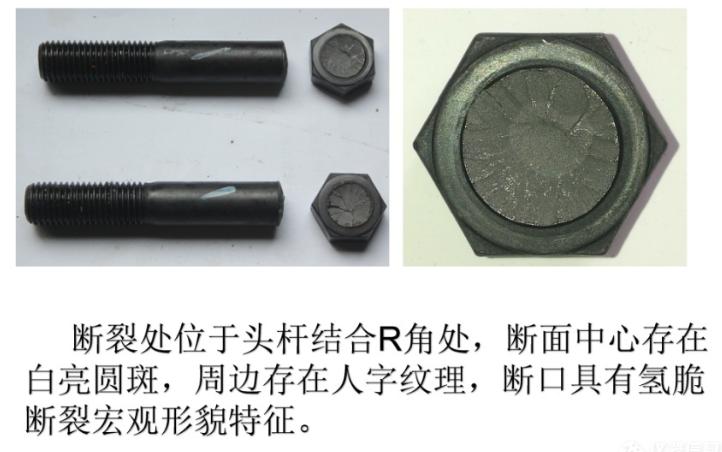
▲ Brittle fracture (left) vs ductile fracture (right) — at low temperatures, carbon steel snaps without the necking and deformation that warn of impending failure
Charpy V-Notch Impact Testing
The Charpy V-notch test is the standard method for measuring a material's resistance to brittle fracture. A notched specimen is struck by a swinging pendulum, and the energy absorbed (in Joules) is measured. The test is repeated at different temperatures to determine the DBTT.
For low-temperature fasteners, specify:
- Test temperature — the minimum service temperature (e.g., -40°C for a project in northern Sweden)
- Minimum impact energy — typically 27J (average of 3 specimens) at the test temperature, per ISO 898-1 or ASTM A320
- Test standard — ISO 148-1 (international) or ASTM E23 (US)
- Certification — EN 10204 3.1 certificate with actual Charpy test results, not just "meets standard"
Never accept "suitable for low temperature" as a specification. Demand actual Charpy test data at your service temperature. A bolt that passes at -20°C may fail at -40°C — and the difference is invisible without testing.
Low-Temperature Steel Grades
For service below -30°C, standard grade 8.8/10.9 bolts are not sufficient. Specify low-temperature steel grades:
Carbon-Manganese Steels
- ML35Mn — improved low-temperature toughness vs standard ML35, suitable down to -40°C with proper heat treatment
- 35K2 — killed steel with fine grain, suitable down to -45°C
Alloy Steels
- 35CrMoA — chromium-molybdenum steel, excellent low-temperature toughness, suitable down to -50°C. Commonly used for grade 10.9 low-temperature bolts.
- 42CrMoA — higher carbon chromium-molybdenum, suitable down to -60°C, used for grade 12.9 low-temperature bolts.
- 40CrNiMoA — nickel-chromium-molybdenum, superior toughness down to -80°C, used for critical cryogenic applications.
Stainless Steel
- A2-70 (304) — austenitic stainless, remains ductile down to -196°C (liquid nitrogen temperature). Excellent for cryogenic service, but lower strength (700 MPa tensile, ~205 MPa yield).
- A4-80 (316) — same low-temperature ductility as 304, with better corrosion resistance. Suitable for coastal cold-climate applications.
For more on stainless steel selection, see our 304 vs 316 guide.
Coating Considerations in Cold Climates
Cold climates bring unique coating challenges:
Hydrogen Embrittlement + Cold Cracking
High-strength bolts (10.9+) that are electroplated or hot-dip galvanized can suffer from hydrogen embrittlement — hydrogen introduced during the plating process causes delayed fracture. At low temperatures, this risk increases because the steel is already more brittle. The combination of hydrogen + low temperature can cause bolts to fracture weeks after installation, even at loads below their rated capacity.
For HDG high-strength bolts in cold climates:
- Specify post-galvanizing baking (190-230°C for 8-24 hours) to remove hydrogen
- Limit hardness to HRC 35 maximum (per ASTM F2329) — harder bolts are more susceptible
- Consider using zinc flake coatings (Dacromet, Geomet) instead of HDG — they don't introduce hydrogen
For more on hydrogen embrittlement, see our hydrogen embrittlement prevention guide.
Road Salt and Corrosion
Cold climates use road salt (NaCl or CaCl₂) for de-icing. This chloride-rich environment accelerates corrosion of fasteners on bridges, parking garages, and road barriers. Standard zinc plating will corrode through in 3-5 years; HDG lasts 15-25 years; A4-80 stainless lasts 30+ years.
For cold-climate exterior structures exposed to road salt, specify HDG minimum, or A4-80 stainless for maximum life. See our coatings guide for detailed comparison.
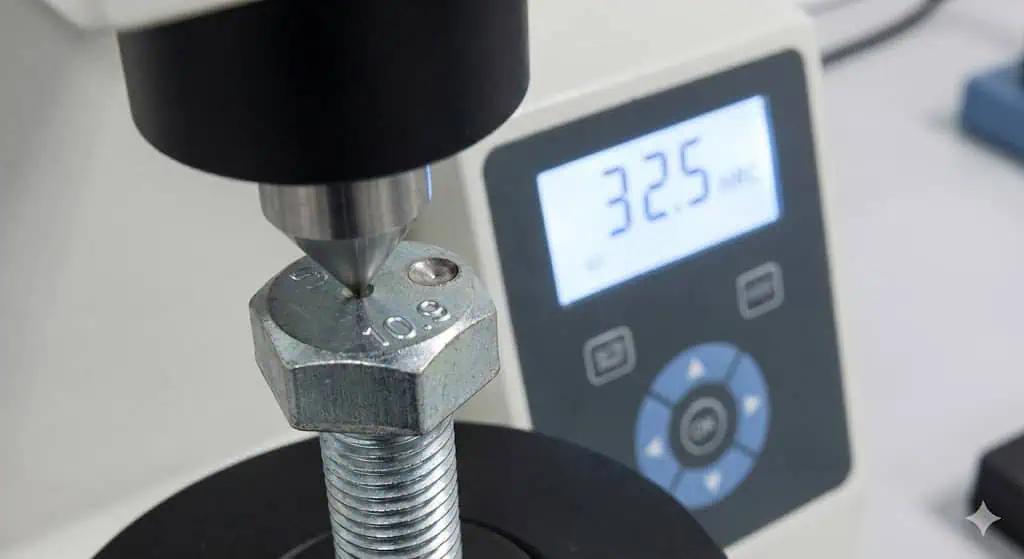
▲ Hardness testing alone isn't enough for low-temperature service — Charpy impact testing at the service temperature is the critical verification
Installation in Cold Weather
Installing fasteners at low temperature requires special procedures:
- Torque adjustment — At low temperatures, lubricants thicken and friction increases. The same torque produces less clamp force in cold weather. Increase torque by 10-15% for installation below -10°C, or use a torque-angle method for accuracy.
- Thermal contraction — Bolts and the joined materials contract at different rates as temperature drops. A bolt tightened at +20°C may lose clamp force at -30°C if the joined material (e.g., aluminum) contracts more than the steel bolt. Design for this differential contraction, or re-torque after the first cold cycle.
- Brittle impact during installation — Never strike a cold bolt with a hammer — it may chip or fracture. Use hand tools or torque wrenches, not impact guns, for final tightening at low temperature.
- Condensation and ice — Bolts stored outdoors in cold weather may have ice or condensation in the threads. Dry and clean threads before installation — ice in the threads prevents proper tightening and can cause galling when it melts.
For more on torque and installation, see our bolt torque calculation guide.
Yuanpai's Low-Temperature Fastener Range
For cold-climate projects, we supply grade 10.9 structural bolts in 35CrMoA low-temperature steel with Charpy V-notch impact testing at -40C, A4-80 stainless steel bolts for coastal cold-climate corrosion resistance, and DIN 931 hex bolts with HDG and post-bake for bridge and structural applications. All low-temperature bolts come with Charpy test certificates (EN 10204 3.1) at your specified service temperature.
Storage and Installation Tips for Cold-Climate Bolts
How you store and install low-temperature bolts matters as much as the steel grade. Keep bolts indoors above 5°C before installation — cold steel is more brittle and更容易受到冲击损伤。 Never heat bolts with a torch to "warm them up" — localized heating changes the temper and creates a brittle zone at the heat-affected area.
During installation, use a calibrated torque wrench — not an impact gun. Impact wrenches can over-torque by 30-40% in cold conditions because the lubricant thickens. For grade 10.9 bolts below -30°C, we recommend torque-angle tightening instead of pure torque — angle tightening produces more consistent preload no matter friction variations. And never reuse a bolt that has been tightened to yield — the work hardening makes it more susceptible to brittle fracture on the second use.
FAQ
Q: Can I use standard grade 8.8 bolts at -25°C?
A: It depends on the specific steel and heat treatment. Some grade 8.8 bolts have a DBTT of -30°C and are fine at -25°C; others have a DBTT of -15°C and will be brittle. The only way to know is to request Charpy impact test data at -25°C. If you can't get test data, don't use standard 8.8 below -20°C for safety-critical applications — specify low-temperature steel (35CrMoA) with Charpy certification.
Q: What about grade 12.9 bolts for low temperature?
A: Grade 12.9 bolts made from 42CrMoA can have good low-temperature toughness (DBTT -50°C to -30°C) if properly heat treated (quenched and tempered at high tempering temperature). But here's the catch: grade 12.9 is highly susceptible to hydrogen embrittlement, especially after plating. For low-temperature service, specify grade 12.9 in 42CrMoA with Charpy testing at service temperature, and use zinc flake coating (not HDG or electroplating) to avoid hydrogen. Or consider grade 10.9 in 35CrMoA — it has better toughness and lower hydrogen risk.
Q: Are stainless steel bolts always safe at low temperature?
A: Austenitic stainless (304, 316) remains ductile down to cryogenic temperatures (-196°C) — yes, they're safe. But they have lower yield strength than carbon steel, so a stainless bolt may deform (yield) at a lower load than a carbon steel bolt of the same size. For high-load applications, verify that the stainless bolt's yield strength is sufficient. Also, stainless steel bolts can gall (seize) when tightened — use anti-seize compound, especially at low temperature where lubricants may be less effective.
Q: What's the difference between ASTM A320 and standard fastener grades?
A: ASTM A320 is a specific standard for low-temperature bolting materials (L7, L7M, B8, B8M classes). It requires Charpy impact testing at specified temperatures (e.g., -100°F/-73°C for L7, -150°F/-101°C for L7M). If your project references ASTM A320, you must use bolts certified to that standard — standard ISO 898-1 grade 8.8/10.9 bolts don't automatically meet A320 requirements, even if the steel chemistry is similar. The Charpy test requirements and heat treatment controls are different.
Q: How do I verify low-temperature performance after installation?
A: You can't easily test installed bolts for low-temperature toughness. The verification must happen at the factory: request Charpy impact test reports (EN 10204 3.1 or 3.2) for every batch, and verify that the test temperature is at or below your minimum service temperature. For critical applications, consider third-party inspection (Lloyd's, SGS, Bureau Veritas) to witness the testing and verify the results. Once installed, periodic inspection for cracks (MPI or visual) and re-torquing is the best you can do.
Low-temperature fastening is one of those areas where "good enough" isn't good enough. A bolt that passes every room-temperature test can fail catastrophically at -40°C. Specify the right steel, demand Charpy testing, choose the right coating, and install correctly. Do that, and your fasteners will perform reliably in the coldest climates on Earth.
Need a Quote? Talk to Our Fastener Engineers
Email: [email protected]
WhatsApp / Phone: +86 185 3100 9807
Factory: No. 668 Longyuan Street, Yongnian District, Handan City, Hebei Province, China
✅ 180-day free warehouse storage | ✅ 96-hour stock delivery | ✅ Mixed container small orders | ✅ ISO 9001 / 14001 / 45001 certified