Key Takeaways
· The nut must be as strong or stronger than the bolt — a grade 8 nut with a grade 10.9 bolt will strip the nut threads before the bolt reaches its rated load.
· ISO nut property classes (5, 8, 10, 12) map to bolt grades (5.8, 8.8, 10.9, 12.9) — always match or exceed the bolt grade with the nut class.
· Nut thread stripping is the preferred failure mode — it's gradual and gives warning; bolt fracture is sudden and catastrophic. Proper grade matching ensures the nut strips first.
· Stainless steel nuts must match the bolt material (A2 nut with A2 bolt, A4 nut with A4 bolt) — dissimilar stainless grades can cause galvanic corrosion and galling.
Quick Answer
Match the nut property class to the bolt grade: class 8 nut for grade 8.8 bolt, class 10 for grade 10.9, class 12 for grade 12.9. A weaker nut strips before the bolt reaches full load — a stronger nut overloads the bolt. Both are failure modes.
It's one of the most common mistakes in fastener sourcing: a buyer orders grade 10.9 bolts and pairs them with grade 8 nuts because "the nuts are cheaper" or "that's what we had in stock." On paper, the joint looks fine. Under load, the nut threads strip — and the bolt, which was the expensive part, is still perfectly intact.
I've seen this on construction sites, in automotive assembly plants, and in oil and gas facilities. The bolt is specified correctly, the torque is correct, the installation is correct — but the nut is wrong. And when the joint fails, everyone blames the bolt. The bolt wasn't the problem. The nut was.
Bolt-nut grade matching is one of those fundamentals that's easy to get wrong if you don't understand the mechanics. Here's how to get it right.
An automotive parts supplier in Mexico once paired grade 10.9 bolts with class 8 nuts because the class 8 nuts were in stock and "looked the same." During vibration testing on an engine mount, the nuts stripped at 62% of the bolt's rated load — the thread sheared off the nut before the bolt yielded. The root cause: class 8 nuts have a lower thread shear strength (800 MPa) than grade 10.9 bolts (1000 MPa), so the nut always fails first. The fix cost them a 3-week production delay and a re-qualification of the entire fastener package.
The Nut That Was Too Weak: A $15,000 Strip Test
A customer ordered grade 10.9 bolts but paired them with class 8 nuts — "they fit, so they must be fine." During installation, the nuts stripped at 70% of specified torque. The bolt was stronger than the nut, so the nut failed first. We supplied class 10 nuts and ran a strip test: bolt fractured at 115% of specified torque, nut held. Rule: nut must be as strong or stronger than the bolt. We automatically match nut grade to bolt grade on every order.
Why Nut Strength Matters
A bolted joint fails in one of two ways when overloaded:
- Bolt fracture — the bolt shank breaks. This is sudden, catastrophic, and gives no warning. The bolt snaps, the joint separates, and whatever it was holding comes apart.
- Thread stripping — the threads on the nut (or bolt) shear off. This is gradual — the nut "rides up" the bolt threads, clamp force decreases, and the joint loosens. It gives warning (decreased torque, visible thread deformation) before complete failure.
Designers intentionally make the nut slightly weaker than the bolt so that thread stripping happens first. This is called "nut factor design" or "stripping before fracture." The logic: a stripped nut can be detected during inspection and replaced before the joint fails completely. A fractured bolt gives no warning.
For this to work, the nut's thread shear strength must be less than the bolt's tensile strength — but not so much less that the nut strips at normal working loads. The sweet spot is when the nut strips at about 90-95% of the bolt's ultimate tensile load.
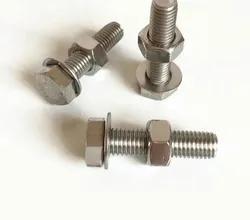
▲ Bolt and nut grade matching — the nut must be matched to the bolt so that threads strip gradually before the bolt fractures catastrophically
ISO Nut Property Classes
ISO 898-2 defines nut property classes (not "grades" — nuts use property classes, bolts use grades). The class number indicates the minimum tensile strength (in 100 MPa units) that the nut can withstand without thread stripping when paired with a matching bolt:
| Nut Property Class | Matching Bolt Grade | Nut Material | Typical Hardness |
|---|---|---|---|
| Class 5 | 5.8, 4.8, 4.6 | Low/medium carbon steel | HRB 60-85 |
| Class 8 | 8.8, 8.8.3 | Medium carbon steel, Q&T | HRC 17-28 |
| Class 10 | 10.9, 10.9.3 | Alloy/boron steel, Q&T | HRC 28-36 |
| Class 12 | 12.9, 12.9.3 | Alloy steel, Q&T | HRC 36-43 |
The rule: the nut property class must be equal to or higher than the bolt grade's first number. Grade 8.8 bolt → class 8 nut (or higher). Grade 10.9 bolt → class 10 nut (or higher). Grade 12.9 bolt → class 12 nut.
Using a lower class nut (e.g., class 8 nut with grade 10.9 bolt) means the nut will strip at a load well below the bolt's rated capacity — the bolt never reaches its design strength, and the joint fails prematurely.
How Nut Height Affects Strength
Nut strength isn't just about material — it's also about thread engagement. A standard-height nut (ISO 4032, DIN 934) has a height equal to 0.8d (0.8 times the nominal diameter). This provides enough thread engagement that the nut's thread shear strength matches the bolt's tensile strength for the matching grade.
There are also thin nuts (height ≈ 0.5d, DIN 439 / ISO 4035) and high nuts (height ≈ 1.0d or 1.2d, DIN 6330 / ISO 4033):
- Thin nuts (lock nuts) — used as jam nuts or for light loads. They have less thread engagement and lower stripping strength. Never use a thin nut as the primary load-bearing nut on a high-strength bolt.
- Standard nuts — the default for most applications. Height 0.8d, matched to bolt grade.
- High nuts (thick nuts) — used for high-temperature applications, or when the bolt is stronger than the nut material (e.g., stainless bolt with carbon steel nut). The extra height compensates for lower nut material strength.
For grade 12.9 bolts, some standards require high nuts because the bolt is so strong that even a class 12 standard nut may strip before the bolt fractures. Always check the specific standard for your application.
Stainless Steel Bolt-Nut Matching
Stainless steel fasteners have their own matching rules. ISO 3506 defines stainless steel nut classes (A2-70, A4-80, etc.), and the same matching principle applies:
- A2-70 bolt → A2-70 nut (or A4-80 nut, which is stronger)
- A4-80 bolt → A4-80 nut (A2-70 nut is too weak and will strip)
- A4-70 bolt → A4-70 or A2-70 nut (both are 700 MPa tensile)
But stainless steel adds another complication: galling. When two stainless steel surfaces rub together under pressure (as during tightening), they can cold-weld — the threads seize. This happens more with A4 (316) than A2 (304), and more with fine threads than coarse threads.
To prevent galling with stainless steel:
- Use anti-seize compound on the threads (nickel-based or copper-based)
- Use slightly dissimilar materials (A2 bolt with A4 nut) — but only if the nut is stronger than the bolt
- Use coarse threads (standard pitch) instead of fine threads
- Avoid high-speed tightening (impact guns) — use hand tools or slow-speed power tools
For more on stainless steel selection, see our 304 vs 316 guide.
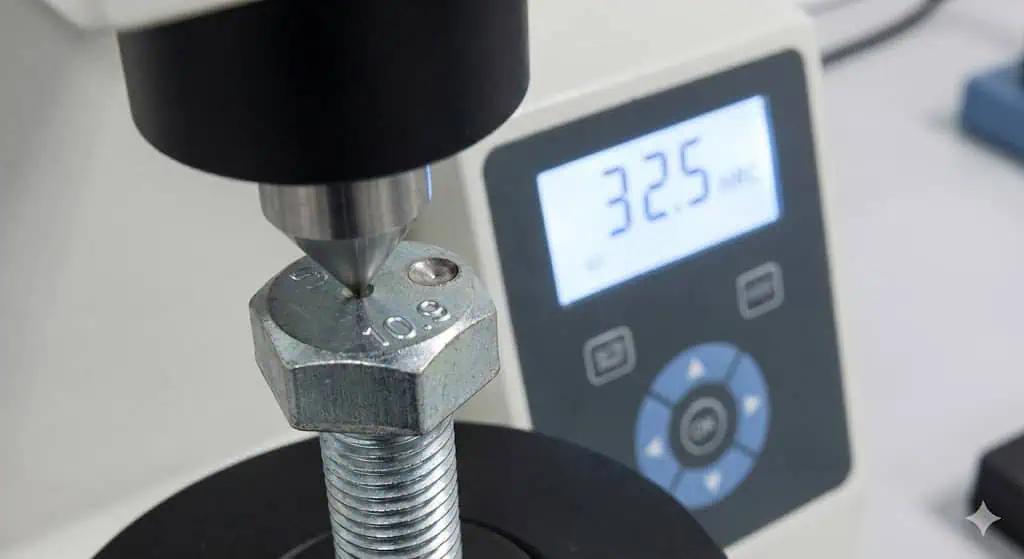
▲ Hardness testing verifies that both bolt and nut meet their specified grade/class — mismatched hardness is the #1 cause of premature thread stripping
Common Grade Matching Mistakes
Mistake 1: Using Class 8 Nuts with Grade 10.9 Bolts
This is the most common mismatch. Class 8 nuts are cheaper and more widely available than class 10 nuts. But a class 8 nut has a stripping strength of ~800 MPa, while a grade 10.9 bolt has a tensile strength of 1000 MPa. The nut strips at 80% of the bolt's capacity — the joint fails at 80% of design load.
Fix: always use class 10 nuts with grade 10.9 bolts. We supply grade 10.9 structural bolt sets with matching class 10 nuts and hardened washers — no guessing required.
Mistake 2: Using Stainless Nuts with Carbon Steel Bolts (or Vice Versa)
Dissimilar metals in a bolted joint create a galvanic cell — one metal corrodes preferentially. A carbon steel bolt with a stainless nut means the carbon steel bolt corrodes (it's the anode). A stainless bolt with a carbon steel nut means the carbon steel nut corrodes. Either way, one component fails prematurely.
Fix: match the bolt and nut materials. Carbon steel bolt → carbon steel nut. Stainless bolt → stainless nut. If you must use dissimilar metals (e.g., stainless bolt in a carbon steel tapped hole), use a coating or sealant to isolate the metals and prevent galvanic corrosion.
Mistake 3: Using Thin Nuts as Primary Load Nuts
Thin nuts (DIN 439, ISO 4035) are designed as lock nuts or for light loads. They have about 60% of the thread engagement of a standard nut, so their stripping strength is proportionally lower. Using a thin nut as the primary load nut on a grade 8.8 or 10.9 bolt is a recipe for thread stripping.
Fix: use standard-height nuts (DIN 934, ISO 4032) for all load-bearing applications. Thin nuts are only for locking (jammed against a standard nut) or for non-structural light loads.
Mistake 4: Ignoring Nut Markings
Nuts are marked with their property class — a number stamped or embossed on the nut face (e.g., "8" for class 8, "10" for class 10). If the nut has no marking, it's likely class 4 or 5 (low strength) and should not be used with high-strength bolts. Always check the nut marking before assembly.
For more on bolt grades and their markings, see our grade 8.8 / 10.9 / 12.9 guide.
Washer Matching
While we're talking about matching, let's not forget washers. The washer must also be matched to the bolt grade:
- Grade 8.8 and below — standard flat washers (DIN 125, ISO 7089) in low-carbon steel are sufficient
- Grade 10.9 and 12.9 — hardened flat washers (DIN 6916, ISO 7412, ASTM F436) are required. Standard washers will crush or deform under the high clamp force of high-strength bolts, reducing clamp force and potentially causing the bolt head to dig in.
- Structural bolts — always use the washer specified in the structural standard (e.g., F436 for A325/A490, DIN 6916 for DIN 6914). Our structural bolt sets include the correct hardened washers.
For more on torque and clamp force, see our bolt torque calculation guide.
How We Match Nuts to Bolts in Production
When a customer orders grade 10.9 bolts, we automatically pair them with class 10 nuts — never class 8. The nut property class is stamped on every nut face, and our packaging line has a camera vision system that reads the marking and rejects any mismatch. Last quarter, the system caught 3 pallets where a class 8 nut was mixed into a class 10 bin — the operator had grabbed the wrong bin during a shift change. The vision system doesn't get tired or distracted.
We also run a "strip test" on every first article: torque the nut until the thread strips. For a grade 10.9 bolt with class 10 nut, the bolt should fracture before the nut strips. If the nut strips first, the nut is too weak. We record the strip torque and compare it to the ISO 898-2 minimum. If it's within spec, the batch gets released. This is the kind of test that takes 5 minutes but prevents a field failure that costs $50,000.
FAQ
Q: Can I use a class 10 nut with a grade 8.8 bolt?
A: Yes — using a higher-class nut than the bolt grade is always safe. The nut will be stronger than necessary, but it won't cause any problems. The bolt will fracture (or yield) before the nut strips, which is the opposite of the preferred failure mode, but the joint will still hold the rated load. Using a higher-class nut is common when class 8 nuts aren't available — just don't use a lower-class nut.
Q: What happens if I use a zinc-plated nut with an HDG bolt?
A: The coatings are compatible (both are zinc), but the thickness differs. HDG bolts have a thick zinc coating (45-85 microns) that can fill the thread clearance, making it hard to start a standard zinc-plated nut. For HDG bolts, use HDG nuts (oversized tapped to accommodate the thick coating) or "HDG tapped" nuts that have been re-tapped after galvanizing. Using a standard nut on an HDG bolt may cause cross-threading or seizing.
Q: Are nyloc nuts (nylon insert lock nuts) rated for high-strength bolts?
A: Nyloc nuts are available in different property classes — class 8, class 10, and stainless A2-70/A4-80. Match the nyloc nut class to the bolt grade just like a standard nut. But here's the catch: nyloc nuts have a temperature limit of ~120°C (the nylon degrades above that), so they're not suitable for high-temperature applications. Also, the nylon insert reduces thread engagement slightly, so verify that the nut's stripping strength is still sufficient for the bolt grade.
Q: How do I verify nut grade if there's no marking?
A: If the nut has no property class marking, assume it's low strength (class 4 or 5) and don't use it with grade 8.8 or higher bolts. To verify, you can perform a hardness test (Rockwell or Vickers) — class 8 nuts are HRC 17-28, class 10 are HRC 28-36, class 12 are HRC 36-43. Or do a proof load test: tighten the nut on a matching-grade bolt to the proof load and check for thread deformation. When in doubt, replace the nut with a marked, certified one.
Q: Can I reuse nuts after they've been torqued?
A: For standard nuts (not nyloc), reuse is generally acceptable if the threads are undamaged and the nut hasn't yielded. But here's the catch: for critical applications (structural, automotive, aerospace), most standards require new nuts with every installation because the nut may have work-hardened or sustained minor thread damage during the first tightening. Nyloc nuts should never be reused — the nylon insert deforms on first use and loses locking effectiveness. When in doubt, replace the nut — it's the cheapest component in the joint.
Bolt-nut grade matching is one of those fundamentals that's easy to overlook but critical to get right. The bolt gets all the attention — the grade marking, the material cert, the hardness test — but the nut is equally important. Match the nut class to the bolt grade, use the right nut height, match the materials, and use the right washer. Do that, and your bolted joints will perform as designed. Skip it, and you're one overload away from a stripped nut and a failed joint.