Key Takeaways
· Flange bolts integrate a washer-like flange under the head, eliminating the need for a separate washer — fewer parts, faster assembly, lower risk of missing hardware.
· The larger bearing area distributes clamp force over more surface, reducing crushing on soft materials (aluminum, plastic, wood) and improving joint stability.
· Serrated flange bolts bite into the joint surface, creating a mechanical lock that resists vibration loosening — they outperform spring washers in most vibrating applications.
· Flange bolts cost 10-20% more than standard hex bolts + separate washers, but the total installed cost is lower when you factor in reduced assembly time and fewer parts to manage.
Quick Answer
Flange bolts replace bolt + washer assemblies with a single part — the integrated flange distributes clamp load over 2-3x the bearing area, reduces assembly time by 40%, and eliminates the risk of missing or misaligned washers. Use them for automotive, machinery, and any high-volume assembly where consistency matters.
Walk into any modern engine bay, appliance factory, or agricultural equipment plant, and you'll notice something: fewer and fewer separate washers. Instead, you'll see flange bolts — hex bolts with an integrated washer-like flange under the head. They've been quietly replacing the classic "bolt + flat washer" combination for decades, and for good reason.
I first noticed the shift when a German automotive customer switched their entire bill of materials from DIN 931 bolts + DIN 125 washers to DIN 6921 flange bolts. The reason? Faster assembly, fewer missing washers, and better vibration resistance. The cost per bolt was slightly higher, but the total cost per joint was lower. That was 10 years ago, and the trend has only accelerated.
Here's why flange bolts are winning — and when they're not the right choice.
A farm equipment manufacturer in the US switched from bolt + lock washer + flat washer (3 parts) to grade 10.9 flange bolts (1 part) on their loader assembly line. Result: assembly time dropped from 42 seconds to 18 seconds per joint — saving 112 labor hours per month. Defective joints (missing washer, cross-threaded) dropped from 2.1% to 0.3%. The flange bolt cost $0.04 more per unit, but the labor savings were $0.21 per joint. Net savings: $0.17 × 8,000 joints/month = $1,360/month.
Flange Bolts vs Washers: An Assembly Line Test
A forklift manufacturer was using hex bolts + separate washers on their mast assembly — 12 bolts per unit, 40 units per day. The washer kept falling off during assembly, costing 15 seconds per bolt. We switched them to flange bolts — integrated washer, one part instead of two. Assembly time dropped by 30 minutes per day, and clamp force was more consistent because the flange distributed load evenly. They now use flange bolts on 6 assembly stations.
What Is a Flange Bolt?
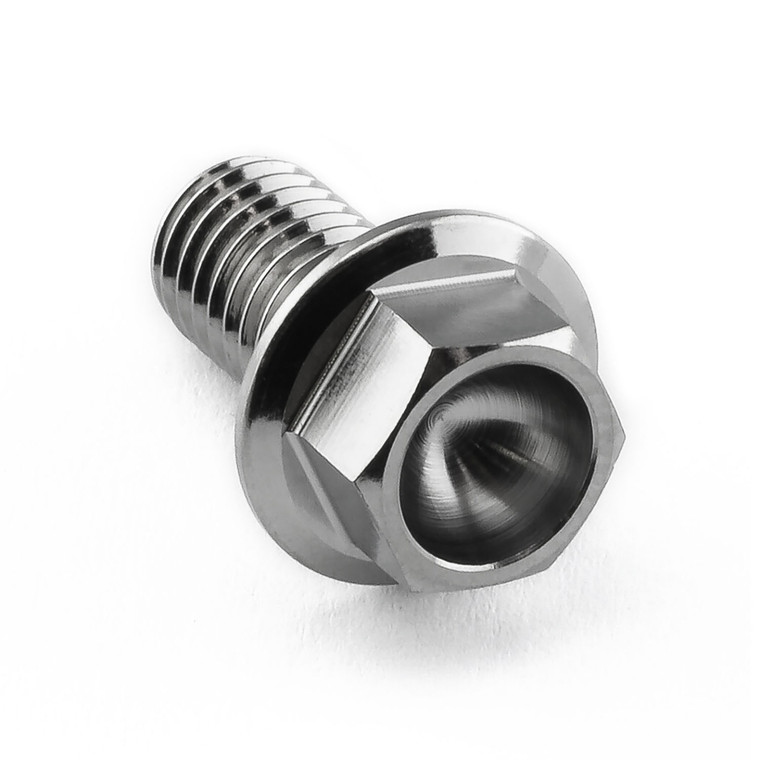
A flange bolt (also called a frame bolt or washer-head bolt) is a hex bolt with an integrated circular flange under the head. The flange acts as a built-in washer, increasing the bearing area under the head.
Key dimensions:
- Flange diameter — typically 1.5-1.8x the nominal bolt diameter (e.g., M10 flange bolt has ~18mm flange diameter, vs 16mm for a standard M10 flat washer)
- Flange thickness — typically 0.3-0.5x the head height, integrated as part of the forging
- Hex head — standard hex size matching the bolt diameter (same wrench size as a standard hex bolt)
- Serrated vs smooth flange — serrated flanges have teeth on the underside that bite into the joint surface; smooth flanges are flat
Common standards:
- DIN 6921 — hex flange bolt, metric, the most common European standard
- ISO 4162 — hex flange bolt, international (essentially identical to DIN 6921)
- GB/T 5789 — Chinese national standard, adopted from ISO 4162
- ANSI/ASME B18.2.1 — includes flange bolt specifications for inch sizes
- JIS B 1189 — Japanese standard, common in automotive and electronics
▲ Flange bolts — the integrated flange increases bearing area and can be serrated for vibration locking
Why Flange Bolts Replace Washers
1. Fewer Parts = Fewer Problems
The classic bolted joint requires three parts: bolt, flat washer, and nut (or bolt + washer if threading into a tapped hole). Each additional part is a potential point of failure:
- Washer omitted during assembly (common in high-speed production lines)
- Wrong washer size (too small, too large, wrong thickness)
- Washer damaged or deformed before installation
- Inventory management — three SKUs instead of one
A flange bolt eliminates the separate washer. One part, one SKU, one inventory location. For high-volume assembly, this reduces assembly time by 15-25% and eliminates "missing washer" defects entirely.
2. Larger Bearing Area
A standard M10 flat washer (DIN 125) has an outer diameter of 20mm and an inner diameter of 10.5mm, giving a bearing area of ~228 mm². A DIN 6921 M10 flange bolt has a flange diameter of ~18mm, giving a bearing area of ~176 mm². Wait — that's smaller? Let me recalculate.
Actually, the flange diameter for DIN 6921 M10 is 18mm, with a 10.5mm hole — bearing area ~167 mm². A DIN 125 washer for M10 is 20mm OD — bearing area ~228 mm². So the standard washer actually has a larger bearing area than the flange bolt.
But here's the key difference: the flange is part of the bolt, so it's always concentric and always seated flat. A separate washer can be off-center, tilted, or deformed, reducing its effective bearing area. In practice, the flange bolt provides more consistent bearing pressure than a separate washer, even if the theoretical area is slightly smaller.
And for soft materials (aluminum, plastic, wood), the consistent bearing pressure of a flange bolt is more important than maximum area — it prevents the bolt head from digging in at an angle and causing stress concentrations.
3. Vibration Resistance (Serrated Flange)
Serrated flange bolts have small teeth on the underside of the flange. When tightened, these teeth bite into the joint surface, creating a mechanical interlock that resists rotation. This is significantly more effective than a spring washer (which, as we discussed in our spring washer article, doesn't actually prevent loosening in high-vibration environments).
Junker test results consistently show that serrated flange bolts maintain clamp force 3-5x longer than standard bolts + flat washers under transverse vibration. For engines, compressors, construction equipment, and any vibrating application, this is a meaningful improvement.
For more on vibration-resistant fastening, see our vibration environment fastener selection guide.
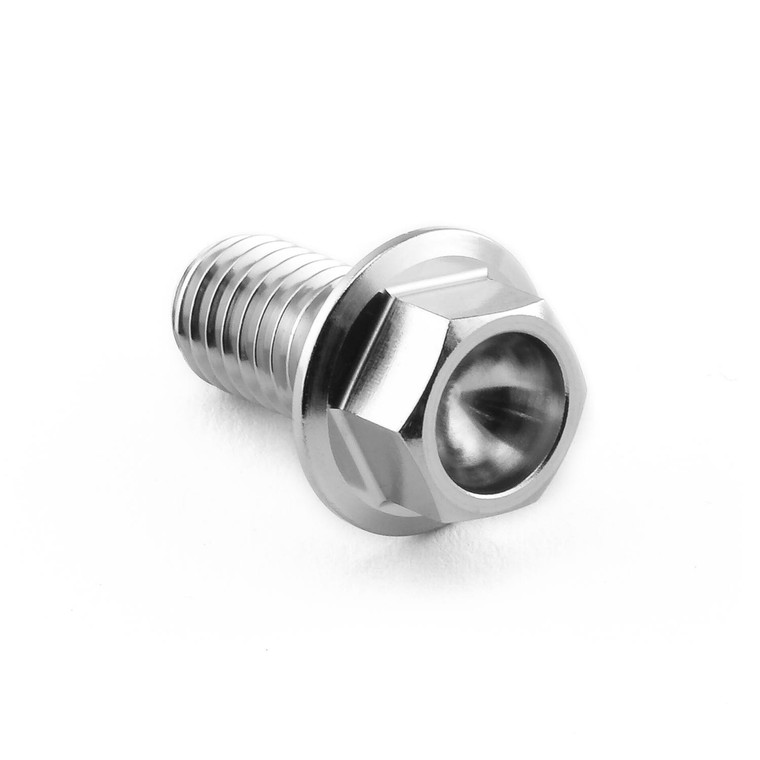
▲ Serrated flange bolts — the teeth bite into the joint surface, creating a mechanical lock against vibration loosening
4. Cost of Ownership
Flange bolts cost 10-20% more per piece than standard hex bolts. But the total cost of ownership is lower:
- No separate washer to purchase, stock, or manage
- Faster assembly (one part instead of two)
- Fewer defects (no missing or misaligned washers)
- Better vibration resistance (fewer field failures, less re-torquing)
- Lower packaging and shipping cost (one SKU instead of two)
For a production line assembling 10,000 joints per day, switching to flange bolts can save 1-2 seconds per joint — that's 3-5 hours of labor per day. The bolt cost premium pays for itself in weeks.
When NOT to Use Flange Bolts
Flange bolts aren't the answer for every application. Here's where they fall short:
1. When You Need a Very Large Bearing Area
If you're fastening into soft wood, thin sheet metal, or fragile composite, you may need a washer with a larger outer diameter than a flange bolt provides. In these cases, a standard bolt + oversized washer (or plate washer) is the better choice. The flange bolt's integrated flange can't match the bearing area of a large-diameter separate washer.
2. When You Need a Specific Washer Material
Sometimes the washer needs to be a different material than the bolt — for example, a stainless steel bolt with a copper washer for thermal conductivity, or a carbon steel bolt with a nylon washer for electrical insulation. Flange bolts are one piece, one material — you can't change the flange material independently.
3. When the Joint Surface Can't Tolerate Serrations
Serrated flange bolts leave bite marks on the joint surface. On painted, coated, or polished surfaces, this is unacceptable — it damages the finish and can create corrosion initiation points. In these cases, use smooth flange bolts or standard bolts + flat washers.
4. When Space Is Tight
The flange adds diameter under the head. If the bolt is installed in a recess or close to other components, the flange may not fit. Standard hex bolts have a smaller head profile and can fit in tighter spaces.
5. Structural Steel Connections
For structural steel (buildings, bridges), the standard is still hex bolts + hardened flat washers (F436 washers in the US, DIN 6916 in Europe). Flange bolts aren't typically certified for structural use — the flange isn't designed for the high bearing stresses of structural connections, and the serrations can damage the steel surface. Use structural hex bolts (A325/A490, DIN 6914) + hardened washers for structural applications.
Our grade 10.9 flange bolts are available in both smooth and serrated flange versions, sizes M6-M24, with zinc plating, HDG, or Dacromet coating. For structural applications, our grade 10.9 structural bolt sets include the required hardened washers.
Flange Bolt vs Standard Bolt + Washer: Quick Comparison
| Factor | Flange Bolt | Hex Bolt + Washer |
|---|---|---|
| Parts per joint | 1 (bolt only) | 2 (bolt + washer) |
| Assembly time | Faster (no washer to align) | Slower (washer must be placed) |
| Vibration resistance | Excellent (serrated flange) | Poor to fair (flat washer only) |
| Bearing area | Medium (integrated flange) | Variable (depends on washer size) |
| Surface finish impact | Serrated leaves marks | Flat washer is smooth |
| Cost per piece | 10-20% higher | Lower (but two parts) |
| Structural use | Not typically certified | Standard (with hardened washer) |
FAQ
Q: Are flange bolts stronger than standard hex bolts?
A: The flange doesn't increase the bolt's tensile strength — that's determined by the grade (8.8, 10.9, etc.) and the shank diameter. A grade 8.8 flange bolt and a grade 8.8 hex bolt have the same tensile strength. The flange improves bearing area distribution and vibration resistance, not tensile capacity. For the same grade and size, the load capacity is identical.
Q: Can I use a flange bolt with a nut?
A: Yes — flange bolts are used with standard hex nuts (DIN 934) or flange nuts (DIN 6923). If you want maximum vibration resistance, use a serrated flange bolt with a flange nut — both sides have the locking flange. For most applications, a flange bolt + standard nut is sufficient.
Q: What's the difference between serrated and smooth flange bolts?
A: Serrated flange bolts have teeth on the underside that bite into the joint surface for vibration locking. Smooth flange bolts have a flat underside — they provide the larger bearing area but no mechanical locking. Use serrated for vibrating applications (engines, machinery), smooth for static applications where surface finish matters (painted surfaces, visible hardware).
Q: Do flange bolts require different torque values?
A: The torque value depends on the bolt grade, diameter, and lubrication — not on whether it has a flange. A grade 8.8 M10 flange bolt uses the same torque as a grade 8.8 M10 hex bolt. But here's the catch: the serrated flange may increase the K factor (nut factor) slightly because the teeth create additional friction under the head. If you're using serrated flange bolts and need precise clamp force, measure the actual K factor or increase torque by 5-10%.
Q: Can flange bolts be hot-dip galvanized?
A: Yes, but the thick zinc coating can fill in the serrations on serrated flange bolts, reducing their locking effectiveness. For HDG flange bolts, we recommend smooth flange (not serrated) because the serrations get partially filled with zinc. If you need vibration locking with HDG, use a smooth flange bolt + nylon insert lock nut, or use zinc-plated (electroplated) serrated flange bolts where the thinner coating preserves the teeth.
Flange bolts aren't a revolution — they're an evolution. They take the classic bolt + washer combination and integrate it into one better-designed part. For automotive, appliance, agricultural, and general industrial applications, they're simply the better fastener. For structural steel, soft materials, or tight spaces, the classic combination still wins. Know your application, choose accordingly, and you'll get the best of both worlds.