Key Takeaways
· Solar PV fasteners must last 25-30 years in outdoor exposure — the coating must survive UV, temperature cycling, humidity, and sometimes coastal salt or desert sand without corrosion.
· Hot-dip galvanizing (HDG) is the industry standard for solar mounting structures — 65-85 micron zinc layer provides 20-40 year life in rural/urban atmospheres.
· Zinc flake coatings (Geomet, Dacromet, Magni) offer 500-1,500 hours salt spray and are preferred for coastal solar farms — no hydrogen embrittlement risk for high-strength bolts.
· Stainless steel (A4-80) is used for coastal and offshore solar, but costs 3-5x more than HDG carbon steel — specify only where corrosion risk justifies the premium.
Quick Answer
Solar mounting fasteners need 25-year corrosion resistance in outdoor UV and temperature cycling. HDG is the standard (500h+ salt spray, 20-30 year life). Zinc flake (Dacromet/Geomet) offers better corrosion and controlled friction but costs 2x. Avoid zinc plating — it fails in 3-5 years on solar rooftops.
A solar farm is designed for 25-30 years of operation. The panels degrade slowly (0.5-1% per year). The inverters get replaced after 10-15 years. But the mounting structure — and the fasteners that hold it together — are expected to last the full 25-30 years with minimal maintenance.
That's a tall order for a fastener. It sits outdoors, exposed to sun, rain, snow, wind, temperature swings from -40°C to +80°C, and in some locations, salt spray, desert sand, or agricultural chemicals. A coating that fails after 10 years means the fastener corrodes, the structure weakens, and the whole solar array is at risk.
Having supplied fasteners for solar projects across Europe, the Middle East, Africa, and Southeast Asia — from rooftop installations in Germany to utility-scale farms in the UAE desert — I've seen which coatings last and which ones fail. Here's what works for solar PV fastening.
A solar developer in India used zinc-plated bolts on a 50MW farm to cut costs. 4 years later, 8% of the mounting bolts had corroded through — the panels were loose and some had shifted in high winds. The replacement program required removing 40,000 panels to access the bolts: ₹3.2 crore (€360,000). HDG bolts would have cost ₹12 lakh (€13,500) more upfront. The solar farm has a 25-year design life — the bolts failed at 4 years. For any outdoor solar installation, HDG is the minimum spec.
Solar Farm Coating: 10-Year Life in 5 Years
A solar developer in India used zinc-plated bolts for a 50MW farm. After 5 years, 30% showed red rust — the coating was only 5μm thick. We supplied HDG bolts with 65μm coating for their next 100MW project. After 7 years, inspection showed only white rust (zinc corrosion), no base metal corrosion. The developer calculated 25-year service life. Coating thickness isn't a spec line item — it's the difference between 5 years and 25 years.
The Solar Fastener Environment
Solar fasteners face a unique combination of stresses:
- UV radiation — constant sunlight degrades organic coatings (paint, polymer). Inorganic coatings (zinc, zinc flake) are UV-resistant.
- Temperature cycling — panels and structures heat to 60-80°C in direct sun, then cool to ambient at night. Daily thermal cycling stresses the coating and can cause cracking or delamination over thousands of cycles.
- Humidity and condensation — morning dew condenses on the structure, creating wet conditions that promote corrosion. The gap between bolt head and bracket is a crevice where moisture accumulates.
- Wind-induced vibration — solar panels act like sails, causing constant micro-movement in the mounting structure. This vibration can cause fretting corrosion at the bolt-bracket interface and can loosen bolts if not properly locked.
- Location-specific factors — coastal farms face salt spray; desert farms face sand abrasion and extreme UV; agricultural farms face fertilizer and pesticide chemical exposure; rooftop installations face runoff from roofing materials.
The fastener must survive all of this for 25+ years. The coating is the first line of defense.
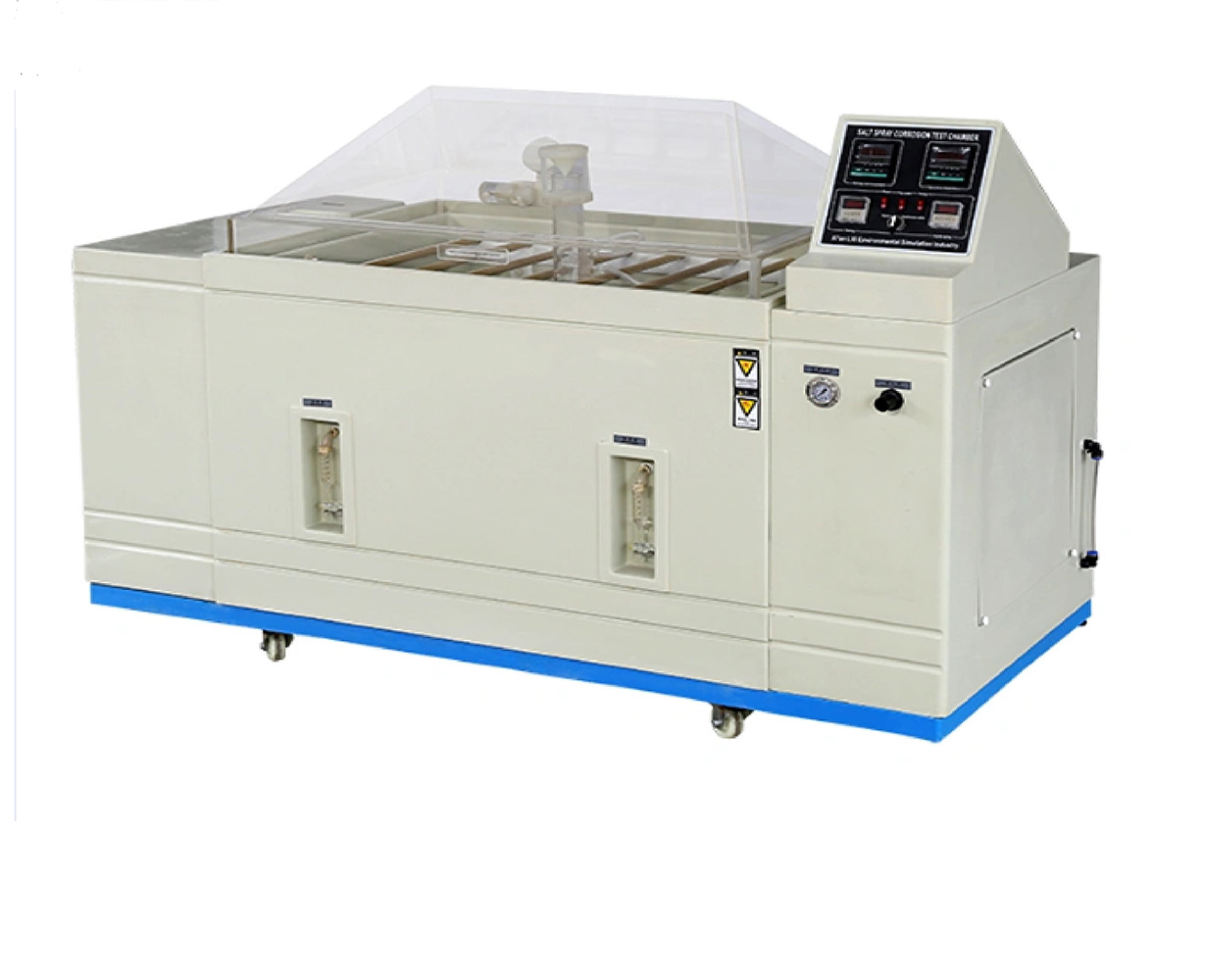
▲ Salt spray testing verifies coating corrosion resistance — but solar fasteners also face UV, thermal cycling, and vibration that salt spray alone doesn't simulate
Coating Options for Solar Fasteners
1. Hot-Dip Galvanizing (HDG) — The Industry Standard
HDG is the most widely used coating for solar mounting structures and fasteners. Bolts are dipped in molten zinc at 450°C, creating a thick zinc-iron alloy layer (45-85 microns) that provides both barrier protection and sacrificial (galvanic) protection.
Advantages:
- Excellent atmospheric corrosion resistance — 20-40 years in rural/urban environments, 15-25 years in industrial, 10-20 years in coastal (above splash zone)
- Tough, abrasion-resistant coating — withstands handling, installation, and sand abrasion better than electroplating
- Self-healing — if scratched, the surrounding zinc corrodes preferentially, protecting the exposed steel
- Cost-effective — typically 15-25% premium over zinc electroplating, but 3-5x longer life
Limitations:
- Thick coating can affect thread fit — HDG nuts must be over-tapped to accommodate
- Hydrogen embrittlement risk for grade 12.9 bolts (HDG involves acid pickling; the 450°C zinc bath provides some baking but may not fully remove hydrogen for very high strength steel)
- Not suitable for direct seawater immersion or heavy splash zones — zinc corrodes through in 3-7 years in direct seawater
- Appearance — gray, crystalline "spangle" finish, not aesthetically uniform (doesn't matter for solar, which is typically ground-mounted or on industrial rooftops)
For most solar farms (rural, urban, industrial), HDG grade 8.8 bolts are the standard choice. We supply DIN 931 HDG bolts and HDG flange bolts in sizes M8-M24 for solar mounting applications.
2. Zinc Flake Coatings (Geomet, Dacromet, Magni, Delta Tone)
Zinc flake coatings are applied by spraying or dipping bolts in a water-based zinc-aluminum flake slurry, then curing at 200-300°C. The coating is 8-15 microns thick, with a lamellar (layered) structure that provides excellent barrier protection.
Advantages:
- Excellent corrosion resistance — 500-1,500 hours salt spray (vs 200-500 for HDG), with topcoat systems reaching 2,000+ hours
- No hydrogen embrittlement — no acid pickling, no electrolysis. Safe for grade 10.9 and 12.9 bolts.
- Thin, uniform coating — no thread fit issues, no over-tapping needed
- UV-resistant — inorganic coating doesn't degrade in sunlight
- Controlled electrical conductivity — can be formulated for grounding (important for solar structures that need electrical continuity for lightning protection)
Limitations:
- More expensive than HDG — typically 30-60% premium per bolt
- Less abrasion-resistant than HDG — the thin coating can be scratched during installation, exposing the steel (though the zinc provides some sacrificial protection)
- Requires specialized coating equipment — not all fastener factories have in-house zinc flake lines
- Lower thickness means less sacrificial protection — a deep scratch may lead to localized corrosion faster than with HDG
Zinc flake is the preferred coating for coastal solar farms, high-strength bolts (grade 10.9+), and projects requiring 1,000+ hours salt spray certification.
3. Zinc Electroplating (Clear or Yellow Passivate)
Electroplated zinc is thin (5-15 microns) and provides 24-240 hours salt spray depending on the passivate. It's the cheapest coating but has the shortest life.
For solar: Generally not recommended for outdoor solar structures — the thin zinc layer corrodes through in 2-5 years in outdoor exposure, leading to rust staining and potential structural weakening. Acceptable only for indoor or protected applications (inverter cabinets, junction boxes) where the fastener isn't directly exposed to weather.
4. Stainless Steel (A2-70 / A4-80)
Stainless steel fasteners don't need a coating — the material itself is corrosion-resistant. A2-70 (304) for inland/urban solar, A4-80 (316) for coastal.
Advantages:
- Excellent corrosion resistance — A4-80 lasts 30+ years in coastal atmospheric exposure
- No coating to chip, scratch, or degrade
- Non-magnetic (important for some sensor and electronics applications)
Limitations:
- Cost — A4-80 is 3-5x more expensive than HDG carbon steel
- Lower yield strength — A4-80 has ~400 MPa yield vs 640 MPa for grade 8.8, so larger bolts may be needed for the same load
- Galling — stainless bolts can seize during tightening; always use anti-seize
- Crevice corrosion — in coastal splash zones, even 316 can develop crevice corrosion under bolt heads after 5-10 years
Stainless is specified for coastal and offshore solar, and for high-visibility architectural solar installations where rust staining is unacceptable.
For more on stainless selection, see our 304 vs 316 guide.
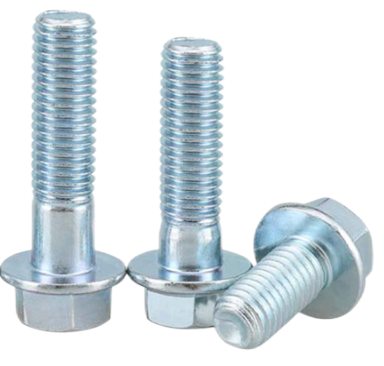
▲ HDG flange bolts for solar mounting — the thick zinc layer provides 20-40 years of atmospheric corrosion protection in most solar environments
Coating Selection by Solar Environment
| Environment | Recommended Coating | Expected Life | Salt Spray (hrs) |
|---|---|---|---|
| Rural / inland | HDG grade 8.8 | 25-40 years | 200-500 |
| Urban / suburban | HDG grade 8.8 | 20-35 years | 200-500 |
| Industrial / polluted | HDG or zinc flake | 15-30 years | 500-1000 |
| Coastal (5-20km from sea) | Zinc flake or HDG (heavy) | 15-25 years | 500-1500 |
| Coastal (within 5km / splash) | A4-80 stainless or zinc flake + topcoat | 20-30+ years | 1000+ |
| Desert (high UV, sand) | HDG (abrasion-resistant) | 25-40 years | 200-500 |
| Agricultural (chemicals) | Zinc flake or A4-80 | 15-25 years | 500-1000 |
| Rooftop (runoff exposure) | HDG or zinc flake | 20-30 years | 500-1000 |
Other Solar Fastener Considerations
Vibration Locking
Solar panels catch wind, creating constant vibration and uplift on the mounting structure. Standard hex bolts + flat washers can loosen over time. Use flange bolts (integrated washer, larger bearing area) or thread locker (medium strength, removable) for module clamps and structural connections. For more on vibration fastening, see our vibration selection guide.
Electrical Grounding
Solar mounting structures must be electrically grounded for lightning protection and safety. The fastener coating must allow electrical continuity between the bolt and the bracket. HDG and zinc flake are conductive; paint and powder coating are not. If the structure is painted after assembly, ensure the bolt contact areas are masked or the paint is removed for grounding connections.
Bimetallic Corrosion
Solar structures often use aluminum rails with steel bolts. Aluminum and steel are dissimilar metals — in the presence of moisture (electrolyte), the aluminum corrodes preferentially (galvanic corrosion). Use an isolating washer (plastic or rubber) between the steel bolt and aluminum rail, or use stainless steel bolts (which are closer to aluminum in the galvanic series). Never use HDG steel bolts directly against aluminum without isolation — the aluminum will corrode around the bolt hole in 5-10 years.
UV Degradation of Organic Coatings
If the fastener has an organic topcoat (paint, polymer coating over zinc flake), UV radiation from 25+ years of sunlight will degrade it. The organic coating may chalk, fade, or peel, exposing the underlying zinc. For long-life solar applications, use inorganic coatings (HDG, zinc flake without organic topcoat) or verify the topcoat is UV-stabilized and rated for 25+ year exterior exposure.
For more on coating selection and corrosion testing, see our salt spray testing guide and coatings guide.
Coating Comparison at a Glance
| Coating | Salt Spray (h) | Thickness (μm) | Relative Cost | Best For | HE Risk |
|---|---|---|---|---|---|
| Zinc Plating | 48-200 | 5-12 | Low (1x) | Indoor, dry environments | High (grade 10.9+) |
| HDG (Hot-Dip Galvanized) | 500-1000+ | 45-85 | Medium (2-3x) | Outdoor structural, solar, marine | Medium (thick coating) |
| Zinc Flake (Dacromet/Geomet) | 500-1500 | 8-15 | High (3-6x) | Automotive, high-strength, EV | None (no acid process) |
| Black Oxide | 12-48 | 1-3 | Low (1x) | Indoor machinery, appearance | None |
| PTFE / Xylan Coated | 1000+ | 15-25 | Very High (8-12x) | Chemical, offshore, controlled friction | None |
Salt spray hours per ASTM B117. Actual service life varies by environment — coastal exposure is 5-10x more aggressive than rural. HE = Hydrogen Embrittlement risk for grade 10.9+ bolts.
FAQ
Q: What's the standard coating for solar panel mounting bolts?
A: Hot-dip galvanized (HDG) grade 8.8 bolts are the global standard for utility-scale and commercial solar mounting structures. HDG provides 20-40 years of atmospheric corrosion resistance in most environments, is cost-effective, and is widely available. For coastal solar farms (within 5-10km of the sea), zinc flake coating (Geomet/Dacromet) or A4-80 stainless steel is specified for better chloride resistance. Always check the project specification — many large solar developers have their own coating standards (e.g., requiring 1000+ hours salt spray, which mandates zinc flake rather than standard HDG).
Q: Can I use zinc electroplated bolts for a rooftop solar installation?
A: Not recommended for exterior structural fasteners. Zinc electroplating is thin (5-15 microns) and will corrode through in 2-5 years in outdoor exposure, leading to rust staining on the roof and potential weakening of the mounting connection. For rooftop solar, use HDG or zinc flake coated bolts — the small cost premium is negligible compared to the cost of re-fastening a rooftop array after 5 years. Electroplated zinc is acceptable only for interior, protected applications (inverter cabinets, junction boxes) where the fastener isn't exposed to weather.
Q: How do I prevent galvanic corrosion between steel bolts and aluminum solar rails?
A: Three options: (1) Use an isolating washer (plastic, rubber, or EPDM) between the bolt head/nut and the aluminum rail — this breaks the electrical contact and prevents galvanic corrosion. (2) Use stainless steel bolts (A2-70 or A4-80) — stainless is closer to aluminum in the galvanic series than HDG steel, so the galvanic current is much lower. (3) Use coated aluminum rails (anodized or powder-coated) — the coating acts as an insulator, though it may be scratched during installation. The most common solution in the solar industry is stainless steel bolts for module clamps (which contact aluminum rails) and HDG steel bolts for ground mounts and structural steel connections.
Q: What salt spray rating should I specify for solar fasteners?
A: It depends on the environment: rural/inland solar — 200-500 hours (HDG is sufficient); urban/industrial — 500-1000 hours (heavy HDG or zinc flake); coastal — 1000+ hours (zinc flake with topcoat or A4-80 stainless); offshore/floating solar — 1500+ hours (super duplex or titanium). Many large solar developers now specify minimum 720 hours salt spray per ASTM B117 for all exterior fasteners, which effectively mandates zinc flake coating rather than standard HDG. Always specify "hours to red rust" (not white rust) as the acceptance criterion.
Q: Do solar fasteners need hydrogen embrittlement prevention?
A: Most solar fasteners are grade 8.8 (low HE risk) with HDG coating — the HDG process (acid pickling + 450°C zinc bath) provides inherent baking that removes hydrogen. For grade 10.9+ solar fasteners (used in some tracking systems and high-load foundations), specify zinc flake coating (no hydrogen) rather than electroplating, or mandate post-plating baking if electroplating is used. See our hydrogen embrittlement guide for details. For most solar projects using grade 8.8 HDG bolts, HE is not a significant concern.
Solar fasteners are invisible but critical — they hold up the panels that generate the power. Specify the right coating for the environment, prevent galvanic corrosion with dissimilar metals, lock against wind vibration, and ensure electrical grounding. Do that, and the fasteners will outlast the panels they support — quietly doing their job for 25-30 years with no maintenance required.