Key Takeaways
· Wood-steel connections require different fastener thinking than steel-steel — wood creeps (compresses over time), so clamp force decreases and bolts must be re-torqued.
· Hot-dip galvanized (HDG) bolts are the standard for timber construction — the thick zinc layer resists corrosion in the moist, acidic environment of wood.
· Oversized holes (1-2mm larger than bolt diameter) are standard in timber connections to allow for wood movement and construction tolerance — but they reduce bearing strength.
· Grade 8.8 is sufficient for most timber connections; grade 10.9 is overkill and more susceptible to hydrogen embrittlement after HDG.
Quick Answer
Timber-to-steel connections need different fasteners than steel-to-steel: coach screws (lag bolts) for wood, through-bolts with large washers for heavy timber, and corrosion-resistant coatings (HDG or 316 stainless) because wood holds moisture. Never use drywall screws or standard wood screws for structural timber connections.
Timber architecture is having a moment. Cross-laminated timber (CLT), glulam beams, and mass timber buildings are going up in cities from Vancouver to Vienna. And every one of those buildings needs fasteners — lots of them — connecting wood to steel, wood to concrete, and wood to wood.
But fastening wood isn't like fastening steel. Wood moves. It swells when wet, shrinks when dry, and creeps (slowly compresses) under sustained load. A bolt that's perfectly tight on installation day may be loose six months later. And the environment inside a timber connection — moist, slightly acidic, with limited air circulation — is aggressively corrosive to ordinary zinc-plated bolts.
Having supplied fasteners for timber construction projects across Europe and North America, I've learned that the right fastener specification makes the difference between a building that performs for 50 years and one that needs costly re-torquing and bolt replacement in year five. Here's what specifiers and contractors need to know.
A mass timber builder in Norway used standard zinc-plated coach screws for a glulam beam connection — 18 months later, 15% showed red rust under the beam. The wood's natural moisture (12-15%) plus the acidic tannins in spruce created a corrosive micro-environment. The replacement required lifting the beam back out: NOK 180,000. HDG coach screws would have cost 25% more and lasted 30+ years. For any timber connection in contact with the beam, specify HDG minimum — 316 stainless for coastal or high-humidity.
Timber Construction: Why A4 Stainless Outperformed HDG
A mass timber project in Austria used HDG bolts for the steel-to-timber connections. After one winter, white rust appeared where the bolts contacted the acidic timber treatment. We recommended A4-80 stainless steel — no corrosion, no maintenance. The architect was concerned about cost (2.2x HDG), but the 50-year design life meant no replacement. We supplied 8,000 bolts in 4 weeks. The building won a national architecture award.
Why Wood Is Different
Steel is rigid. When you tighten a bolt against steel, the clamp force stays essentially constant for decades (assuming no vibration or corrosion). Wood is viscoelastic — it deforms over time under sustained load. This is called "creep."
In a timber connection, the bolt clamps wood members together. Over months and years, the wood under the bolt head and washer slowly compresses. The bolt, which was stretched to create clamp force, effectively becomes less stretched — the clamp force decreases. In extreme cases, clamp force can drop by 30-50% over 5-10 years.
This has three practical consequences:
- Re-torquing — Timber connections should be re-torqued after the first 6-12 months, and periodically thereafter (every 3-5 years for exterior structures). The bolt doesn't need to be replaced; it just needs to be re-tightened to compensate for wood creep.
- Washer size matters — A larger washer distributes the clamp force over more wood area, reducing creep and maintaining clamp force longer. For timber connections, use oversized washers (minimum 3x bolt diameter) or steel plate washers. Standard flat washers are too small and will crush into the wood.
- Don't over-torque — Over-tightening crushes the wood fibers, accelerating creep and actually reducing long-term clamp force. Follow the manufacturer's torque values for timber connections — they're typically 20-30% lower than for steel-to-steel connections of the same bolt size.
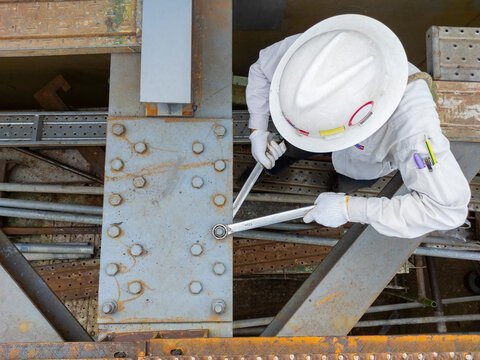
▲ Timber-steel connections — the wood will creep over time, so specify oversized washers and plan for re-torquing
Corrosion in Timber Connections
The environment inside a timber connection is surprisingly corrosive. Here's why:
- Moisture — Wood naturally contains moisture (12-18% for interior, 18-25% for exterior). Even in a "dry" building, the wood in a bolted connection holds moisture against the bolt surface.
- Acidity — Wood is slightly acidic (pH 4-6 for most species). Acid accelerates corrosion of zinc plating and steel.
- Limited oxygen — The tight gap between bolt and wood limits air circulation, creating a micro-environment that promotes crevice corrosion.
- Tannins — Some wood species (oak, chestnut, redwood) contain tannins that are particularly corrosive to steel and zinc.
Standard zinc-plated (electroplated) bolts have a thin zinc layer (5-15 microns) that will corrode through in 3-7 years in a timber connection. Hot-dip galvanized (HDG) bolts have a much thicker zinc layer (45-85 microns) and can last 20-40 years in the same environment.
For exterior timber structures (bridges, boardwalks, pavilions), HDG is the minimum. For interior mass timber buildings in controlled environments, HDG is still recommended — the small cost premium is negligible compared to the cost of replacing corroded bolts in a completed building.
For more on coating selection and corrosion testing, see our fastener coatings guide and salt spray testing guide.
Bolt Grade Selection for Timber
For most timber connections, grade 8.8 bolts are sufficient. The limiting factor in a timber connection is usually the wood (bearing strength, shear strength perpendicular to grain), not the bolt. Using grade 10.9 bolts in a timber connection doesn't make the connection stronger — it just makes the bolt more expensive and more susceptible to hydrogen embrittlement after HDG.
Hydrogen embrittlement is a real concern for HDG high-strength bolts. The HDG process (pickling in acid + molten zinc bath) can introduce hydrogen into the steel. For grade 10.9 and above, this hydrogen can cause delayed fracture — the bolt breaks weeks or months after installation, with no warning. For more on this, see our hydrogen embrittlement prevention guide.
Our recommendation for timber connections:
- Interior, dry: Grade 8.8 HDG, or grade 8.8 zinc plated if budget is tight (but expect shorter life)
- Exterior, moist: Grade 8.8 HDG (mandatory)
- High-load, critical: Grade 8.8 HDG with post-galvanizing baking (to remove hydrogen), or grade 10.9 with proven hydrogen embrittlement prevention process
- Coastal / salt air: Grade 8.8 HDG, or A4-80 stainless steel for maximum corrosion resistance (see our 304 vs 316 guide)
We supply DIN 931 grade 8.8 HDG bolts in sizes M12-M30, with matching HDG nuts and oversized washers — the standard specification for timber construction.
▲ Hot-dip galvanizing — the thick zinc layer (45-85 microns) is essential for timber connection corrosion resistance
Hole Sizing and Installation
In steel construction, bolt holes are typically 1-2mm larger than the bolt diameter (standard clearance). In timber construction, the same applies, but for different reasons:
- Wood movement — Timber swells and shrinks with moisture changes. Oversized holes accommodate this movement without putting lateral stress on the bolt.
- Construction tolerance — Pre-drilled holes in timber members may not align perfectly on site. Oversized holes allow for adjustment.
- Reduced bearing strength — Oversized holes reduce the contact area between bolt and wood, lowering the bearing capacity. The connection design must account for this — don't just use standard steel connection calculations.
Standard hole sizes for timber connections (per Eurocode 5 / NDS):
- M12 bolt → 13-14mm hole
- M16 bolt → 17-18mm hole
- M20 bolt → 21-22mm hole
- M24 bolt → 25-26mm hole
Always use a washer under both the bolt head and the nut in timber connections. The washer distributes the clamp force and prevents the bolt head from crushing into the wood. For high-load connections, use steel plate washers (typically 50x50x5mm for M16, 60x60x6mm for M20) instead of standard round washers.
Common Mistakes in Timber Fastening
- Using electroplated zinc bolts instead of HDG — The thin plating corrodes through in a few years. HDG costs 15-25% more but lasts 3-5x longer.
- Using standard washers — They crush into the wood, reducing clamp force. Use oversized or plate washers.
- Over-torquing — Crushes wood fibers, accelerates creep. Use timber-specific torque values.
- Skipping re-torquing — Wood creep reduces clamp force. Plan for re-torquing at 6-12 months and every 3-5 years.
- Using grade 10.9 bolts unnecessarily — More expensive, higher hydrogen embrittlement risk, and no benefit because the wood is the weak link.
- Ignoring wood species — Oak and chestnut have corrosive tannins. ACQ-treated lumber is more corrosive than untreated. Specify HDG or stainless for these.
For more on torque and connection design, see our bolt torque calculation guide.
FAQ
Q: Can I use stainless steel bolts in timber connections?
A: Yes — A4-80 (316) stainless steel is an excellent choice for coastal or highly corrosive timber applications. But here's the catch: stainless steel has lower yield strength than carbon steel (A4-80 = 800 MPa tensile but only ~400 MPa yield, vs grade 8.8 = 800 MPa tensile and 640 MPa yield). For high-load connections, verify that the stainless bolt's shear and bearing capacity is sufficient. Also, stainless steel bolts in timber can cause "brown staining" (tannin reaction) on some wood species — use stainless washers to isolate.
Q: How often should timber connections be re-torqued?
A: First re-torque at 6-12 months after installation (the initial creep period). After that, every 3-5 years for exterior structures, every 5-10 years for interior. If you find loose bolts during inspection, re-torque all connections in that area — creep is usually uniform across similar connections. Always use a calibrated torque wrench and follow the timber-specific torque values.
Q: Are HDG bolts compatible with ACQ-treated lumber?
A: ACQ (alkaline copper quaternary) treated lumber is more corrosive than untreated lumber because of the copper in the treatment. HDG bolts are compatible, but the zinc will corrode faster than in untreated wood — expect 15-25 year life instead of 25-40. For maximum life in ACQ-treated timber, use A4-80 stainless steel or HDG with additional coating (e.g., Dacromet over HDG). Never use electroplated zinc bolts with ACQ-treated lumber — they'll corrode through in 2-3 years.
Q: What's the maximum bolt size for timber connections?
A: There's no strict maximum, but bolts larger than M24-M30 are uncommon in timber because the wood's bearing and shear capacity become the limiting factor. For very high-load connections, designers often use multiple smaller bolts (bolt groups) rather than one very large bolt. Bolt groups distribute the load and reduce the risk of wood splitting. Always follow the connection design from a structural engineer.
Q: Can I install HDG bolts with a power tool?
A: Yes, but use a torque-limiting tool or finish with a calibrated torque wrench. Impact guns can easily over-torque HDG bolts in timber, crushing the wood. Also, HDG bolts have a thicker coating that can affect the torque-clamp force relationship — the K factor (nut factor) for HDG is typically 0.18-0.20, higher than for electroplated zinc (0.15). Adjust your torque values accordingly.
Timber architecture is beautiful, sustainable, and growing fast. But it demands fastener thinking that accounts for wood's unique behavior — creep, movement, acidity, and corrosion. Specify HDG, use oversized washers, torque correctly, and plan for re-torquing. Do that, and your timber connections will perform as long as the building stands.